
How to Choose Bond Repair Treatments for Scalp and Strand Concerns
A bond repair treatment is mainly a strand-care purchase, even when the bottle can be applied near the roots. Choose by separating two questions: what does the scalp need, and what do the lengths and ends need? That distinction helps you avoid putting a rich strand formula on a reactive scalp—or expecting a cosmetic treatment to diagnose shedding, soreness, or sudden breakage.
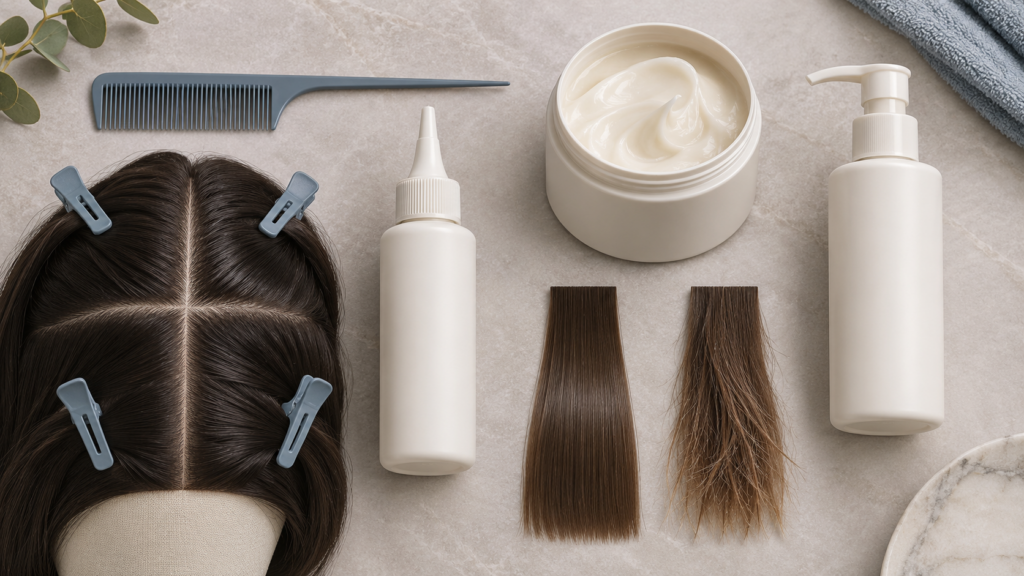
Buying framework
Separate the Scalp Question from the Strand Question
Start with location and symptom, then decide whether a bond repair product belongs in the solution at all.
Map where the concern begins: Itching, burning, flaking, bumps, and tenderness start at the scalp. Roughness, tangling, split-looking ends, and snapping during handling show up along the fiber.
Treat repair as strand care: Bond repair formulas are cosmetic hair treatments. Their useful test is whether lengths become easier to handle and less prone to snapping under the same routine—not whether they cure a scalp condition.
Check permitted placement: Some formulas are designed for roots through ends; others belong on mid-lengths and ends. Follow the label instead of assuming “repair” means scalp-safe.
Separate breakage from shedding: Short snapped pieces and frayed ends differ from full-length hairs releasing at the root. A strand treatment may improve handling, but it cannot identify why shedding changes.
Escalate warning signs: Persistent pain, sores, marked redness, sudden shedding, or rapidly worsening breakage deserve appropriate professional assessment rather than repeated product experiments.
Who this is for
Match the Format to the Dominant Concern
The best format depends on placement tolerance, conditioning need, and how easily residue reaches the scalp.
Comfortable scalp, damaged lengths: A rinse-out mask or targeted treatment can stay mainly on mid-lengths and ends, preserving the usual scalp cleanser.
Oily or buildup-prone roots: Prefer precise, limited placement and a dose you can keep off the scalp. A heavy mask at the roots may make cleanliness harder to judge.
Dry, tangled, high-friction lengths: Look for a treatment sequence that leaves room for enough slip and conditioning. Bond-repair positioning alone does not guarantee easy detangling.
Sensitive or reactive scalp history: Choose clearly labeled placement and a short ingredient list only as practical screening tools; patch directions and professional advice matter more than marketing language.
Color, bleach, or heat-related strand stress: Prioritize controlled frequency, consistent conditioning, and reduced mechanical and heat stress. A treatment is one layer of risk management, not permission to intensify damage.
What to pay attention to
Read the Label Through Two Lenses
Compare what the product asks you to do at the scalp and what it changes along the strand.
Scalp lens
Is application permitted there, and could residue, fragrance, or contact time complicate comfort?
Strand lens
Does the format improve handling without creating stiffness, coating, or inadequate conditioning?
Application zone: Look for scalp, roots, all-over, mid-lengths, or ends. This is the clearest guardrail for a location-sensitive purchase.
Rinse status: A rinse-out can limit residue time; a leave-in stays under styling products. That difference matters when roots become oily or the scalp reacts easily.
Contact time and frequency: Use the directed minutes and cadence as a starting boundary. More exposure is not automatically more repair.
Conditioning role: Confirm whether conditioner follows or whether the treatment replaces it. Hair that tangles easily may still need a dedicated source of slip.
Fragrance and exposure: Fragrance-free wording can help some shoppers narrow choices, but it does not guarantee that every scalp will tolerate the formula.
Dose control: Nozzles, pumps, and measured portions help keep product where intended. Jar textures invite generous application, which may be unhelpful near oily roots.
Avoid these traps
Avoid Category and Symptom Mix-Ups
The costly errors come from treating a location label as a diagnosis or treating cosmetic breakage as the same thing as shedding.
Buying for the word “scalp” alone: Root-to-end application does not prove the formula treats itching, flakes, oiliness, or hair loss. Read the intended cosmetic use.
Applying a strand mask to irritated skin: Keep rich or fragranced treatments away from the scalp unless directions include that placement, especially when discomfort is already present.
Calling every fallen hair breakage: Check whether hairs are short fragments or full-length strands. Product evaluation changes when the concern begins at the root.
Replacing conditioner automatically: A repair step may not provide enough slip. Follow the stated sequence and judge detangling under normal handling.
Stacking scalp serum, mask, and leave-in at once: Multiple new formulas make irritation, residue, stiffness, and improvement difficult to attribute.
Continuing through burning or worsening symptoms: Rinse or stop as directed and seek appropriate help for persistent or concerning reactions. Discomfort is not evidence that repair is working.
Decision guidance
Use Location to Route the Purchase
Let the first repeatable sign decide whether to change placement, format, routine, or category.
If the concern is itch, flakes, or soreness: Do not make bond repair the primary category. Choose scalp care appropriate to the concern or seek professional guidance when symptoms persist.
If lengths snap during detangling: Consider a strand-focused treatment plus adequate conditioner, wider sections, less friction, and lower heat or chemical stress.
If roots feel coated but ends improve: Move placement lower, reduce dose, rinse more thoroughly when directed, or choose a lighter strand format.
If strands feel stiff or rough: Reduce overlapping repair products and frequency, restore conditioning, and reassess after several consistent washes.
If shedding or breakage changes suddenly: Pause product guessing and document timing, location, and severity for an appropriate professional assessment.
Ownership & compatibility
Test Placement Before Adding Complexity
A controlled trial should make scalp comfort and strand handling easier to evaluate separately.
Record the baseline: Note scalp comfort, wash interval, detangling, visible residue, and where snapping appears before adding the treatment.
Apply only to the directed zone: Section hair so a mid-lengths-and-ends product does not repeatedly migrate onto the scalp.
Keep one new variable: Use the same cleanser, conditioner, styling stack, and heat setting where practical.
Check after drying: Record root freshness, scalp comfort, strand softness, tangling, stiffness, and ordinary handling breakage—not just the slippery feel during rinsing.
Know the stop rule: Stop for irritation and do not keep escalating frequency when coating, stiffness, or tangling worsens.
FAQ
Scalp and Strand Questions
Use these answers to route placement and expectations without turning a cosmetic guide into a diagnosis.
Are bond repair treatments meant for the scalp?
Can bond repair treatments help an itchy scalp?
How can I tell breakage from shedding?
Should I apply treatment to roots or ends?
What format is best for oily roots and dry ends?
Can a bond treatment stop hair loss?
What if my scalp burns after application?
Why do my ends feel better but my roots feel heavy?
How long should I test a strand treatment?
Readiness check
Choose by Location, Then by Format
A clear boundary between scalp and strand concerns keeps the purchase useful and the claims realistic.
Name the location: Decide whether the concern begins on skin, at the root, or along the fiber.
Use the right category: Do not make strand repair the default answer to scalp symptoms or shedding.
Control placement: Match nozzle, dose, and rinse status to the intended zone.
Protect conditioning: Keep enough slip for low-friction detangling.
Escalate wisely: Seek appropriate help for persistent scalp symptoms, sudden shedding, or severe breakage.
Scalp-or-Strand Shortcuts
Jump to the decision that changes product category or placement.
Six Placement Checks
Use these before a treatment touches scalp or lengths.
- Location: Skin, root, mid-length, or end?
- Symptom: Comfort, residue, shedding, or snapping?
- Directions: Is scalp placement explicitly allowed?
- Rinse status: How long will residue remain?
- Conditioning: Is there enough detangling slip?
- Stop rule: When will you pause or seek help?
Useful Concern Terms
Plain language for separating location and product role.
When a Top 10 List Helps
Use rankings only after the concern and placement zone are clear.
- The concern is strand-focused: Filter out products making irrelevant scalp promises.
- Placement is compatible: Choose root-safe or lengths-only directions deliberately.
- The format fits: Compare rinse-out and leave-in residue exposure.
- The stop rule is clear: Know what discomfort or worsening ends the trial.
Already have a shortlist? A Comparison can help resolve the remaining tradeoffs.
When a Comparison Helps
Compare finalists using the same scalp and strand boundaries.
- Zones differ: Map where each formula is intended to go.
- Exposure differs: Compare rinse status, contact time, and fragrance.
- Conditioning differs: Account for separate conditioner and detangling needs.
- Dose control differs: Compare nozzles, pumps, jars, and portion guidance.
Still discovering options? Start with a Top 10 to build a relevant shortlist.