
How to Choose Brake Calipers for OEM Replacement Planning
OEM replacement planning for brake calipers is about restoring the vehicle's expected behavior, not chasing the most aggressive or cheapest part in the catalog.
Use this guide to compare OE-style choices, understand when aftermarket equivalents make sense, and plan related parts before the vehicle is apart.
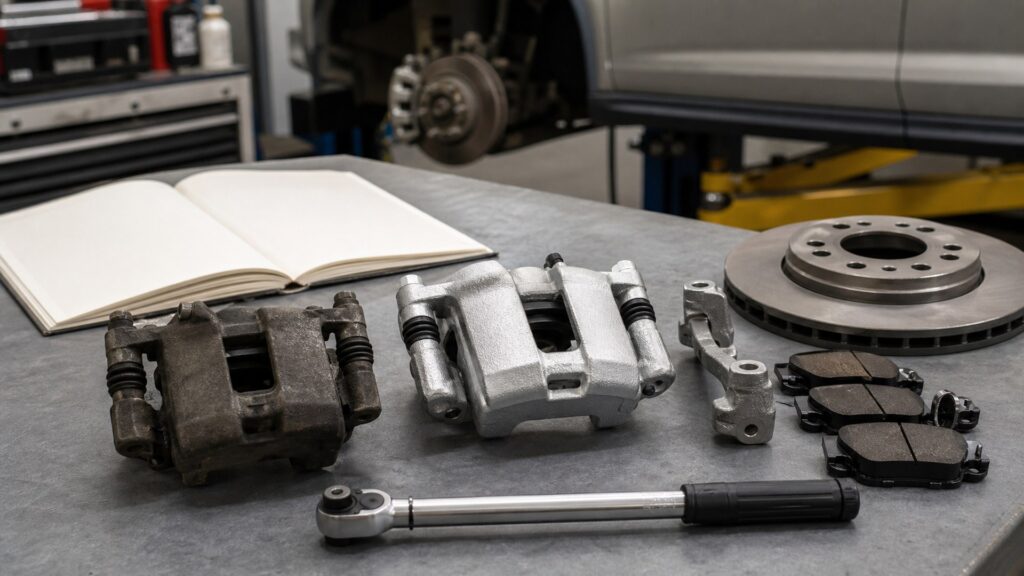
Buying framework
How to think about buying brake calipers for OE-style planning
Use the original part as the reference point, then decide where equivalent, remanufactured, or upgraded options make sense.
Use the original behavior as the target: OEM-style brake calipers should preserve the vehicle's expected disc brake hydraulic clamping behavior rather than introduce a new feel or service compromise.
Separate OE from OE-equivalent: An OE-equivalent caliper can be sensible when the casting, bracket, hydraulic connection, piston setup, bleeder access, and parking-brake provisions line up with the original application.
Decide what must stay stock: For brake calipers, stock dimensions, service access, and warning or adjustment behavior usually matter more than upgrade language.
Budget for adjacent renewal: OE replacement planning should include the clips, seals, springs, fluid, fasteners, or housings that let the brake caliper work like the original.
Avoid changing only one weak link: If surrounding wear is visible, a new brake caliper may not restore OE behavior unless the related parts are handled too.
Who this is for
Match brake calipers to the vehicle, repair goal, and buyer situation
Use these profiles for OE-style planning decisions.
Factory-feel owner: Choose brake calipers that match the original fit and service design instead of chasing a different response.
Dealer estimate comparer: Compare the quoted brake caliper against aftermarket OE-equivalent options with the same side, axle position, bracket style, piston material, bleeder screw location, banjo bolt seat, and parking-brake design.
Long-term keeper: Favor brake calipers with stable part availability and documentation because the same vehicle may need future matched service.
Warranty-conscious buyer: Select a brake caliper source that explains claim handling and does not hide behind vague OE-style wording.
Used-vehicle refresher: Use OE planning to undo mismatched past repairs before judging whether an upgraded brake caliper is necessary.
What to pay attention to
Which brake caliper specs actually matter
Use original behavior as the benchmark for every specification.
Original behavior checks
The replacement should preserve pedal feel, pad sweep, hose routing, bleeder access, wheel clearance, and parking-brake behavior from the original setup.
OE-equivalent evidence
Look for OE references, casting photos, bracket notes, seal and piston details, included contents, and a clear core or warranty process.
OE reference trail: A strong listing ties the replacement to OE numbers, brake package notes, and clear photos rather than a broad year-make-model promise.
Stock geometry: Match the casting shape, bracket interface, hose seat, bleeder access, and pad support points so the repair restores the original layout.
Equivalent materials: Judge piston material, seals, coating, and remanufacturing quality by whether they meet the original service need, not by flashy upgrade language.
Hardware parity: Check whether the caliper arrives bare, semi-loaded, or loaded, and whether the included pieces mirror what the vehicle originally used.
Documentation quality: Prefer suppliers that show fit notes, included contents, core policy, warranty terms, and installation cautions in one clear listing.
Avoid these traps
Common mistakes people make when buying brake calipers
OE-style planning fails when fit or context is skipped.
Treating OE-style as a brand promise: The phrase only helps when brake calipers actually match the vehicle's original dimensions and service details.
Mixing unmatched parts: Combining one OE-style brake caliper with unrelated worn hardware can produce results that feel worse than the old setup.
Paying dealer prices blindly: Dealer-sourced brake calipers can be appropriate, but compare exact-equivalent options before assuming price equals outcome.
Ignoring service data: OE replacement still requires torque, direction, cleaning, bleeding, adjustment, or break-in steps for the brake caliper system.
Using upgrades to mask diagnosis: Do not buy a more aggressive brake caliper until the original failure mode is understood.
Decision guidance
Which type of brake caliper purchase is right for you
Use the repair evidence before choosing a part tier.
Choose genuine OE when risk is high: If the vehicle has sensitive fit notes or difficult labor, genuine OE brake calipers may justify the cost.
Choose OE-equivalent for normal repairs: A well-documented equivalent brake caliper is often enough when the vehicle is stock and the listing is specific.
Choose complete packages for aging hardware: OE behavior is easier to restore when the brake caliper arrives with the small parts that commonly wear.
Avoid performance substitutions: Performance-oriented brake calipers are not automatically better for a commuter that needs predictable stock behavior.
Pause for mismatched history: If previous repairs changed hardware or related parts, verify the whole brake caliper layout before ordering.
Ownership & compatibility
What you are really buying into with brake calipers
Keep records, related parts, and support in view.
Keep original references: Store OE numbers and service notes for the installed brake calipers to simplify future matching.
Document equivalent choices: If you choose an OE-equivalent brake caliper, save the evidence that links it to the original application.
Review support channels: Warranty and seller support matter because OE-style brake calipers are often bought to avoid repeat decisions.
Inspect related systems: Original behavior depends on the neighboring hardware and surfaces as much as the replacement brake caliper.
Plan future consistency: Use the same quality tier on paired or axle-related brake calipers when consistency matters.
FAQ
Brake calipers buying guide FAQ
Focused answers for OE-style replacement decisions.
What does OE-style mean for brake calipers?
Is genuine OEM worth it for a caliper?
Can an aftermarket caliper be OE-equivalent?
What should stay stock during replacement?
Do OE-style calipers skip inspection?
Bottom line
The simplest way to choose brake calipers
Choose by fit, evidence, and repair risk.
Safest replacement path: Use OE or OE-equivalent brake calipers when normal vehicle behavior is the priority.
Where equivalents work: A documented equivalent brake caliper is reasonable when side, axle position, bracket style, piston material, bleeder screw location, banjo bolt seat, and parking-brake design match the original part.
Where genuine parts help: Choose genuine OE brake calipers when labor risk, unusual options, or warranty expectations justify the cost.
Do not skip the surroundings: Original behavior still depends on loaded caliper, semi-loaded caliper, clean surfaces, and correct service steps.
Final OE check: The best brake caliper restores the vehicle's intended function without creating a new maintenance puzzle.
Reading Shortcuts
Jump to the sections that matter most for choosing brake calipers.
Decision Reminders
A quick checklist before you commit to brake calipers.
- Confirm the old part: Use the removed part, OE number, or service data to verify the catalog listing.
- Check included hardware: Missing clips, springs, seals, brackets, or fasteners can change the real cost.
- Inspect nearby wear: Do not expect a new brake caliper to solve problems caused by related components.
- Read warranty details: Know the claim process, exclusions, and whether labor is covered.
- Plan the install: Cleaning, torque, direction, bleeding, bedding, or adjustment steps matter after purchase.
Glossary Snippets
Quick translations for terms that confuse replacement-part buyers.
When to Use a Top 10 Review
Use this format when you want a faster way to narrow the field.
- You are early in the process: A Top 10 can separate common brake calipers by fitment confidence, completeness, and value.
- You want a shortlist: Ranked picks help organize budget, OE-style, complete-kit, and harsh-use options.
- You need category context: It is useful when you still need to understand the major choices before comparing two parts.
Already down to 2-3 options? A Comparison is usually faster than broad buying advice.
When to Use a Comparison
Ideal once you have a shortlist and need clear, practical tradeoffs.
- You narrowed it to 2-3 options: A comparison makes differences in fit notes, included hardware, warranty, and total repair cost easier to see.
- You are checking the quote: Side-by-side tradeoffs help determine whether a recommended part grade is justified.
- You are ready to decide: Use a comparison when the vehicle fit is known and the final choice is about value and risk.
Still exploring? Start with a Top 10 to identify the right brake caliper category first.