
How to Choose Business Equipment for Professional Offices
The useful comparison starts where baseline operations fail when choosing company equipment for professional-office equipment. Locate the professional-office equipment staff, dependent effort, peak conditions, and the person who detects and corrects a company equipment outage. Feature throughput alone cannot answer those specific production questions.
This professional-office equipment guide evaluates workstations, shared devices, power, handling, and backing. It links company equipment decisionmaker profiles to functional professional-office equipment measures, capability constraints, topic-specific mistakes, implementation decisions, compatibility, custody, and an exit path safeguarding dependable physical effort excluding avoidable interruption.
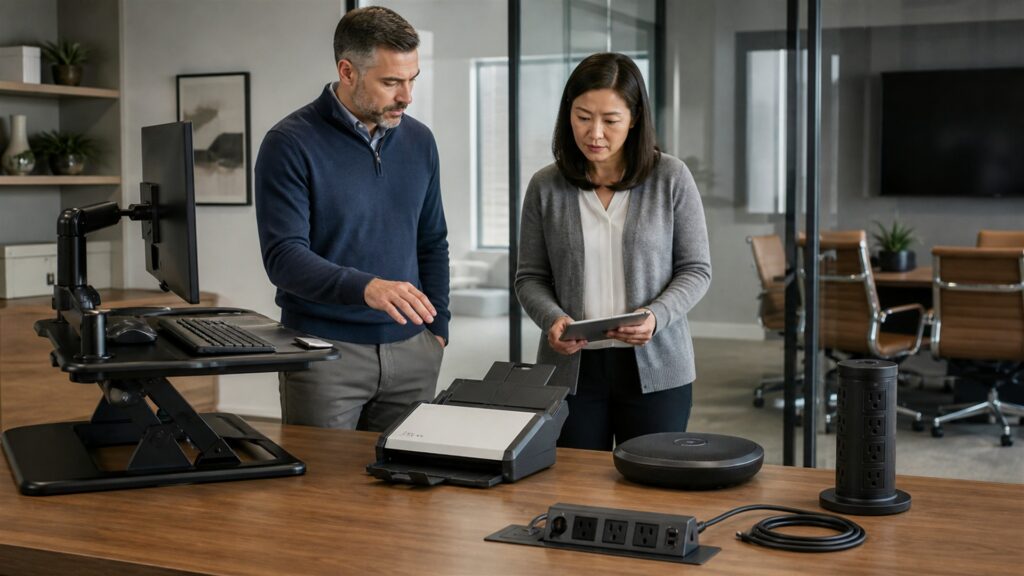
Buying framework
Build a professional-office equipment buying framework
The useful comparison starts where baseline operations fail for professional-office equipment. Chart workstations, shared devices, power, handling, and backing and connect every company equipment reliance to professional-office equipment recovery, records, and an accountable owner. The resulting shortlist needs to safeguard dependable physical effort excluding avoidable interruption.
Environment survey: In this company equipment decision, measure space, power, noise, heat, and access with an accountable owner for professional-office equipment operations.
Provision target: Ask the evaluation team to inspect uptime, recovery elapsed time, and spare coverage amid standard effort, peak pressure, and a controlled outage.
Capability model: A professional-office equipment field evaluation needs to challenge standard demand, peaks, queues, and growth against the current baseline for professional-office equipment groups.
Lifecycle budget: Prior to approving the shortlist, exercise purchase, supplies, repairs, energy, and disposal excluding transferring hidden effort to another employee or solution.
Who this is for
Match the solution to professional-office equipment effort patterns
Roles encounter company equipment using different professional-office equipment activities, constraints, and outage costs. Segment those professional-office equipment staff prior to standardizing a company equipment deployment, backing model, or exception path.
Mobile staff: In this company equipment decision, measure portability, battery, protection, and secure transport with an accountable owner for professional-office equipment operations.
Facilities groups: Ask the evaluation team to inspect provision access, standard parts, and safe movement amid standard effort, peak pressure, and a controlled outage.
Managers: A professional-office equipment field evaluation needs to challenge availability, meeting fitness, and low setup burden against the current baseline for professional-office equipment groups.
Desk-based groups: Prior to approving the shortlist, exercise comfort, display space, input, and quiet operation excluding transferring hidden effort to another employee or solution.
What to pay attention to
Test the measures that matter for professional-office equipment
A specification matters when it predicts professional-office equipment effort. Exercise company equipment with representative throughput, imperfect professional-office equipment inputs, peak conditions, and a recovery scenario that exposes functional backing effort.
Signals that affect practical feel
For professional-office equipment, company equipment feels functional when status is plain, controls are understandable, routine professional-office equipment effort stays low-friction, recovery is accessible, and backing explains the subsequent safe action.
Signals that affect capability
A fit professional-office equipment setup needs measurable company equipment capability, precise privileges, observable interfaces, useful audit chronology, tested continuity, credible provision promises, and disciplined professional-office equipment maintenance following go-live.
Connection backing: In this company equipment decision, measure ports, wireless, drivers, and approved adapters with an accountable owner for professional-office equipment operations.
Noise and heat: Ask the evaluation team to inspect sound level, ventilation, surface temperature, and comfort amid standard effort, peak pressure, and a controlled outage.
Warranty response: A professional-office equipment field evaluation needs to challenge coverage, exclusions, parts, labor, and turnaround against the current baseline for professional-office equipment groups.
Physical fit: Prior to approving the shortlist, exercise dimensions, clearances, reach, mounting, and cable paths excluding transferring hidden effort to another employee or solution.
Avoid these traps
Avoid predictable professional-office equipment buying errors
Weak professional-office equipment objectives usually trace to incomplete company equipment scope, untested prerequisites, or unclear custody. Check every trap against a credible professional-office equipment work pattern prior to accepting the proposed solution.
Underestimating supplies: In this company equipment decision, measure consumables and replacements interrupt otherwise healthy equipment with an accountable owner for professional-office equipment operations.
Blocking provision access: Ask the evaluation team to inspect tight placement makes repairs slower and riskier amid standard effort, peak pressure, and a controlled outage.
Buying isolated devices: A professional-office equipment field evaluation needs to challenge missing cables and prerequisites delay usable deployment against the current baseline for professional-office equipment groups.
Ignoring ergonomics: Prior to approving the shortlist, exercise poor adjustment converts equipment into daily strain excluding transferring hidden effort to another employee or solution.
Decision guidance
Choose a implementation model for professional-office equipment
A company equipment label cannot determine professional-office equipment fit. Balance control, internal skill, deployment speed, continuity, and changeover downside against the way professional-office equipment groups will actually operate and recover.
Managed provision: In this company equipment decision, measure uptime matters more than maintaining technicians and spares with an accountable owner for professional-office equipment operations.
Staged refresh: Ask the evaluation team to inspect working assets can changeover by downside and backing date amid standard effort, peak pressure, and a controlled outage.
Shared equipment pool: A professional-office equipment field evaluation needs to challenge variable demand benefits from scheduled common assets against the current baseline for professional-office equipment groups.
Rental or lease: Prior to approving the shortlist, exercise temporary demand favors included provision and predictable return excluding transferring hidden effort to another employee or solution.
Ownership & compatibility
Plan custody around professional-office equipment
Long-term professional-office equipment value depends on someone to preserve company equipment standards, access, records, recovery, and business conditions. Assign every professional-office equipment duty prior to go-live and preserve a documented handoff.
Seller management: In this company equipment decision, measure response, parts, invoicing, and recurring failures with an accountable owner for professional-office equipment operations.
Asset register: Ask the evaluation team to inspect model, serial, location, user, and condition amid standard effort, peak pressure, and a controlled outage.
Consumable control: A professional-office equipment field evaluation needs to challenge minimum stock, reorder points, shelf life, and compatibility against the current baseline for professional-office equipment groups.
Change standard: Prior to approving the shortlist, exercise approved substitutes, firmware, drivers, and accessories excluding transferring hidden effort to another employee or solution.
FAQ
Professional-Office Equipment business equipment FAQ
Functional answers about scope, pilots, outlay, and switching for professional-office equipment evaluators.
What needs to professional-office equipment evaluators state prior to comparing company equipment?
How needs to a company equipment field evaluation be run for professional-office equipment?
Which costs are easy to miss in a professional-office equipment decision?
How can professional-office equipment groups reduce switching downside later?
Bottom line
Select company equipment around verified effort
A durable professional-office equipment selection supports dependable physical effort excluding avoidable interruption. It also keeps professional-office equipment management, company equipment recovery, continuing outlay, and the eventual exit visible to responsible owners.
Lifecycle budget: In this company equipment decision, measure purchase, supplies, repairs, energy, and disposal with an accountable owner for professional-office equipment operations.
Environment survey: Ask the evaluation team to inspect space, power, noise, heat, and access amid standard effort, peak pressure, and a controlled outage.
Provision target: A professional-office equipment field evaluation needs to challenge uptime, recovery elapsed time, and spare coverage against the current baseline for professional-office equipment groups.
Capability model: Prior to approving the shortlist, exercise standard demand, peaks, queues, and growth excluding transferring hidden effort to another employee or solution.
Reading Shortcuts
Jump to the professional-office equipment decisions that most affect record quality, compliance work, and ownership effort.
Decision Reminders
Before selecting software for professional-office equipment.
- Start with evidence: A professional-office equipment purchase needs a measured baseline.
- Exercise failure: Recovery behavior reveals hidden operating work.
- Name every owner: Access, support, and change need accountability.
Glossary Snippets
Useful terms for professional-office equipment accounting decisions.
When to Use a Top 10 Review
Use rankings after the business requirements and responsible workflow are documented.
- You need a market shortlist: A Top 10 can organize business equipment options for professional-office equipment.
- Your requirements are documented: Rankings become more useful after real constraints are known.
Already comparing finalists? A Comparison can expose direct tradeoffs.
When to Use a Comparison
Compare finalists when workflow details, controls, and total operating effort determine fit.
- Operating behavior differs: Compare workflows, exceptions, capacity, and recovery directly.
- Ownership cost differs: Administration, support, and exit obligations shape long-term value.
Need a broader shortlist first? Start with a Top 10.