
How to Choose Business Security Systems for 24/7 Monitoring
Good selection separates essential outcomes from attractive extras when choosing company security services for round-the-clock monitoring. Locate the round-the-clock monitoring teams, dependent work, maximum situations, and the person who detects and corrects a company security services problem. Feature volume alone cannot answer those relevant operating questions.
This round-the-clock monitoring guide evaluates cameras, alarms, access control, monitoring, policy, and incident response. It links company security services evaluator profiles to workable round-the-clock monitoring signals, capability constraints, topic-relevant mistakes, execution choices, compatibility, custody, and an exit path safeguarding proportionate deterrence, detection, response, and artifacts.
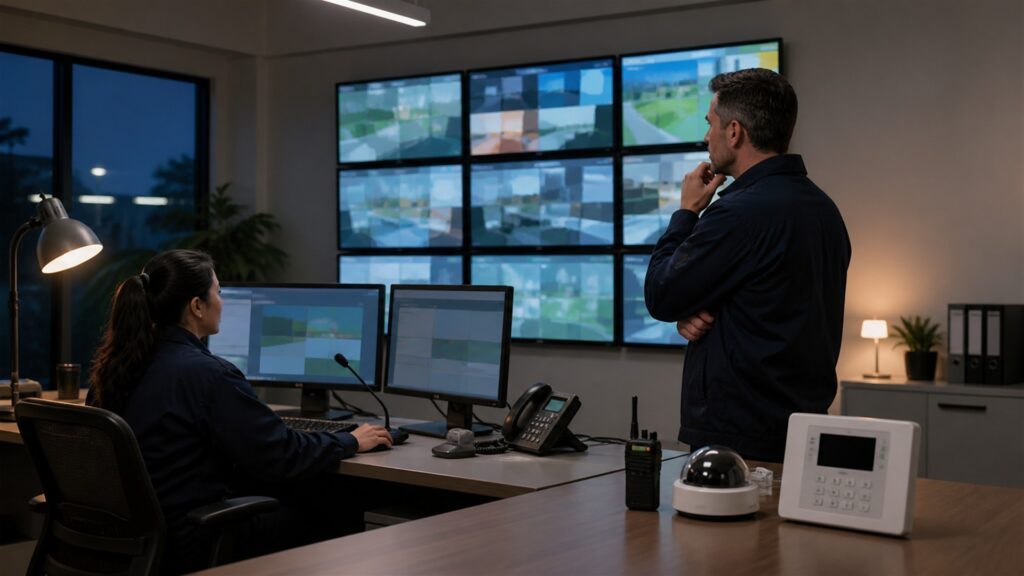
Buying framework
Build a round-the-clock monitoring buying framework
Good selection separates essential outcomes from attractive extras for round-the-clock monitoring. Chart cameras, alarms, access control, monitoring, policy, and incident response and connect individual company security services reliance to round-the-clock monitoring recovery, artifacts, and an accountable owner. The resulting shortlist ought to preserve proportionate deterrence, detection, response, and artifacts.
Asset and harm chart: At the busiest realistic point, compare people, property, information, disruption, and liability using a pilot that includes difficult unusual cases.
Site survey: For round-the-clock monitoring, benchmark doors, sight lines, lighting, barriers, and communications and capture who corrects the result when situations modification.
Privacy boundary: In this company security services decision, inspect purpose, notice, access, retention, and restricted spaces before round-the-clock monitoring purchasers compare vendors.
Artifacts need: Ask the evaluation team to challenge time, identity, image, event, and chain of custody under realistic round-the-clock monitoring demand, not a prepared demonstration.
Who this is for
Match the platform to round-the-clock monitoring work patterns
Roles encounter company security services using different round-the-clock monitoring duties, constraints, and problem prices. Segment those round-the-clock monitoring teams before standardizing a company security services design, assistance model, or exception path.
Retail stores: At the busiest realistic point, compare public access, cash areas, stock, exits, and incident check using a pilot that includes difficult unusual cases.
Warehouses: For round-the-clock monitoring, benchmark perimeter, loading, high bays, inventory, and wide-area coverage and capture who corrects the result when situations modification.
Restricted facilities: In this company security services decision, inspect strong identity, anti-passback, logging, and layered authorization before round-the-clock monitoring purchasers compare vendors.
Remote sites: Ask the evaluation team to challenge communications continuity, environmental protection, and verified response under realistic round-the-clock monitoring demand, not a prepared demonstration.
What to pay attention to
Test the signals that carry weight for round-the-clock monitoring
A specification matters when it predicts round-the-clock monitoring work. Exercise company security services alongside sampled volume, imperfect round-the-clock monitoring source material, maximum situations, and a recovery scenario that exposes workable assistance effort.
Signals that affect practical feel
For round-the-clock monitoring, company security services feels workable when status is explicit, safeguards are understandable, routine round-the-clock monitoring work stays low-friction, recovery is accessible, and assistance explains the following responsible response.
Signals that affect capability
A credible round-the-clock monitoring setup requires measurable company security services capacity, precise privileges, observable linkages, useful audit record, tested continuity, credible support arrangement promises, and disciplined round-the-clock monitoring maintenance after rollout.
Access decisions: At the busiest realistic point, compare credential, schedule, door state, request, and exception path using a pilot that includes difficult unusual cases.
Monitoring workflow: For round-the-clock monitoring, benchmark signal receipt, verification, contacts, dispatch, and audit record and capture who corrects the result when situations modification.
Cyber safeguards: In this company security services decision, inspect segmentation, updates, encryption, accounts, and remote management before round-the-clock monitoring purchasers compare vendors.
Camera coverage: Ask the evaluation team to challenge pixels on target, angle, lighting, motion, and obstruction under realistic round-the-clock monitoring demand, not a prepared demonstration.
Avoid these traps
Avoid predictable round-the-clock monitoring buying errors
Weak round-the-clock monitoring outcomes usually trace to incomplete company security services scope, untested linkages, or unclear custody. Check individual trap relative to a actual round-the-clock monitoring workflow before accepting the proposed solution.
Ignoring response time: At the busiest realistic point, compare detection has little value without a reachable response chain using a pilot that includes difficult unusual cases.
Skipping lighting tests: For round-the-clock monitoring, benchmark day and night situations modification usable coverage and capture who corrects the result when situations modification.
Letting privileges accumulate: In this company security services decision, inspect departed teams and vendors retain unnecessary control before round-the-clock monitoring purchasers compare vendors.
Maximizing retention blindly: Ask the evaluation team to challenge privacy and breach exposure grow alongside unnecessary storage under realistic round-the-clock monitoring demand, not a prepared demonstration.
Decision guidance
Pick a execution model for round-the-clock monitoring
A company security services label cannot determine round-the-clock monitoring fit. Balance control, internal skill, deployment speed, continuity, and migration exposure relative to the way round-the-clock monitoring workforces will actually operate and recover.
Specialist video platform: At the busiest realistic point, compare coverage and artifacts dominate the project using a pilot that includes difficult unusual cases.
Hybrid storage: For round-the-clock monitoring, benchmark local continuity and remote access both carry weight and capture who corrects the result when situations modification.
Local standalone platform: In this company security services decision, inspect small bounded sites can sustain direct control before round-the-clock monitoring purchasers compare vendors.
Cloud-managed security: Ask the evaluation team to challenge several locations need centralized management and health status under realistic round-the-clock monitoring demand, not a prepared demonstration.
Ownership & compatibility
Plan custody around round-the-clock monitoring
Long-term round-the-clock monitoring value calls for someone to sustain company security services standards, access, artifacts, recovery, and contractual conditions. Assign each relevant round-the-clock monitoring duty before rollout and preserve a documented handoff.
Provider access: At the busiest realistic point, compare named accounts, time constraints, logging, and removal using a pilot that includes difficult unusual cases.
Artifacts practice: For round-the-clock monitoring, benchmark export, hashing, custody, restricted access, and lawful release and capture who corrects the result when situations modification.
Daily health check: In this company security services decision, inspect offline devices, storage, communications, power, and faults before round-the-clock monitoring purchasers compare vendors.
Privacy check: Ask the evaluation team to challenge purpose, placement, notices, requests, and retention under realistic round-the-clock monitoring demand, not a prepared demonstration.
FAQ
Round-The-Clock Monitoring business security systems FAQ
Workable answers about scope, pilots, price, and switching for round-the-clock monitoring purchasers.
What ought to round-the-clock monitoring purchasers define before comparing company security services?
How ought to a company security services pilot be run for round-the-clock monitoring?
Which prices are easy to miss in a round-the-clock monitoring decision?
How can round-the-clock monitoring workforces reduce switching exposure later?
Bottom line
Select company security services around verified work
A durable round-the-clock monitoring choice supports proportionate deterrence, detection, response, and artifacts. It also keeps round-the-clock monitoring management, company security services recovery, continuing price, and the eventual exit visible to responsible owners.
Artifacts need: At the busiest realistic point, compare time, identity, image, event, and chain of custody using a pilot that includes difficult unusual cases.
Asset and harm chart: For round-the-clock monitoring, benchmark people, property, information, disruption, and liability and capture who corrects the result when situations modification.
Site survey: In this company security services decision, inspect doors, sight lines, lighting, barriers, and communications before round-the-clock monitoring purchasers compare vendors.
Privacy boundary: Ask the evaluation team to challenge purpose, notice, access, retention, and restricted spaces under realistic round-the-clock monitoring demand, not a prepared demonstration.
Reading Shortcuts
Jump to the round-the-clock monitoring decisions that most affect record quality, compliance work, and ownership effort.
Decision Reminders
Before selecting software for round-the-clock monitoring.
- Start with evidence: A round-the-clock monitoring purchase needs a measured baseline.
- Exercise failure: Recovery behavior reveals hidden operating work.
- Name every owner: Access, support, and change need accountability.
Glossary Snippets
Useful terms for round-the-clock monitoring accounting decisions.
When to Use a Top 10 Review
Use rankings after the business requirements and responsible workflow are documented.
- You need a market shortlist: A Top 10 can organize business security systems options for round-the-clock monitoring.
- Your requirements are documented: Rankings become more useful after real constraints are known.
Already comparing finalists? A Comparison can expose direct tradeoffs.
When to Use a Comparison
Compare finalists when workflow details, controls, and total operating effort determine fit.
- Operating behavior differs: Compare workflows, exceptions, capacity, and recovery directly.
- Ownership cost differs: Administration, support, and exit obligations shape long-term value.
Need a broader shortlist first? Start with a Top 10.