
How to Choose Car Care & Detailing for Detailer Workflow Planning
A detailing workflow is the order in which information, people, chemicals, tools, and the vehicle move through a job. Without that order, a shop can wash a panel that still needs inspection, polish beside airborne dressing, reuse contaminated towels, or discover a missing adapter after the vehicle is disassembled. The result is delay and rework rather than productive equipment capacity.
Start with the promised outcome and work backward through intake, preparation, cleaning, correction, protection, inspection, and handoff. Mark dependencies, safety controls, cure or drying time, and the checkpoint that releases each stage. Then buy carts, bottles, lighting, machines, media, and storage for those movements. Capacity should be measured by completed vehicles—not by the number of tools on a wall.
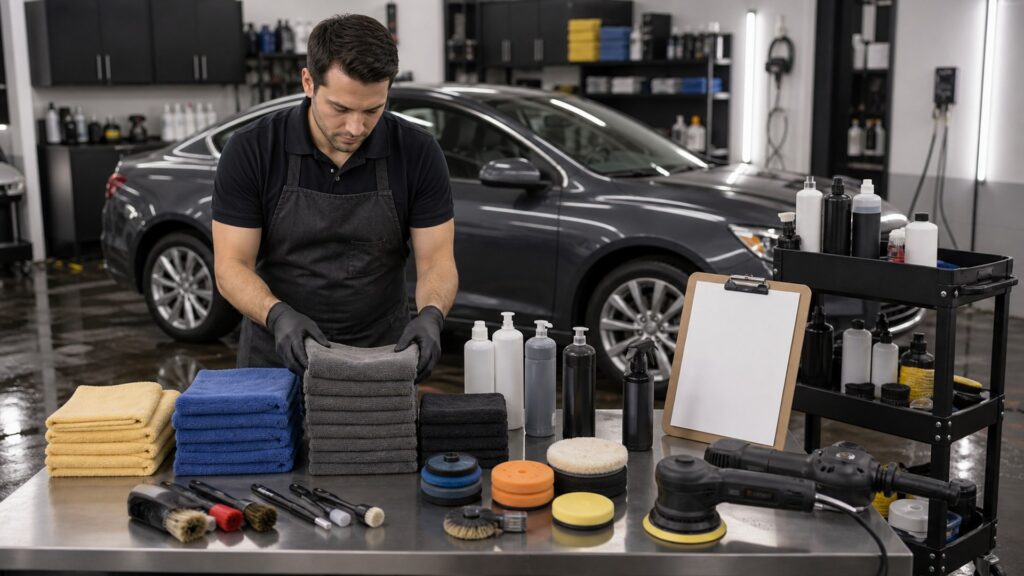
Buying framework
Build the purchase around the real job
Define the outcome, constraints, and verification steps before comparing products. Let build the purchase around the real job shape the comparison.
Intake record: Begin by documenting customer goals, existing damage, warning lights, valuables, modifications, sensitive materials, access, and agreed exclusions.
Dependency map: Make a separate decision about tasks that must precede taping, extraction, polishing, coating, drying, reassembly, and delivery.
Clean and dirty zones: Before shopping, establish wheels, exhaust, jambs, carpets, paint, glass, towels, pads, and applicators with controlled movement between them.
Timed standard work: Use a test to settle hands-on minutes, dwell, drying, cure, equipment setup, cleanup, and realistic interruption allowance for each package.
Release checkpoints: Complete the plan with lighting, touch, moisture, residue, odor, function, and documentation tests before the next stage begins.
Who this is for
Different users need different priorities
Frequency, environment, skill, vehicle design, and tolerance for downtime change the best choice. Let different users need different priorities shape the comparison.
Solo mobile detailer: This use pattern rewards compact redundancy, water and power independence, weather contingencies, load security, and rapid pack-out.
Single-bay studio: This owner should prioritize vertical storage, cord and hose routing, shared utility scheduling, lighting control, and one-vehicle process discipline.
Multi-technician shop: For this situation, compare role handoffs, identical dilution systems, labeled tools, training records, bay status, and supervisor quality checks.
Weekend enthusiast: This project needs a shorter repeatable sequence, limited chemical set, dedicated media, safe storage, and cleanup that fits available time.
What to pay attention to
Specifications that change the result
Published numbers matter only when they connect to fit, performance, safety, and repeatable use. Let specifications that change the result shape the comparison.
Process Control
Intake, scope, dependencies, task order, labor time, bottlenecks, checkpoints, rework, handoff, and records.
Contamination & Resource Control
Clean and dirty zones, chemical dilution, towel and pad segregation, water, electricity, ventilation, lighting, storage, and tool maintenance.
Task-cycle capacity: Read listings for tank volume, battery runtime, heat-up, recovery, pad inventory, towel turnover, and charging or laundry time across the planned jobs.
Dispensing accuracy: Confirm the published details for dilution ratios, bottle markings, metering, concentrate compatibility, labels, secondary-container dates, and spill control.
Lighting coverage: Compare evidence covering diffuse cleanliness light, focused defect light, color rendering, glare control, mounting, portability, and inspection access around lower panels.
Cart and storage geometry: Treat as essential doorway width, vehicle clearance, shelf height, bottle retention, clean drawers, dirty bins, and stable movement over thresholds.
Cross-contamination controls: Look beyond headline claims to color coding, sealed containers, dedicated wheel and interior media, towel laundering groups, pad cleaning, and discard criteria.
Maintenance support: Require documentation of filters, seals, brushes, backing plates, hoses, batteries, service intervals, replacement parts, and local downtime options.
Avoid these traps
Shortcuts that create avoidable problems
A plausible product can still fail when preparation, interfaces, or operating limits are ignored. Let shortcuts that create avoidable problems shape the comparison.
Buying for peak specifications: This fails when buyers overlook that the slowest dependency, cleanup step, or technician handoff—not maximum machine output—often controls completed capacity.
Combining every chemical: The hidden problem is how oversimplified product roles can compromise material compatibility, dwell, residue removal, coating preparation, or technician understanding.
Skipping intake photographs: Avoid assuming that that pre-existing chips, stains, scratches, loose trim, and warning indicators need agreement before cleaning changes their appearance.
Storing clean media openly: This shortcut can cause airborne polish, overspray, dust, wheel soil, and dampness can contaminate towels, pads, and applicators before use.
Inspecting only at the end: Correct the plan by checking stage-specific defects become more expensive to correct after protection, reassembly, dressing, or customer arrival.
Decision guidance
Turn the evidence into a shortlist
Use conditional choices instead of treating one configuration as universally best. Let turn the evidence into a shortlist shape the comparison.
Recurring maintenance packages: Choose this path only after confirming a linear wash, dry, interior, glass, inspection, and reset flow with enough duplicate media for continuous turnover.
Correction and coating work: This option fits when separate dirty preparation from dust-sensitive installation and reserve lighting, pad rotation, panel wipe, cure, and follow-up capacity.
Mixed mobile services: Prefer this approach if modular cases organized by task so unused chemicals and machines stay secured rather than crowding every appointment.
Growing technician count: Escalate the project when standard labels, checklists, training, handoff ownership, and replenishment points before buying higher-output machinery.
Chronic late deliveries: Delay purchase until you resolve time observations and bottleneck analysis before adding labor or equipment to a stage that is not limiting throughput.
Ownership & compatibility
Keep the system dependable after purchase
Maintenance, records, updates, inspection, and storage determine whether the initial result lasts. Let keep the system dependable after purchase shape the comparison.
Daily closeout: After installation or use, track chemical quantities, damaged tools, wet towels, pad condition, tanks, batteries, filters, spills, and next-day readiness.
Job-level records: Preserve a record of scope, products, dilution, condition changes, test spots, exceptions, cure instructions, photos, and customer acceptance.
Inventory triggers: Routine care should include minimum stock, open dates, shelf life, seasonal demand, reorder lead time, and quarantine for leaking or unidentified containers.
Workflow revisions: Recheck the system whenever rework causes, technician feedback, new materials, equipment failures, package changes, and measured completion times.
FAQ
Detailer workflow questions
Settle process, capacity, contamination, and quality-control decisions before equipping the workflow.
What should a detailing intake form include?
How should detailing towels be organized?
Is one all-purpose cleaner enough?
How many polishing pads are needed?
Where should quality checks occur?
How can a mobile detailer reduce setup time?
What is the best way to track dilution?
Should dirty and clean work happen in one bay?
When should workflow equipment be upgraded?
Bottom line
Make the final choice defensible
The strongest purchase connects the requirement, evidence, and verification plan without adding unsupported complexity. Let make the final choice defensible shape the comparison.
Documented dependencies: Anchor the purchase to a job sequence that prevents one stage from contaminating or blocking another.
Visible quality control: Protect the result through specific release tests during the work instead of a rushed final glance.
Sustainable reset: Leave room for clean, labeled, maintained tools and replenished supplies ready for the next vehicle.
Reading Shortcuts
Move directly to the decision you need to resolve.
Decision Reminders
Use these checks while narrowing the field.
- Identify the exact application: Names alone do not prove fit.
- Read primary instructions: Limits and steps matter.
- Test before full commitment: Small trials expose mismatch.
- Budget the complete system: Accessories and labor count.
- Protect safety functions: Convenience never overrides control.
- Keep records: Future diagnosis needs evidence.
Glossary Snippets
Terms that appear in listings, labels, and service information.
When to Use a Top 10 Review
Use rankings after requirements and exclusions are clear.
- Scan candidates: Find credible options.
- Compare strengths: See major tradeoffs.
- Build a shortlist: Choose what to inspect.
- Check availability: Confirm current offerings.
Already down to 2–3 options? A Comparison is usually the faster next step.
When to Use a Comparison
Compare directly when only a few candidates remain.
- Align versions: Compare equivalent configurations.
- Trace differences: Locate meaningful distinctions.
- Price the outcome: Include continuing costs.
- Verify uncertainty: Inspect unresolved details.
Still exploring? Start with a Top 10 to build a shortlist first.