
How to Choose Car Care & Detailing for Exterior Correction Projects
Exterior correction intentionally changes a surface, usually by removing or refining a small amount of paint. The project therefore begins with identification: factory or repaired finish, gloss or matte texture, film or coating, thickness variation, sharp edges, chips, oxidation, sanding marks, etching, swirls, and scratches. Not every defect can or should be polished away.
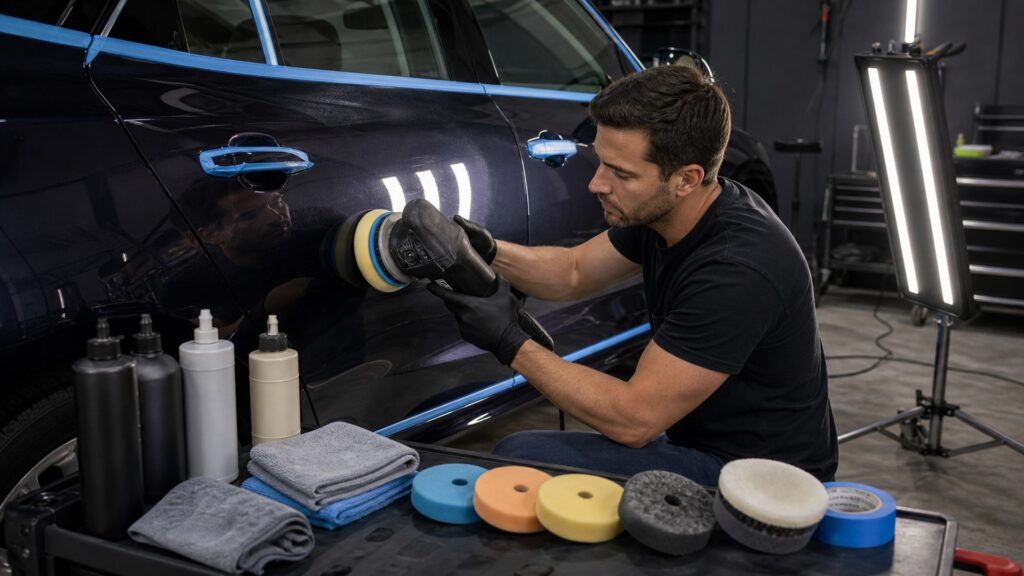
Define an acceptable improvement before selecting a machine, pad, or compound. Clean and decontaminate the panel, measure where appropriate, mask vulnerable areas, and make a small test spot with the least aggressive plausible combination. Inspect the result under controlled light after removing residue. Scale the proven process only while temperature, pad condition, correction rate, and finish quality remain predictable, then protect and document the remaining limitations.
Buying framework
Build the purchase around the real job
Define the outcome, constraints, and verification steps before comparing products. Let build the purchase around the real job shape the comparison.
Defect classification: Begin by documenting loose contamination, bonded deposits, transfer, oxidation, water etching, swirls, sanding marks, chips, cracks, and scratches.
Surface and repair map: Make a separate decision about clear coat, single-stage paint, repainting, spot repair, film, matte areas, plastics, trim, decals, body lines, and exposed edges.
Risk boundary: Before shopping, establish target improvement, acceptable remaining defects, thickness uncertainty, burn-through consequence, texture preservation, and owner expectations.
Controlled test spot: Use a test to settle cleaning, decontamination, masking, machine, pad, liquid, speed, pressure, passes, temperature, wipe-off, and inspection.
Panel-by-panel record: Complete the plan with combination, observed response, anomalies, pad changes, temperatures, defects left, and protection applied.
Who this is for
Different users need different priorities
Frequency, environment, skill, vehicle design, and tolerance for downtime change the best choice. Let different users need different priorities shape the comparison.
First-time machine polisher: This use pattern rewards forgiving random-orbital action, mild polish, clear instruction, small test areas, spare pads, and conservative stop criteria.
Enthusiast refining wash marks: This owner should prioritize inspection lighting, finish-oriented pads and polish, residue control, isolated deeper-defect acceptance, and durable maintenance afterward.
Detailer correcting varied vehicles: For this situation, compare paint measurement, broad pad inventory, repeatable test records, efficient cleaning, edge controls, and escalation options.
Restored, repainted, or rare vehicle: This project needs repaint documentation, texture goals, highly conservative abrasion, specialist evaluation, and willingness to preserve age-related evidence.
What to pay attention to
Specifications that change the result
Published numbers matter only when they connect to fit, performance, safety, and repeatable use. Let specifications that change the result shape the comparison.
Paint & Defect Risk
Paint system, repaint history, thickness variation, edges, texture, defect depth, remaining material, and stop criteria.
Abrasive Process & Verification
Machine motion, pad, liquid, working cycle, pressure, temperature, residue, inspection lighting, refinement, and protection.
Machine motion and size: Read listings for free-spinning orbital, forced rotation, rotary action, throw, backing-plate diameter, speed range, stall behavior, balance, and access.
Pad construction: Confirm the published details for foam density, cell structure, microfiber or wool fiber, interface, thickness, edge shape, cooling, cut, finishing behavior, and clean quantity.
Abrasive system behavior: Compare evidence covering initial cut, abrasive breakdown or consistency, lubrication, working time, dust, wipe-off, fillers, staining, and pad compatibility.
Paint measurement limits: Treat as essential ferrous, nonferrous, composite, calibration, repeatability, coating stack ambiguity, curvature, edge distance, and interpretation.
Inspection-light character: Look beyond headline claims to beam size, intensity, diffusion, color temperature, color rendering, ambient control, and ability to reveal haze without glare.
Thermal and dust control: Require documentation of panel temperature checks, pad rotation, compressed-air or brush cleaning, ventilation, residue containment, hearing protection, and cord safety.
Avoid these traps
Shortcuts that create avoidable problems
A plausible product can still fail when preparation, interfaces, or operating limits are ignored. Let shortcuts that create avoidable problems shape the comparison.
Chasing every scratch: This fails when buyers overlook that a deep defect may require disproportionate clear-coat removal while remaining structurally visible or vulnerable even after improvement.
Trusting one thickness number: The hidden problem is how substrate, primer, base, clear, repainting, curvature, coatings, and gauge limits complicate interpretation.
Running one pad too long: Avoid assuming that saturated abrasive, removed paint, heat, compressed foam, and debris change cut and finish across later panels.
Judging through polishing oils: This shortcut can cause residue or fillers can temporarily hide haze and defects until an approved wipe and different lighting reveal them.
Polishing matte or textured finishes: Correct the plan by checking abrasion can permanently create gloss and uneven texture that spot refinement cannot blend invisibly.
Decision guidance
Turn the evidence into a shortlist
Use conditional choices instead of treating one configuration as universally best. Let turn the evidence into a shortlist shape the comparison.
Light uniform wash marring: Choose this path only after confirming a mild polish and finishing pad proven on a test spot before considering stronger compound.
Mixed moderate defects: This option fits when a correction step followed by refinement only where the first combination leaves measurable haze or texture change.
Isolated deep scratches: Prefer this approach if edge-safe local evaluation and acceptance, touch-up, repaint, or specialist repair rather than whole-panel overcorrection.
Unknown repaint history: Escalate the project when measurement, visual inspection, cautious testing, and body-shop or specialist input before aggressive sanding or rotary work.
Matte paint, film, or delicate trim: Delay purchase until you resolve surface-specific cleaning and repair methods without conventional gloss-paint abrasion unless explicitly approved.
Ownership & compatibility
Keep the system dependable after purchase
Maintenance, records, updates, inspection, and storage determine whether the initial result lasts. Let keep the system dependable after purchase shape the comparison.
Corrected-surface baseline: After installation or use, track photos, measurements where meaningful, test combination, panels treated, defects retained, repaint findings, and protection date.
Wash-induced change: Preserve a record of new swirls, towel marks, water spots, contamination, and whether maintenance tools or technique need correction.
Pad and machine service: Routine care should include backing-plate condition, cord, bearings, ventilation, pad adhesion, cleanliness, storage, and replacement intervals.
Future correction budget: Recheck the system whenever finite material, prior steps, recurring defects, owner tolerance, and whether preservation now outweighs additional gloss.
FAQ
Exterior correction questions
Resolve paint-risk, machine, pad, abrasive, inspection, and stopping decisions before correction.
Can polishing remove every paint scratch?
Do I need a paint-depth gauge?
Which polisher type is safest for a beginner?
How many pads are needed for one vehicle?
What is a polishing test spot?
Can ceramic coating hide polishing haze?
Should panel temperature be monitored?
Is wet sanding part of normal correction?
When should correction stop?
Bottom line
Make the final choice defensible
The strongest purchase connects the requirement, evidence, and verification plan without adding unsupported complexity. Let make the final choice defensible shape the comparison.
Diagnosed defects: Anchor the purchase to knowing what is on, in, or missing from the surface before abrasion.
Measured test results: Protect the result through the mildest repeatable combination that reaches the agreed improvement.
Explicit stop criteria: Leave room for protecting thin, uncertain, textured, repaired, or high-consequence areas from unnecessary removal.
Reading Shortcuts
Move directly to the decision you need to resolve.
Decision Reminders
Use these checks while narrowing the field.
- Identify the exact application: Names alone do not prove fit.
- Read primary instructions: Limits and steps matter.
- Test before full commitment: Small trials expose mismatch.
- Budget the complete system: Accessories and labor count.
- Protect safety functions: Convenience never overrides control.
- Keep records: Future diagnosis needs evidence.
Glossary Snippets
Terms that appear in listings, labels, and service information.
When to Use a Top 10 Review
Use rankings after requirements and exclusions are clear.
- Scan candidates: Find credible options.
- Compare strengths: See major tradeoffs.
- Build a shortlist: Choose what to inspect.
- Check availability: Confirm current offerings.
Already down to 2–3 options? A Comparison is usually the faster next step.
When to Use a Comparison
Compare directly when only a few candidates remain.
- Align versions: Compare equivalent configurations.
- Trace differences: Locate meaningful distinctions.
- Price the outcome: Include continuing costs.
- Verify uncertainty: Inspect unresolved details.
Still exploring? Start with a Top 10 to build a shortlist first.