
How to Choose Car Interior Accessories for Ride-Share and Commuter Cars
Ride-share and commuter cabins experience repetitive rather than occasional stress: door cycles, sliding bags, wet shoes, device docking, cable pulls, food spills, passenger questions, and rapid driver handoffs. An accessory that looks useful in a personal car may add cleaning time, block a seat buckle, reveal private information, become a loose object, or fail often enough to interrupt earning or commuting time.
This guide evaluates seat and floor protection, mounts, chargers, cable control, trash systems, document storage, and small passenger amenities through the complete shift. It focuses on driver vision and control, passenger boundaries, fast cleaning, account and data separation, theft resistance, replacement logistics, and total cost per operating period—not showroom neatness.
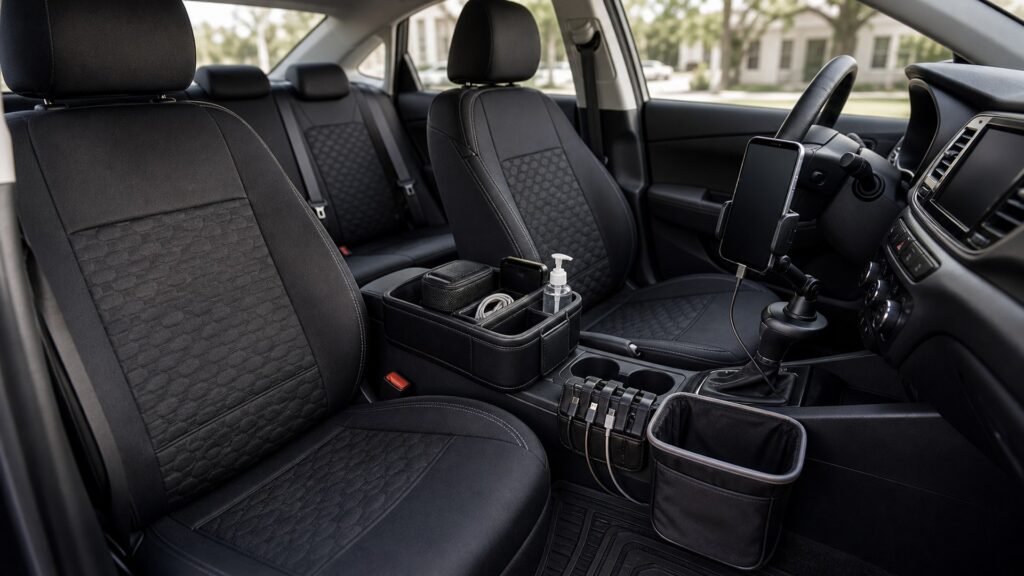
Buying framework
Design around the complete shift
Observe the cabin from vehicle entry through final handoff, then remove any accessory that adds attention, ambiguity, or unmeasured reset work.
Map touchpoints and transitions: Record driver setup, passenger entry, luggage, charging requests, spills, stops, cleaning, parking, and driver change. Note who touches each item and when.
Separate driver and passenger zones: Keep navigation, mounts, cables, documents, and controls within safe driver use while giving passengers clear buckle, door, footwell, vent, and approved charging access.
Standardize the reset: Define trash removal, surface cleaning, drying, cable check, lost-item sweep, seat and floor inspection, supply refill, account sign-out, and readiness confirmation.
Plan failures without losing a shift: Carry compatible spare cables and consumables, choose replaceable wear pieces, document mount and charger faults, and know which equipment can be removed while service continues.
Who this is for
Match equipment to passenger volume and handoff
A solo commute, occasional ride-share work, and multi-driver full-time service need different durability, privacy, inventory, and reset discipline.
Daily solo commuters: Favor a stable driver interface, low cable clutter, easy floor care, discreet storage, and accessories that leave passenger space and safety systems unchanged.
Part-time ride-share drivers: Choose removable, reversible protection and amenities that can transition to personal use without residue, exposed data, bulky storage, or a long setup.
High-volume drivers: Prioritize commercial duty cycle, replaceable contact parts, fast cleaning and drying, consistent charging, low theft exposure, spare stock, and measured downtime.
Shared-vehicle operators: Use neutral layouts, adjustable but repeatable mounts, labeled supplies, organization-controlled accounts where applicable, condition logs, and a clear responsibility transfer at every handoff.
What to pay attention to
Specifications that survive repeated passenger use
Compare performance after hundreds of entries, cable pulls, cleanings, temperature cycles, and resets—not after a single installation.
Driver, Passenger & Shift Flow
Compare sight lines, reach, restraints, doors, charging handoff, luggage, lost-item checks, privacy, and rapid resets.
Durability, Cleaning & Operating Cost
Compare contact wear, cable cycles, spill control, drying, chemicals, spares, theft, replacement labor, downtime, and restoration.
Driver interface and sight lines: Verify mount stability, glance angle, reach, glare, physical controls, voice use, cable strain, vents, airbags, steering, mirrors, windshield view, and setup while parked.
Passenger access and restraint clearance: Preserve buckles, belts, child-seat anchors, seat travel, airbags, doors, handles, windows, vents, footwells, head space, and uncomplicated emergency exit.
Charging and cable duty cycle: Match connector mix, USB protocols, shared output, port wear, strain relief, cable length, replaceable leads, fuse and socket limits, heat, ignition behavior, and passenger tampering.
Surface and cleaning system: Compare soil visibility, seams, liquid containment, removable liners, drying time, odor, color transfer, approved cleaners, disinfectant contact requirements, material damage, and safe storage of chemicals.
Security and operating cost: Assess visible valuables, quick-release theft risk, locked storage, branding, personal data, receipts, replacement parts, consumables, labor minutes, failures, downtime, warranty, and restoration.
Avoid these traps
Accessories that consume the time they promise to save
Passenger amenities fail when they complicate safe access, collect contamination, expose data, or require delicate daily maintenance.
Building a cable web: Long loose leads snag feet, seats, luggage, and doors. Provide only supported connectors, control slack, protect ports, and replace damaged cables immediately.
Covering every surface: Layers can conceal airbags, buckles, seat controls, spills, wear, and lost property while increasing removal and drying time. Protect only verified high-exposure areas.
Leaving personal notifications visible: Mounted phones, paired devices, shared screens, and assistant history may expose messages, locations, contacts, or accounts. Configure privacy before accepting passengers or handing off.
Ignoring minutes per reset: A low-cost organizer that requires emptying, washing, drying, and rebuilding can cost more than a simpler system. Measure labor and vehicle unavailability.
Decision guidance
Choose by reliable service per shift
The best product makes safe passenger use obvious, resets quickly, protects private information, and can be replaced without taking the vehicle out of service.
Choose passenger charging if: Ports and cables are safely routed, output is predictable, connectors are replaceable, driver-critical power has priority, and the system can be inspected between shifts.
Choose removable protection if: It fits exact seats and floors, clears airbags and restraints, remains secured, contains the expected soil, and can be removed and dried within the reset window.
Choose permanent or managed equipment if: High utilization, standardized installation, remote administration, warranty support, spare parts, and reduced daily handling justify cost and removal complexity.
Reject the accessory if: It blocks a safety system, demands driver interaction, creates loose or sharp objects, exposes accounts, retains odor or moisture, lacks replaceable parts, or repeatedly delays service.
Ownership & compatibility
Operate accessories as shift equipment
Inspection, cleaning records, spares, account controls, and measured replacement time keep a high-use cabin predictable.
Use a handoff checklist: Record condition, lost items, stains, odor, seat and floor fit, mount tension, cable damage, charging, supplies, warning lights, paired devices, and account state.
Clean by a documented method: Identify surface and soil, use compatible chemistry and contact time, avoid unsafe mixing or overspray, remove residue, dry fully, ventilate, and secure chemicals outside passenger reach.
Track wear and downtime: Log failure date, cycles or mileage, replacement part, labor, cleaning minutes, unavailable hours, warranty outcome, and whether the design should remain standardized.
FAQ
Ride-share and commuter accessories FAQ
Answers about mounts, passenger chargers, cable routing, seat and floor protection, cleaning, privacy, trash, theft, handoffs, and operating cost.
What makes a phone mount suitable for ride-share driving?
Should passengers receive charging cables?
How should passenger cables be routed?
Which seat protection works for repeated passengers?
How can a ride-share cabin be cleaned quickly?
How should driver privacy be protected?
What makes a practical in-car trash system?
How can accessory theft exposure be reduced?
What costs belong in a ride-share accessory decision?
Bottom line
A working cabin must reset cleanly
Protect driver attention, give passengers clear safe access, standardize cleaning and privacy, and measure every accessory by dependable shifts delivered.
Map the shift: Observe entry, ride, charging, luggage, cleanup, and handoff.
Protect boundaries: Preserve driver controls, restraints, exits, and private data.
Measure service: Track cleaning time, wear, spares, failures, and downtime.
Reading Shortcuts
Move from high-use cabin accessories fundamentals to specifications, decision paths, or recurring questions.
Decision Reminders
Keep these high-use cabin accessories checks visible before committing.
- Shift: Map setup, pickups, luggage, stops, and handoff.
- Driver: Protect vision, controls, power, and privacy.
- Passenger: Preserve buckles, doors, vents, and charging access.
- Reset: Standardize trash, cleaning, drying, and lost-item checks.
- Reliability: Inspect mounts, cables, surfaces, and supplies.
- Cost: Include labor, spares, failures, and downtime.
Glossary Snippets
Terms that clarify high-use cabin accessories decisions.
When to Use a Top 10 Review
Use rankings after the requirements and compatibility gates are settled.
- Shift field: Rank by operating workflow.
- Passenger review: Compare access and restraint clearance.
- Reset screen: Measure cleaning and handoff.
- Cost view: Include downtime and spares.
Already down to 2–3 options? A Comparison is usually the faster next step.
When to Use a Comparison
Use direct high-use cabin accessories comparisons when finalists differ in specifications that alter installation, use, or ownership.
- Same shifts: Normalize passenger and trip volume.
- Same cabin: Use identical seats and surfaces.
- Same reset: Measure labor and drying.
- Same lifecycle: Include replacement and downtime.
Still exploring? Start with a Top 10 to build a shortlist first.