
How to Choose Car Phone Mounts for Cargo and Storage Planning
Map the cabin's storage and loading routes before assigning space to a phone. The mount must coexist with trays, cupholders, console lids, bags, parcels, charging leads, and vehicle transfers.
Before choosing hardware, document cupholder availability in the actual vehicle and consult the relevant manuals. This guide connects console-lid travel and parcel movement to reversible checks made before installation.
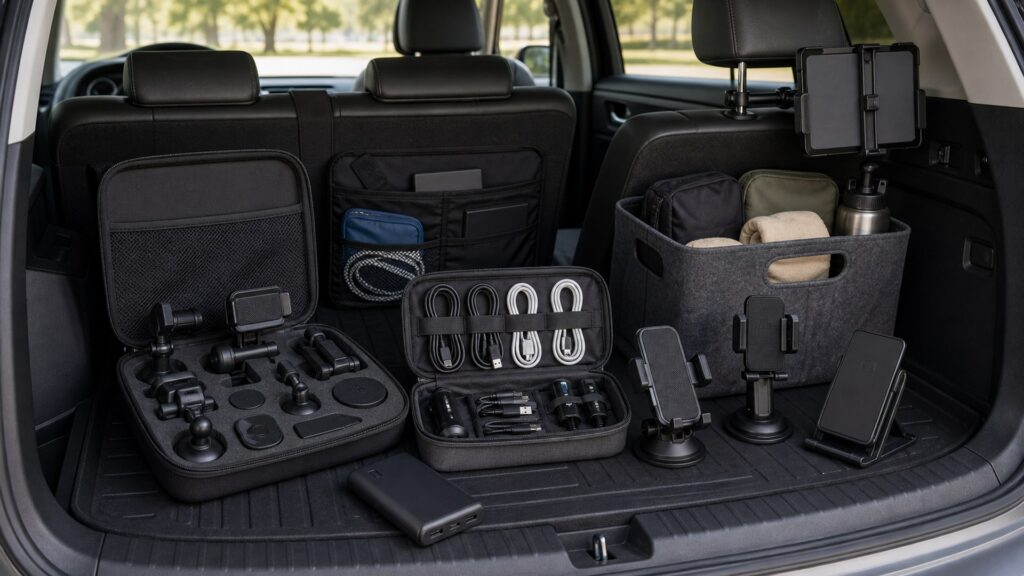
Buying framework
Build the decision around storage-aware placement
The order matters: establish the cargo-carrying car removable interface and use constraints before comparing convenience features. These four checks prevent a superficially compatible navigation device holder from becoming a daily nuisance.
Cupholder Availability: Map cupholder availability before shopping, then reject locations that compromise fold-flat arm storage. This sets the first priority for the intended packing routine.
Console-Lid Swing: Treat console-lid swing as a physical constraint; document it with detachable cradle size in the working stowable position. The result narrows which interfaces deserve comparison.
Glovebox Access: Compare attachment styles only after documenting glovebox access and the limits created by cable coil assigned storage zone. That evidence prevents a convenience feature from masking poor cargo-compatible fit.
Bag And Parcel Movement: Use a parked mock-up to judge bag and parcel movement, paying particular attention to door-pocket gear clearance during adjustment. Keep only positions that remain workable without improvisation.
Who this is for
Match the arrangement to the actual user
Different owners expose the product to different combinations of cupholder availability, folded mount size, and vehicle transfer. Weight the profile that best matches the recurring risk.
Daily commuter with bags: This owner should establish cupholder availability first, then check whether parcel movement changes the result. Reproduce the occupied cabin and regular equipment so the trial reflects storage-aware placement rather than a store display.
Mobile-work driver: For this routine, document console-lid travel with all regular components present. Compare alternatives only after folded mount size has been observed through its full movement or contact range.
Road-trip organizer: Give this user a separate trial centered on parcel movement. The better candidate preserves cable stowage without additional pressure, a blocked control, or a special handling sequence.
Multi-vehicle household: This profile benefits from a reversible setup that makes folded mount size easy to inspect. Recheck vehicle transfer after normal adjustment and retain the option with the fewest assumptions.
What to pay attention to
Specifications that become real storage area consequences
Translate dimensions, materials, and compatibility claims into visible outcomes for storage-aware placement. Record the first point where console-lid travel changes access, movement, surface contact, or intended function.
cargo-carrying car removable interface
Judge attachment and gear clearance against the storage area conditions that shape storage-aware placement.
packed Use
Observe the navigation device holder with the real navigation device and cable in place, not as an empty display.
cupholder availability: Count the cupholders that remain usable after the mount, drink sizes, and passenger needs are included.
console-lid travel: Open the lid, tray, and armrest through their full paths with the loaded phone in place.
parcel movement: Trace how groceries, backpacks, and work parcels enter and leave so they cannot strike the arm or cable.
folded mount size: Measure the hardware both deployed and folded; a compact parked state can return useful storage space.
cable stowage: Give the charging lead a repeatable home that avoids loose loops across bins, controls, or the footwell.
Avoid these traps
Shortcuts that create hidden conflicts
Most disappointments begin with an assumption made before assigned assigned storage zone. Correct the buying logic while the navigation device holder can still be returned or repositioned.
Assuming console-lid swing will sort itself out: A broad compatibility label says nothing conclusive about cupholder availability in this vehicle. Check it together with console-lid travel, using the manuals and all regular components.
Assuming glovebox access will sort itself out: Product photography cannot establish the movement envelope for parcel movement. Recreate that condition and observe folded mount size before approving the location.
Assuming bag parcel will sort itself out: A successful first fitting does not establish durability. Recheck cable stowage after representative use and inspect for a new pressure point, loose interface, blocked function, or material change.
Assuming fold-flat arm will sort itself out: Solving for one feature can create a conflict elsewhere. Move nearby controls and components through their normal ranges while checking vehicle transfer.
Decision guidance
Turn constraints into a clear choice
Use the storage area's limiting condition to narrow the arrangement. The objective is to map storage and movement zones before assigning the navigation device a permanent assigned storage zone.
When cupholder capacity is scarce: Exclude cupholder bases unless the vehicle has a genuinely unused opening. Compare vent, dash, and glass locations by their effect on storage, reach, and sightlines, then retain the simplest reversible interface.
When the console must open fully: Favor a shorter arm or a location beyond the lid's complete swept path. Test with the phone attached and a hand entering the bin; a position that allows only partial opening has not solved the conflict.
When bags move through the front cabin: Keep the phone and lead inside a protected cockpit zone rather than bridging a parcel route. Check shoulder bags, grocery sacks, and work cases individually because their straps and corners travel differently.
When the mount changes vehicles often: Prioritize clean release and components intended for reuse, but treat every cabin as a new fit problem. Re-establish reach, visibility, control movement, airbag clearance, and cable storage before driving the second vehicle.
Ownership & compatibility
Keep the removable interface clean, stable, and reversible
Storage patterns drift as new cables, bags, and passengers enter the vehicle. Revisit the phone zone when those routines change instead of allowing the mount to consume space by default.
Reset the cabin weekly: Return the cable to its clips, empty the mount's surrounding tray, and inspect the base for movement. Remove grit before it is dragged across console or dashboard surfaces.
Watch movable storage: Reopen lids, trays, and cupholder inserts after adjustment or cleaning. A shifted arm or cable clip can quietly reduce clearance that was present on installation day.
Remap after equipment changes: Repeat the parked layout when a larger phone, case, work bag, child item, or passenger accessory arrives. Preserve a clear loading route rather than stacking another workaround around the mount.
FAQ
Questions about storage-aware placement
These answers address cargo-compatible fit and use details that are easiest to document before permanent assigned assigned storage zone.
Should a phone mount occupy a cupholder?
How do I check console-lid clearance?
Where should the mount sit when I carry bags or parcels?
Does the mount's folded size matter?
How should I store the charging cable?
What makes a mount practical to transfer between vehicles?
Can a long arm solve storage conflicts?
How do passengers change storage planning?
What should I compare between final mount choices?
Bottom line
retain for the storage area you actually use
A sound storage-aware placement choice passes the vehicle-specific boundaries without sacrificing a safety-related opening, control, surface, or function.
Start with the storage area: Confirm cupholder availability and console-lid swing before choosing features that cannot rescue a poor assigned storage zone.
Test the packed setup: Use the real navigation device, case, charging lead, seat stowable position, and screen orientations to expose conflicts before permanent assigned assigned storage zone.
Prefer repeatable use: The sound choice for storage-aware placement preserves the key storage area function without a fragile workaround.
Reading Shortcuts
Jump to the decision layer that matters most for storage-aware placement.
Storage-Aware Placement Checks
Complete these observations in the parked vehicle with the normal load present.
- Cupholder Availability: Write down the available range.
- Console-Lid Travel: Observe movement under load.
- Parcel Movement: Keep the affected path unobstructed.
- Folded Mount Size: Repeat after a representative cycle.
- Cable Stowage: Include every connected component.
- Vehicle Transfer: Retain a reversible exit plan.
Glossary Snippets
Terms that define the physical boundaries behind storage-aware placement.
When to Use a Top 10 Review
Use a ranked shortlist after the vehicle limits for cupholder availability and vehicle transfer are documented.
- Cupholder Availability: The limiting condition is documented.
- Console-Lid Travel: The loaded behavior has been observed.
- Parcel Movement: The relevant movement path remains usable.
- Folded Mount Size: The recurring ownership demand is understood.
Already down to 2–3 options? A Comparison is usually the faster next step.
When to Use a Comparison
Compare finalists against the same storage-aware placement setup, manuals, movements, and contact surfaces.
- Parcel Movement: Both candidates preserve this boundary.
- Folded Mount Size: Both survive the representative routine.
- Cable Stowage: Both include the complete everyday setup.
- Vehicle Transfer: The remaining difference changes a real outcome.
Still exploring? Start with a Top 10 to build a shortlist first.