
How to Choose Cardio Equipment for Low-Impact Workouts
Low-impact cardio equipment should reduce repeated landing forces while still giving you a movement you can perform comfortably and control precisely. That description can include recumbent and upright bikes, ellipticals, rowing machines, steppers, and treadmills used for walking, but each places the body differently.
Begin with the reason you want lower impact. Someone avoiding pounding may value seated exercise, while another buyer may need easier mounting, a guided stride, or dependable hand support. Compare the complete movement, not the category label, and include the space required to get on, exercise, and step away safely.
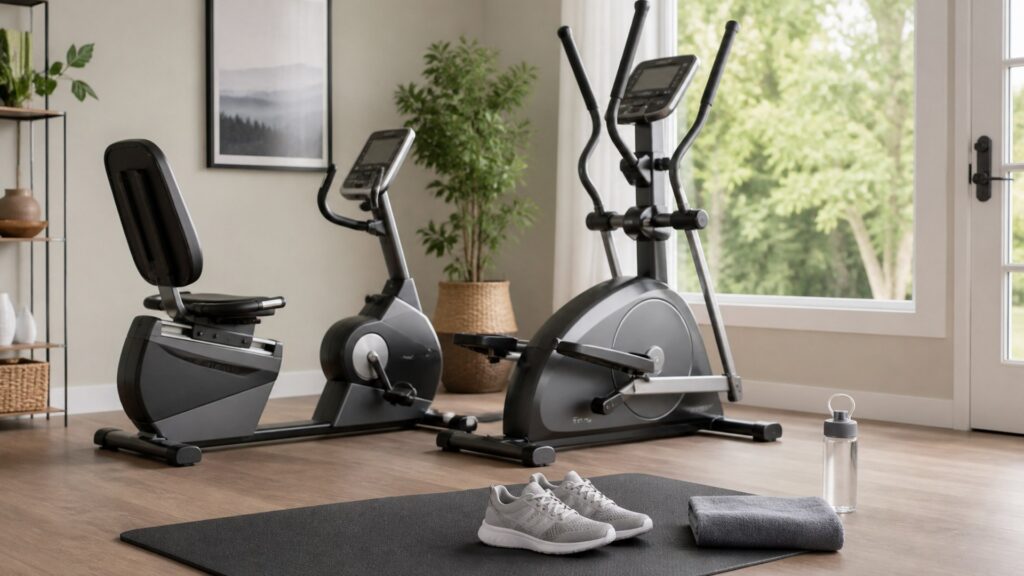
Buying framework
Define what low impact must accomplish
A machine can avoid jumping and still feel wrong because of knee bend, hip position, reach, or balance demands. Set the physical and practical requirements before comparing displays or workout libraries.
Name the movement you want to reduce: Separate repeated foot strikes from deep joint angles, unsupported balance, and uncomfortable contact. The machine should address the actual obstacle rather than merely carry a low-impact label.
Choose seated, standing, or guided motion: A recumbent bike supports the torso, an elliptical guides the feet, and a rower coordinates a sliding seat with a pull. Decide which pattern feels controllable and repeatable.
Check the easiest usable setting: The lowest speed or resistance should allow a calm start without jerky motion. A machine that begins above your comfortable effort range leaves no useful room for gradual progression.
Plan entry and exit: Measure step-over height, pedal position, handholds, and open floor beside the machine. Getting on and off should not require a more difficult movement than the workout itself.
Judge the whole home setup: Flooring, ceiling height, vibration, power access, and storage can change which format works. Include the clearance needed for moving handles, a sliding rail, or a folding deck.
Who this is for
Match the machine to the user's constraint
Buyers arrive at low-impact exercise for different reasons, so the best compromise depends on mobility, preferred posture, available room, and how often the equipment must be moved.
The seated-exercise buyer: Prioritize saddle or seat support, pedal reach, and a resistance range that stays smooth at easy levels. A recumbent layout may simplify balance, but its longer frame requires more floor space.
The walking-focused buyer: A treadmill preserves a familiar movement without outdoor weather or uneven ground. Compare deck access, handrail placement, belt dimensions, and low-speed behavior rather than assuming every walking setup feels alike.
The balance-conscious buyer: Guided foot paths and well-positioned handles can reduce the need to stabilize independently. Test whether the supports remain useful during mounting, adjustment, and dismounting, not only once motion begins.
The small-room buyer: An upright bike or compact stepper may occupy less space than a rower or treadmill. Confirm working dimensions because pedals, handles, rails, and safe access often extend beyond the stored footprint.
The shared-household buyer: Look for adjustments that are quick to understand and broad enough for each intended user. Marked seat positions and accessible controls are more valuable than settings nobody can reproduce.
What to pay attention to
Specifications that change comfort and control
Useful specifications explain how the machine meets the body and room. Translate every number into a mounting, movement, adjustment, or storage consequence.
Step-up and step-over height: Compare the height of the deck, pedal, rail, or center frame with the user's comfortable range of motion. Also check where a hand can provide support during entry.
Adjustment range: Seat distance, handle position, pedal straps, and stride geometry determine whether the movement fits. Confirm that adjustments lock securely and can be repeated without guesswork.
Low-end resistance or speed: A broad top range matters less if the first setting is too demanding or uneven. Test how smoothly the machine starts, changes effort, and slows down.
Contact surfaces: Inspect saddle shape, pedal size, foot retention, handle diameter, and deck feel. Pressure or slipping at one contact area can end a session before cardiovascular effort becomes the limit.
Support without obstruction: Handrails and fixed handles should be reachable without forcing a hunched posture or shortening the natural motion. Make sure supports do not block entry or interfere with controls.
Operating space and sound: Use the dimensions for active motion, not just storage. Add room for the user's body, moving components, ventilation, power cords, vibration control, and routine cleaning.
Avoid these traps
Low-impact buying mistakes that create new barriers
The wrong purchase often solves one concern while introducing another. These mistakes reveal where labels and showroom impressions can hide a poor everyday fit.
Assuming low impact means effortless: Reduced pounding does not eliminate muscular effort, coordination, or joint movement. Choose a starting level and motion you can control, then leave room to increase resistance or duration.
Ignoring the mount and dismount: A comfortable seated or gliding motion cannot compensate for an awkward step-over. Rehearse the complete sequence, including reaching the controls and leaving the machine after exercise.
Buying around one comfort feature: A cushioned deck or padded seat is only one part of fit. Check posture, reach, movement path, pressure distribution, and adjustment together before deciding a machine is comfortable.
Measuring only the stored footprint: Folding equipment can need substantial room when open, and a rower requires clearance behind the seat. Mark the working outline on the floor before delivery.
Treating discomfort as something to push through: Persistent pinching, numbness, instability, or restricted motion signals a mismatch worth investigating. Recheck setup and fit rather than assuming every low-impact machine should feel the same.
Decision guidance
Choose the motion before the feature set
Each cardio format reduces impact in a different way. Use the following routes to identify the movement and setup that best address your reason for shopping.
Choose a recumbent bike for seated support: Consider this format when back support, a lower center of gravity, and independent resistance control matter more than compact length. Check seat travel, pedal reach, walk-through access, and how easily the user can stand afterward.
Choose an upright bike for compact pedaling: An upright bike suits buyers who are comfortable balancing on a narrower saddle and want a smaller footprint. Verify handlebar reach, saddle adjustment, pedal straps, and smooth resistance at the easiest levels.
Choose an elliptical for guided standing motion: An elliptical can avoid repeated foot strikes while keeping the user upright. Check step-up height, stride path, pedal spacing, handle reach, and ceiling clearance with the tallest user aboard.
Choose a rower for coordinated full-body work: A rower is useful when sliding leg drive and pulling feel comfortable together. Confirm rail length, seat height, footplate adjustment, handle return, and enough rear clearance for the complete stroke.
Choose a treadmill when walking is the priority: A treadmill keeps the most familiar gait but still produces foot contact. Compare low-speed smoothness, deck dimensions, belt response, handrail access, and the open area needed behind the machine.
Ownership & compatibility
Keep the movement smooth and accessible
Low-impact equipment remains useful only while its adjustments, moving parts, and access route work as intended. Build inspection and cleaning into the normal routine.
Inspect motion and fasteners: Listen for new rubbing, knocking, or uneven resistance, and check the parts identified in the manufacturer instructions. Loose pedals, rails, handles, or leveling feet can change how stable the machine feels.
Clean where the body meets the machine: Wipe seats, handles, pedals, rails, and display areas using the recommended method. Sweat and debris can affect grip, adjustment mechanisms, and the smooth travel of exposed components.
Preserve a clear access path: Do not let stored items crowd the step-on area or power cord. If the machine folds, confirm that opening and securing it remains manageable for the person who will use it.
Recheck fit when needs change: A different user, footwear change, or altered comfort requirement may call for new seat, pedal, handle, or stride settings. Record useful positions instead of relying on memory.
FAQ
Low-impact cardio equipment FAQ
These answers address the fit and setup questions that usually remain after comparing machine types.
Which cardio machines are generally considered low impact?
Is a recumbent bike always easier to use than an upright bike?
What should I test before buying an elliptical?
Can a treadmill be used for low-impact exercise?
How much clearance should I leave around cardio equipment?
Which specifications matter most for easy mounting?
Does more cushioning guarantee a more comfortable workout?
How can multiple people share one cardio machine?
When should I consider professional guidance before choosing equipment?
Bottom line
Buy for the movement you can repeat comfortably
Start with the specific impact, balance, or access problem you need the machine to solve. The strongest choice combines a controllable motion with practical entry, correct fit, and enough room for safe operation.
Compare movement patterns: Try seated pedaling, guided stepping, rowing, or walking against the same comfort requirements before comparing optional programs.
Verify the complete setup: Measure active floor space and check mounting, adjustment, controls, and the lowest effort setting with the intended user in mind.
Protect repeatability: Choose equipment you can reach, clean, and reset easily enough that lower-impact exercise remains available on ordinary days.
Reading Shortcuts
Move directly to low-impact movement, fit, machine-type, and ownership guidance.
Decision Reminders
Keep these low-impact requirements beside your shortlist.
- Purpose: Identify whether pounding, balance, mounting, or posture is the main barrier.
- Motion: Compare the full joint path and contact areas, not only the product label.
- Access: Rehearse getting on, adjusting the machine, and stepping away.
- Space: Measure the machine while operating and include clearance for the user.
Glossary Snippets
Plain-language terms used in the low-impact fit and movement checks.
When a Top 10 Helps
Use ranked options only after deciding which movement pattern and access requirements fit.
- Filter first: Remove machines that miss the required mounting height, adjustment range, or operating space.
- Compare second: Use a shortlist to examine contact surfaces, starting resistance, controls, sound, and upkeep.
A ranking is useful after the suitable machine type and the user's non-negotiable fit requirements are clear.
When a Comparison Helps
A direct comparison helps when two machines offer acceptable motion but differ in access or ownership.
- Movement: Compare posture, joint path, balance demand, and how smoothly effort changes.
- Home fit: Check active dimensions, entry clearance, noise, cleaning, storage, and service access side by side.
Compare finalist machines using the same user, room, and starting-effort requirements.