
How to Choose Cologne for Layering Scents
Layering colognes creates a third wearing experience whose balance, projection, and duration may differ from either bottle alone. More notes do not automatically produce more sophistication; two complete formulas can just as easily compete or become excessively loud.
Begin with colognes you understand separately. Define one intended change—perhaps adding lift, dryness, warmth, or softness—then combine small measured amounts on labeled blotters before placing a simple pairing on skin.
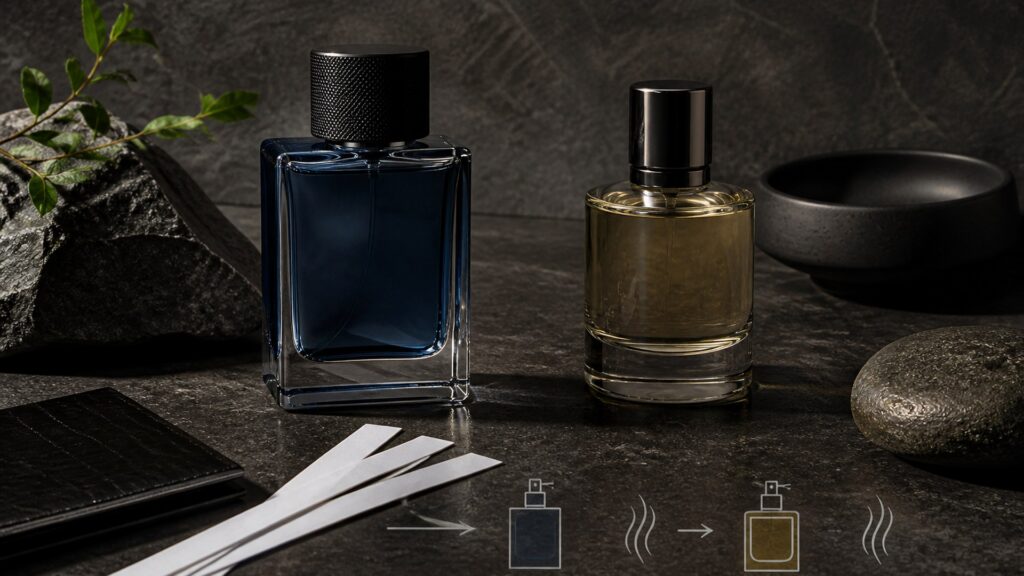
Experiment design
Give the pairing one clear purpose
A useful layering trial asks a specific question. “Make it better” is too vague to reveal whether the second formula contributes or merely adds volume.
Establish solo baselines: Wear each cologne alone through its opening, heart, and base, noting dose, projection, comfort, and the parts already enjoyed or disliked.
Name the intended change: State whether the second scent should brighten the opening, temper sweetness, add texture, or extend a particular effect.
Change one variable: Keep placement and total sprays stable while testing order or ratio; altering everything together makes the result impossible to interpret.
Layering profiles
Not every fragrance owner needs to combine bottles
Layering rewards patient note-taking and repeated testing. Someone seeking speed or predictability may be happier choosing one complete cologne that already fits.
Curious experimenter: Use samples and blotters to explore pairings economically, accepting that many trials should end without a skin wear or purchase.
Targeted modifier: Start from a familiar favorite and add only a restrained accent whose role can be named and observed.
Routine minimalist: Choose a single formula when remembering ratios, order, drying time, and bottle maintenance would add unwanted friction.
Pairing variables
Track order, ratio, placement, and timing
Layering performance depends on application choices as well as note families. A successful pairing should be reproducible without an elaborate guessing ritual.
Blotter grid
Label each strip with formulas, order, ratio, and time. Include solo controls beside the blends so development remains comparable.
Skin confirmation
Move only promising combinations to a small skin trial and follow comfort, projection, and the settled scent for the full intended wear.
Application order: Test which scent is applied first and allow a short settling interval when appropriate; reversing order can change which structure dominates.
Total dose: Keep the combined spray count conservative. Two moderate solo applications stacked together may create an excessive trail.
Separate or shared placement: Placing scents on different skin areas preserves some independence, while overlapping them can make interactions stronger and harder to attribute.
Layering mistakes
Do not use a second bottle to hide a bad base
Layering cannot reliably repair a formula that causes irritation, has spoiled, or develops into a scent the wearer already dislikes.
Combining unfamiliar colognes: Without solo baselines, the wearer cannot identify which product caused harshness, poor longevity, discomfort, or an unwelcome note.
Adding more after adaptation: The nose may stop noticing part of the blend while other people still perceive a strong cloud. Seek fresh-air or distance feedback before reapplying.
Mixing liquids in the bottle: Layer on blotter or skin as directed; never pour finished fragrances together, because the change is irreversible and can contaminate both formulas.
Pairing guidance
Keep, revise, or abandon the blend
A pairing deserves repetition only when it achieves the stated goal, remains comfortable, and can be reproduced at a socially appropriate strength.
Keep the pairing: Record the exact formulas, order, placement, and sprays after several wears produce a coherent dry-down across suitable settings.
Revise one element: Change only ratio, timing, or placement when the concept works but one fragrance dominates or the total presence is too large.
Return to solo wear: Abandon the combination when it muddies both structures, creates discomfort, demands constant correction, or solves no identified problem.
Safe practice
Protect skin, bottles, and the experiment record
Multiple formulas introduce more ingredients, handling, and opportunity for confusion. Clear labels and conservative testing keep the process manageable.
Respect skin reactions: Do not layer on irritated or broken skin, and stop if persistent burning, itching, swelling, or other unexpected discomfort develops.
Prevent cross-contamination: Keep atomizer nozzles from touching skin or one another, and use separate labeled sample vessels for any authorized decanting.
Store each formula correctly: Return bottles upright to a cool dark location; do not leave a frequently tested pair in sunlight, heat, or humid bathroom air.
FAQ
Cologne-layering questions
These answers keep experimentation controlled, traceable, and focused on a specific change rather than maximum complexity.
Which colognes should I layer together first?
Does the order of layered cologne matter?
Can layering make weak cologne last longer?
Bottom line
A successful layer is deliberate and repeatable
The best combination has a stated purpose, conservative total dose, clear solo baselines, and a dry-down that remains more satisfying than either accidental clutter or needless complexity.
Write the recipe: Record names, concentrations, spray counts, order, placement, timing, weather, and setting while the successful trial is still easy to remember.
Recheck the social radius: Ask for honest feedback at conversational distance because a balanced blend to the wearer may still be too present to others.
Keep solo wear available: Layering is an option, not an obligation; each bottle should remain enjoyable and understandable without the other.
Reading Shortcuts
Move directly to the scent layering decision stage you need.
Decision Reminders
Keep the evidence for scent layering visible while comparing.
- Role: The cologne serves the named task.
- Proof: The trial observes a clear opening, balanced projection, wearable dry-down, and predictable duration.
- Care: Keep the bottle capped, shaded, upright, and protected from repeated temperature swings.
Glossary Snippets
Useful language for comparing colognes.
When a Top 10 List Helps
Use rankings to discover credible colognes, then screen them for scent layering.
- The format is undecided: A broad list reveals plausible forms and price levels.
- A shortlist is needed: Rankings narrow discovery but do not replace fit testing.
Have finalists already? Open the comparison section.
When a Direct Comparison Helps
Compare finalists after establishing their suitability for scent layering.
- Two candidates remain: Side-by-side evidence exposes meaningful tradeoffs.
- An upgrade is uncertain: Compare whether added cost corrects the original weakness.
Still exploring? Start with the Top 10 section.