
How to Choose Cologne for Travel Sizes
Travel-size cologne should solve a defined trip problem: enough controlled applications in a vessel that remains sealed, identifiable, protected from impact, and acceptable under the carrier’s current liquid rules. Small packaging alone does not guarantee any of that.
Choose among an official mini, a prepared decant, and a refillable atomizer by considering trip length, spray output, transfer risk, cleaning, and destination conditions. Test the exact filled container before it shares luggage with clothing, documents, or electronics.
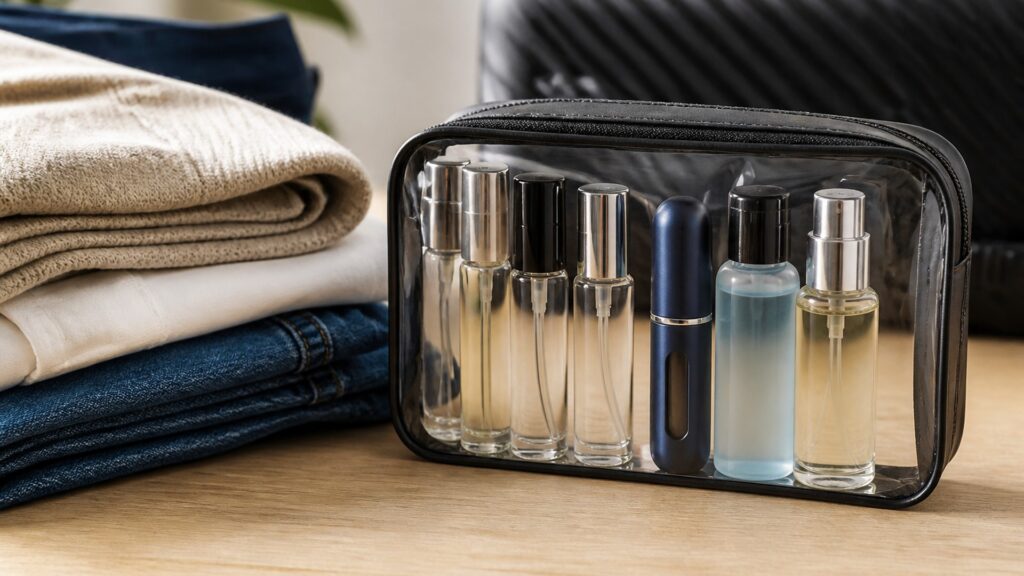
Trip calculation
Convert the itinerary into sprays and milliliters
A business weekend, long holiday, and multi-climate journey produce different volume and packaging needs. Estimate use before selecting the largest allowable vessel.
Count intended wears: Multiply normal applications by likely cologne days, then add a restrained margin rather than assuming the traveler will reapply constantly.
Measure the travel sprayer: Compare its output with the full-size atomizer; one coarse travel spray may use more liquid than the familiar fine mist.
Confirm every rule: Check current airline, rail, cruise, venue, and destination requirements directly, because a product marketed as travel size may still be unsuitable.
Container profiles
Choose the degree of factory certainty and flexibility
Official minis preserve original filling, decants minimize volume, and reusable atomizers support repeat trips. Each format introduces a different failure point.
Factory-sealed traveler: Select an official spray when formula identity, packaging integrity, and avoiding manual transfer matter more than achieving the smallest footprint.
Minimal-volume packer: Use a compatible labeled decant when only a few wears are needed and careful transfer can be completed without mixing scents.
Frequent refiller: Consider a reusable atomizer after verifying valve design, cleaning access, reservoir material, fill visibility, and replacement availability.
Vessel details
Inspect the liquid path from reservoir to nozzle
Leak resistance depends on the bottle joint, refill port, pump, and seal—not on how tightly a decorative outer cap appears to fit.
Leak-test evidence
Fill the vessel, wipe it dry, rest it on absorbent paper in multiple orientations, and inspect the pouch after several hours.
Spray-test evidence
Operate several pumps to confirm priming, mist consistency, cap clearance, grip, and the approximate number of uses available.
Valve and crimp: Look for looseness, residue, damaged threads, tilted hardware, or fragrance odor around the collar before filling or packing.
Protective structure: Glass needs impact protection, while thin plastic may flex or interact poorly with alcohol-based formula; use containers designed for fragrance.
Permanent identification: Label the exact cologne and transfer date with writing that survives abrasion and minor spills; never rely on recognizing clear liquid by color.
Travel mistakes
Avoid contamination and false confidence
An unmarked container or untested refill mechanism can create more trouble than packing the original bottle securely or choosing no fragrance for the trip.
Topping up old liquid: Empty and clean a reusable vessel according to its directions; adding another cologne creates an unidentified blend and obscures residue problems.
Trusting a product claim: “Leakproof” still requires a filled orientation test, because seals can be damaged, incorrectly assembled, or incompatible with the user’s formula.
Stowing beside valuables: Place fragrance in its own sealed washable pouch, separated from passports, medication labels, chargers, cameras, and stain-sensitive fabrics.
Format choice
Pick official spray, decant, or refillable case
The right answer depends on trip frequency, certainty about the cologne, appetite for transfer work, and tolerance for cleaning and seal inspection.
Official travel spray: Choose this when the favorite formula is available in a practical sealed size and the bottle has adequate impact protection.
Prepared decant: Choose this for a specific short trip when exact low volume matters and the traveler can label and isolate the vial properly.
Reusable atomizer: Choose this for repeated travel only after the fill method, valve, mist, cleanout process, and long-term seal prove dependable.
Between trips
Reset the travel cologne kit after returning
Atomizers left in luggage may experience heat, lose labels, seep unnoticed, or become mystery containers by the next journey.
Inspect immediately: Remove the vessel from the pouch, check seams and fill level, and investigate any scent that escaped into the surrounding kit.
Refresh the record: Confirm the formula name and date remain readable, then note whether the observed spray rate matched the original trip estimate.
Store under stable conditions: Keep the travel cologne upright in a cool dark cabinet instead of a car, sunny suitcase, steamy bathroom, or exposed shelf.
FAQ
Travel-size cologne questions
These answers connect itinerary, volume, container engineering, rules, and storage to a safer portable fragrance choice.
How much cologne do I need for travel?
Is an official cologne mini better than a decant?
How do I prevent travel cologne from leaking?
Bottom line
Pack only the cologne the trip can justify
A successful travel size contains a calculated supply, uses a compatible proven vessel, remains clearly labeled, and is isolated from possessions that a leak could damage.
Verify the estimate: Use actual atomizer output and wearing plans to choose volume rather than treating the maximum permitted size as a target.
Prove the hardware: Complete fill, orientation, spray, closure, and handling tests early enough to replace a questionable vessel before departure.
Control the environment: Follow transport rules and move cologne promptly to cool dark destination storage instead of leaving it in vehicles or direct sun.
Reading Shortcuts
Move directly to the portable fragrance decision stage you need.
Decision Reminders
Keep the evidence for portable fragrance visible while comparing.
- Role: The cologne serves the named task.
- Proof: The trial observes a clear opening, balanced projection, wearable dry-down, and predictable duration.
- Care: Keep the bottle capped, shaded, upright, and protected from repeated temperature swings.
Glossary Snippets
Useful language for comparing colognes.
When a Top 10 List Helps
Use rankings to discover credible colognes, then screen them for portable fragrance.
- The format is undecided: A broad list reveals plausible forms and price levels.
- A shortlist is needed: Rankings narrow discovery but do not replace fit testing.
Have finalists already? Open the comparison section.
When a Direct Comparison Helps
Compare finalists after establishing their suitability for portable fragrance.
- Two candidates remain: Side-by-side evidence exposes meaningful tradeoffs.
- An upgrade is uncertain: Compare whether added cost corrects the original weakness.
Still exploring? Start with the Top 10 section.