
How to Choose Curling Tools for Travel Styling
A travel curling tool must work with the destination’s electrical supply, fit the luggage, and cool safely before checkout. Compact dimensions are useful only when the barrel still suits the planned style and hair length.
Read the tool’s voltage marking and power requirements directly; a plug adapter changes connector shape, not voltage. When compatibility is uncertain, use destination-approved equipment rather than risking shock, fire, damage, or failed styling.
Buying framework
Define the travel styling job before comparing curling tools
List destinations, supply voltage, outlet types, lodging equipment, luggage limits, and the exact hairstyles needed during the trip.
Recreate the setting: Confirm dual-voltage behavior from the rating label and manual, including whether a physical selector must be set before plugging in.
Write a pass condition: A plug adapter does not convert electricity, and a voltage converter must be appropriately rated for the tool’s load.
Set the rejection line: Measure the barrel and handle in usable terms because a shortened hot surface may force overlap on long hair.
Use profiles
Match the curling tool to the person and frequency
Choose stable low settings, readable controls, dependable shutoff, and a cord that does not strain unfamiliar hotel outlets.
The low-maintenance buyer: Test the complete setup at home well before departure, including adapter fit, selector position, warm-up, controls, and cooling.
The careful experimenter: Use only on clean dry hair with heat protection, beginning at the lowest effective setting despite a rushed itinerary.
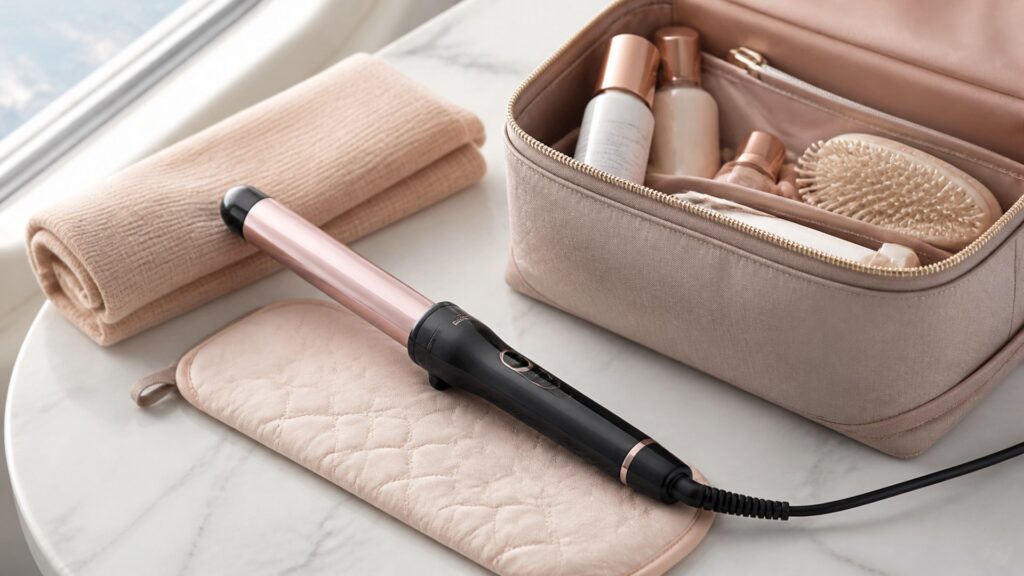
The targeted upgrader: Place the hot tool on a dedicated heat-safe mat rather than towels, bedding, carpet, luggage, or bathroom counters.
Specifications
Read curling tool specifications through real use
A heat-resistant sleeve is for packing only after the maker’s cooling requirements are met, not for enclosing an active barrel.
Evidence from the first trial
Keep the tool in carry-on luggage only when current carrier and security rules permit, and protect controls from activation.
Evidence after repetition
Inspect cord, plug, adapter, barrel surface, and case after transit because crushing and bending can create hidden damage.
Working behavior: Leave enough departure time for complete cooling; never pack a warm appliance merely because checkout has arrived.
Contact and comfort: List destinations, supply voltage, outlet types, lodging equipment, luggage limits, and the exact hairstyles needed during the trip.
Package and control: Confirm dual-voltage behavior from the rating label and manual, including whether a physical selector must be set before plugging in.
Common mistakes
Avoid shortcuts that distort the travel styling decision
A plug adapter does not convert electricity, and a voltage converter must be appropriately rated for the tool’s load.
Rewarding the loudest claim: Measure the barrel and handle in usable terms because a shortened hot surface may force overlap on long hair.
Testing under ideal conditions: Choose stable low settings, readable controls, dependable shutoff, and a cord that does not strain unfamiliar hotel outlets.
Ignoring the boundary: Test the complete setup at home well before departure, including adapter fit, selector position, warm-up, controls, and cooling.
Decision guidance
Decide when basic, premium, or no purchase makes sense
Use only on clean dry hair with heat protection, beginning at the lowest effective setting despite a rushed itinerary.
Choose a basic option: Place the hot tool on a dedicated heat-safe mat rather than towels, bedding, carpet, luggage, or bathroom counters.
Upgrade for evidence: A heat-resistant sleeve is for packing only after the maker’s cooling requirements are met, not for enclosing an active barrel.
Wait when uncertainty remains: Keep the tool in carry-on luggage only when current carrier and security rules permit, and protect controls from activation.
Ownership & compatibility
Keep the curling tool reliable after purchase
Inspect cord, plug, adapter, barrel surface, and case after transit because crushing and bending can create hidden damage.
Build the reset step: Leave enough departure time for complete cooling; never pack a warm appliance merely because checkout has arrived.
Watch compatibility: List destinations, supply voltage, outlet types, lodging equipment, luggage limits, and the exact hairstyles needed during the trip.
Know the retirement signal: Confirm dual-voltage behavior from the rating label and manual, including whether a physical selector must be set before plugging in.
FAQ
Questions about curling tools for travel styling
A plug adapter does not convert electricity, and a voltage converter must be appropriately rated for the tool’s load.
What should I check first when choosing a curling tool for travel styling?
How long should I test the curling tool?
When is a more expensive curling tool worthwhile?
Bottom line
Finish the travel styling choice with observable proof
Measure the barrel and handle in usable terms because a shortened hot surface may force overlap on long hair.
Restate the actual role: Choose stable low settings, readable controls, dependable shutoff, and a cord that does not strain unfamiliar hotel outlets.
Rehearse an ordinary day: Test the complete setup at home well before departure, including adapter fit, selector position, warm-up, controls, and cooling.
Write the purchase reason: Use only on clean dry hair with heat protection, beginning at the lowest effective setting despite a rushed itinerary.
Reading Shortcuts
Move directly to the travel styling decision stage you need.
Decision Reminders
Keep the evidence for travel styling visible while comparing.
- Role: The curling tool serves the named task.
- Proof: The trial observes consistent curl formation, controlled tension, predictable heat, and a comfortable styling pace.
- Care: Unplug after use, cool on a heat-safe surface, wipe residue, and inspect the cord.
Glossary Snippets
Useful language for comparing curling tools.
When a Top 10 List Helps
Use rankings to discover credible curling tools, then screen them for travel styling.
- The format is undecided: A broad list reveals plausible forms and price levels.
- A shortlist is needed: Rankings narrow discovery but do not replace fit testing.
Have finalists already? Open the comparison section.
When a Direct Comparison Helps
Compare finalists after establishing their suitability for travel styling.
- Two candidates remain: Side-by-side evidence exposes meaningful tradeoffs.
- An upgrade is uncertain: Compare whether added cost corrects the original weakness.
Still exploring? Start with the Top 10 section.