
How to Choose Cycling Accessories for Long Rides
Choose accessories for a long ride by the longest stretch between reliable stops, not by distance alone. Carry the water capacity, repair equipment, lighting and route information that stretch requires, then check that the loaded bags still leave bottles, controls and lamps usable. Extra equipment earns its place when it provides a realistic recovery option.
A supported day with regular stops can use a leaner kit than a remote route or a ride expected to finish in darkness. This guide helps you plan that difference, compare useful redundancy with unnecessary duplication and test the packed bicycle before departure. It focuses on what the accessories can actually cover rather than an arbitrary list of must-have gadgets.
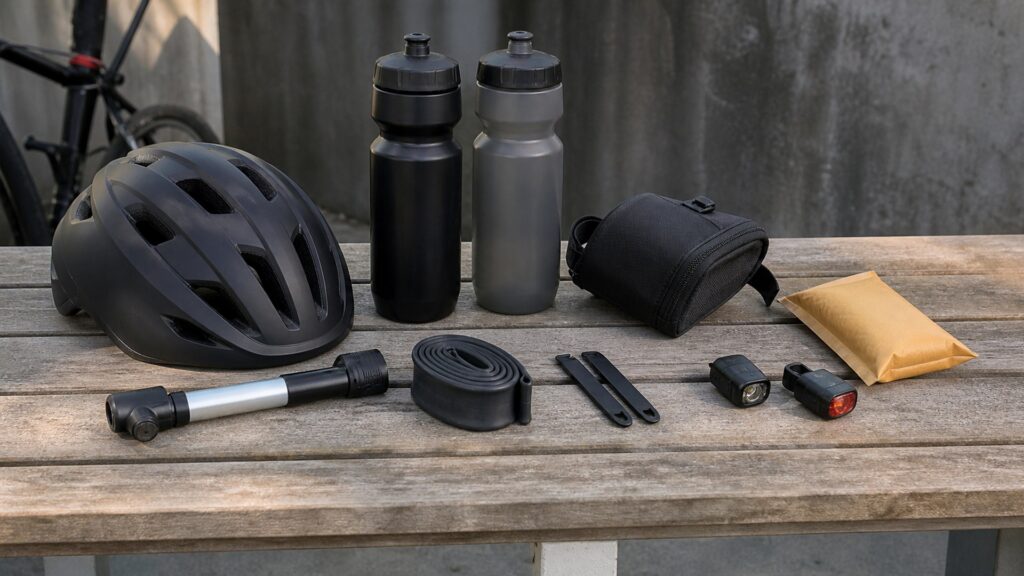
Buying framework
Plan around gaps in support
Map dependable services and likely delays before choosing carrying capacity. A long ride's hardest equipment problem may occupy only one section of the route.
Identify the longest unsupported interval: Mark reliable water, supplies and practical exit points, checking opening or access information when it matters. Do not base the entire plan on a stop that may be closed or unavailable.
Choose recoverable failures: Decide which punctures or minor mechanical problems you can address with your skills. Carry equipment for those tasks and establish a separate recovery plan for damage beyond roadside repair.
Include possible darkness: Use the likely schedule and delay margin to decide the lighting function required. A small visibility lamp is a different tool from a front beam suitable for an unlit route.
Allocate access before volume: Place frequently needed items where they can be reached or removed conveniently at a stop. Avoid filling the frame triangle with a bag before checking that the planned water containers still work.
Who this is for
Match the kit to the support available
Two rides of equal distance may need very different accessories. Choose according to access to help, operating time and carried load.
Organized rides with dependable support: Use the event's confirmed provision to avoid unnecessary duplication. Still carry the personal items and compatible spares the organizer expects rather than assuming every problem is covered.
Remote self-supported day rides: Give repair capability and reliable route access greater priority. More redundancy may be worthwhile when an alternative exit is difficult, but only if you can use the extra equipment.
Long outings extending after dark: Plan the front beam and rear visibility for the dark portion plus a realistic margin. Compare backup options according to the consequence of a failed light, not just the total advertised brightness.
Several days with luggage: Choose bags, charging arrangements and consumables as a repeatable system. Check drying and replenishment opportunities between days instead of treating each morning as a fully serviced restart.
What to pay attention to
Check coverage and access under a full load
Pack the proposed system before buying the final bag sizes. These checks reveal conflicts that separate product specifications miss.
Coverage between reliable stops
Assess the time and distance between dependable services, including the consequences of a delay or unavailable stop.
Packed access and recovery options
Check the packed bicycle for accessible supplies, compatible repair parts and genuinely separate backup options.
Water-container fit: Test the bottles or reservoir, cages and bags together. Select carrying capacity for the route and personal needs without assuming a fixed amount suits every rider, weather condition or duration.
Complete tire-repair chain: Match the spare or plug system, valve hardware and inflation method to the fitted wheels. Include the components and skills needed to finish the repair rather than counting tools in isolation.
Light duration at usable output: Compare runtime in the mode that illuminates or marks the route as required. Allow for the maker's stated conditions and a sensible reserve instead of planning to exhaust the advertised duration exactly.
Offline navigation and access: Confirm the route is available on the chosen device without depending on live reception. Check how you would retrieve essential directions if that screen or its battery becomes unavailable.
Battery and charging interfaces: List the required cables, connectors and supported charging behavior for each device. A power bank does not establish that a light can operate while charging or retain weather protection with a port open.
Loaded bag clearance: Check straps, knee room, tire space and lamp visibility with the full packing list. Inspect the bicycle through normal steering and pedaling movement before accepting a large bag's nominal capacity.
Avoid these traps
Do not confuse more equipment with more resilience
Additional items help only when they cover a meaningful failure or access problem. Examine the gap each one actually closes.
Carrying two devices with one dependency: Two lights or navigation devices may still rely on the same missing cable or exhausted supply. Consider the failure path rather than counting duplicate units as automatic independence.
Packing tools for repairs you cannot perform: A tool's presence does not make an unfamiliar repair practical beside the road. Learn and rehearse the intended task or plan recovery, rather than adding weight for imagined capability.
Choosing a bag by maximum capacity: An oversized bag may block bottle removal, contact legs or move under load. Select usable placement first, then buy enough volume for the equipment that remains justified.
Trusting one unconfirmed resupply point: A route note is not proof that a tap, shop or staffed stop will be available. Verify critical access close to departure and retain a plan for the relevant gap if it fails.
Decision guidance
Build the kit from the route outward
Select the essential capabilities, fit them to the bicycle and test the result. Add redundancy where the route makes a failure difficult to recover from.
Stops and assistance are frequent: Use a lean kit based on confirmed support and personal requirements. Avoid carrying a second version of every item when an accessible alternative already addresses the likely problem.
The route has a long unsupported stretch: Increase the relevant carrying or repair capability and define an exit option. Accept extra weight when it closes a real gap instead of pursuing the lightest possible bag at any cost.
Darkness is expected or a plausible delay: Choose lighting capable of the actual dark route, with an appropriate reserve or backup. Resolve operating time before paying for wireless integration or cosmetic matching.
Packing interferes with normal riding: Redistribute the load across approved positions or remove nonessential items. A smaller accessible system is preferable to one large bag that obstructs the water, controls or lights it was meant to support.
Ownership & compatibility
Prepare the kit before the major outing
Long-ride accessories should be familiar before they become necessary. Use shorter rides to find fit and operating problems.
Rehearse a representative repair: Practice the selected tire procedure with the actual pump and spares. Replace consumed supplies afterward and check that all parts have returned to the carried kit.
Test the packed bicycle: Ride a suitable shorter route with the intended load and inspect for movement, rubbing and access problems. Secure straps as instructed and protect contact points according to the bicycle and bag makers' guidance.
Restore readiness after each trip: Dry bags, replenish consumables and check powered equipment before storage. Record a successful packing list, then adjust it when route support or bicycle hardware changes.
FAQ
Questions before packing for a long ride
Settle these details while there is still time to test the equipment.
How much water capacity should I buy?
Is a second pump necessary?
Can a power bank keep a light running?
Should I carry a paper route?
Are frame bags better than saddle bags?
Do I need a backup rear light?
Can I share tools with other riders?
Should I buy a larger multitool for distance?
When should I stop adding accessories?
Bottom line
Carry capability you can use
The right distance kit covers the route's meaningful gaps without obstructing the bicycle. Judge the packed system by its recovery options and accessibility.
Cover the unsupported stretch: Plan supplies, route access and realistic exits around dependable services.
Prove each function: Rehearse repair, light operation and charging with the equipment you will carry.
Keep the load workable: Accept useful redundancy while removing duplicates that add no practical recovery option.
Reading Shortcuts
Plan support gaps, verify carried capability and test the loaded bicycle.
Decision Reminders
Build the packing list around the least-supported part of the route.
- 1: Verify the critical refill or supply stop.
- 2: Try bottle removal after fitting every bag.
- 3: Check usable lighting time at the required mode.
- 4: Test all charging cables with their intended devices.
Glossary Snippets
Terms for operating-time margins and independent recovery options.
When to Use a Top 10 Review
Look for products that fill a specific duration, access or repair requirement.
- Support interval: Distinguish compact supported-ride equipment from remote-route capability.
- Recovery evidence: Look for explicit operating limits and compatible replacement parts.
References: Park Tool: tire and tube procedures; Park Tool: puncture-repair options; Trek light functions and selection; ORTLIEB bag use and attachment guidance. Checked October 6, 2026. This guide does not claim original product measurements. Use the Comparison to assess finalists.
When to Use a Comparison
Compare complete packed systems against the same route assumptions.
- Real redundancy: Identify which failure each additional item lets you recover from.
- Packed access: Compare the load with water, tools and lamps installed rather than empty bag dimensions.
For a selection of candidates, visit the Top 10.