
How to Choose Cycling Apparel for Storage Space
Limited clothing storage changes what is worth buying, but it should not change the fit you need on the bike. A shallow drawer, a shared rail and a small drying area create different constraints. Padded shorts occupy a different shape from a thin jersey, and wet kit needs temporary space before it belongs in the clean wardrobe.
Begin by looking at the garments you use, the conditions they cover and the time available between rides and washing. This guide helps you choose useful functions and a workable rotation without collecting overlapping outfits. Compare the complete stored and drying arrangement rather than treating a jacket’s small stuff pocket as proof that the whole wardrobe will fit.
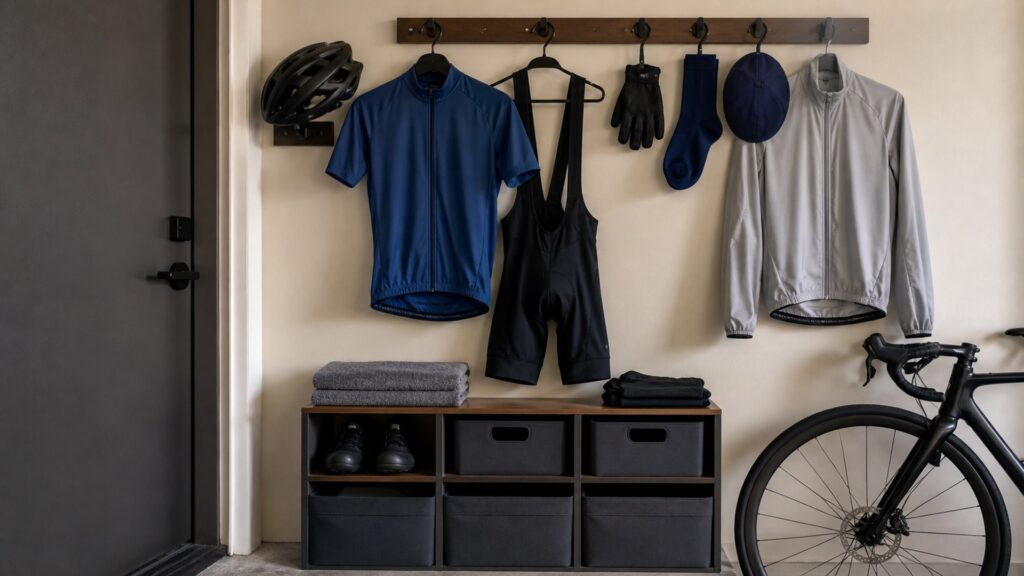
Buying framework
Measure the wardrobe’s two space demands
Clean storage and drying space are separate parts of the purchase. Plan both before choosing quantities.
Map the usable storage: Check the actual drawer or rail you can allocate, including other household clothing. Compare real folded samples where possible; advertised garment size describes body fit, not the volume of a padded short or lined jacket.
Reserve temporary drying space: Consider where damp shorts and layers can dry after a ride. That spread-out arrangement may need more room than the folded clean outfit, so a wardrobe that fits neatly in a drawer can still exceed the available drying area.
List distinct clothing functions: Separate saddle-contact padding, ordinary upper-body coverage, insulation and wind or rain barriers. Several colors or similar jerseys add quantity without necessarily adding a new function; choose another piece only when it changes coverage or enables laundry rotation.
Work backward from ride frequency: Count the gap between outings and the realistic washing and drying turnaround. A single padded garment is a small stored pile, but it is not a workable plan when that insert remains wet at the next departure.
Compare complete combinations: Include the liner and outer shorts, or jersey and warmers, in the space comparison. A compact individual accessory can be useful, yet several loose pieces still require organization and should be evaluated as one wearable arrangement.
Who this is for
Which space constraint controls your purchase?
Different households need different garment quantities and storage arrangements, even for similar rides.
One shallow drawer: Bulky chamois inserts and lined garments may determine what fits. Favor a small set of distinct functions and inspect actual folded shapes, while keeping any item that your riding conditions truly require rather than sacrificing fit to reduce the pile.
A short shared hanging rail: Garments that require hanging can compete with everyday clothes. Check the care label and available support before buying more bibs or heavy wet layers; a strap should not become the default hanging point simply because it is convenient.
Frequent rides with little drying room: Rotation and temporary space matter more than collecting a full seasonal wardrobe. Prioritize a workable schedule for clean, dry padded shorts and assess whether additional pieces can actually dry simultaneously in the area you have.
Variable mild-weather riding: A jersey with removable warmers and a separate barrier may cover several outings using existing garments. You gain combinations but inherit loose pieces to keep together; compare that complete stack with the long-sleeve alternative you would otherwise buy.
Seasonal cycling with long breaks: A small active wardrobe and separate clean seasonal storage may suit infrequent winter or summer use. Buy for the conditions you really ride in, and allow garments to dry fully before their longer period packed away.
What to pay attention to
Inspect volume, support and care requirements
These observable details turn a vague compact-wardrobe goal into a garment selection.
Stored shape
Inspect the actual folded pad, lining and complete modular outfit. Body size and a single stuff-pocket claim do not establish wardrobe volume.
Drying and rotation
Evaluate the label-approved drying arrangement and turnaround. This determines temporary space and how many clean padded garments the riding schedule requires.
Pad and lining bulk: Look at the folded short with its insert in a natural position rather than compressing it flat to imitate a shirt. Thermal linings and multiple panels also change the stack; compare like-for-like complete garments in the usable drawer.
Drying arrangement: Read whether the label calls for hanging, laying flat or another drying method. Check how the whole garment opens in that arrangement, particularly the padded area, instead of assuming an outside surface that feels dry means every layer is ready.
Layer compatibility: Try the jersey with warmers, or the liner with outer shorts, in riding posture. A modular wardrobe saves duplicate garments only when the pieces work together; cuffs, grippers and extra fabric should not bunch simply to achieve a smaller collection.
Closure and strap storage: Inspect where zips, hook-and-loop closures and straps sit when folded or hung. Organize them so closures do not catch delicate fabric, following garment instructions rather than letting loose fasteners rub through the neighboring kit.
Care turnaround: Check washing and drying restrictions before choosing the number of padded garments. A piece that cannot follow your usual household laundry routine may need separate handling; its small folded size does not remove that recurring time requirement.
Avoid these traps
Avoid false space savings
A compact purchase is useful only when the clothing remains wearable, clean and ready on your riding schedule.
Choosing a smaller body size: A tighter garment does not meaningfully solve the storage problem if it pulls or mispositions the pad on the bike. Choose size by fit, then manage quantity and overlapping functions to address the wardrobe’s space.
Packing kit while damp: A small stuff sack can conceal a wet shell or insert rather than solve drying. Keep drying and clean storage as separate steps; the relevant saving is the dry stored shape, not how tightly damp material can be squeezed.
Counting pieces instead of outfits: One liner and one outer short are two garments serving a combined outfit. Compare their full storage and laundry burden with a standalone option rather than calling the liner a space saving while ignoring the layer worn over it.
Buying the shortest possible rotation: Fewer shorts leave less to store but create dependence on rapid washing and drying. If the timetable does not work, reduce unnecessary duplicate functions before cutting the clean padded garments needed for your actual ride schedule.
Decision guidance
Choose a small wardrobe that can keep up
Select the combination and quantity for the space you actually have, accepting the management each choice needs.
For a drawer limit, remove overlap before essential coverage: Keep garments with distinct jobs and defer extra colors or near-identical cuts. This reduces choice and spare capacity, but preserves the fit, padding and weather functions that determine whether the wardrobe works on the bike.
For changing mild conditions, compare warmers with another jersey: Warmers can extend an existing short-sleeve outfit without another full top. The cost is managing matching loose pieces and their overlap; a dedicated long-sleeve garment may be simpler if you rarely remove coverage.
For frequent rides, buy the rotation your drying time supports: Choose enough padded garments for the interval between clean, dry availability and the next ride. That consumes more stored space than a single pair, but avoids making an unreliable laundry promise the foundation of the purchase.
For limited hanging space, favor a care routine you can provide: Select garments whose specified drying and support arrangement fits your household. Do not choose a label-demanding item solely for compact packing; accepting its separate handling is part of owning it.
Ownership & compatibility
Keep the compact wardrobe organized
A small collection needs deliberate separation of wet, used and clean garments so its limited space stays useful.
Dry the insert completely: Open padded garments in their label-approved drying arrangement and inspect the thicker area before storage. Let the real turnaround inform your rotation instead of repeatedly discovering that the only clean-looking pair is still damp inside.
Separate used kit: Keep worn clothing out of the clean drawer while it waits for laundering. Give that temporary pile a defined place so a compact wardrobe does not become a mixture of ready-to-ride and used pieces.
Protect neighboring fabrics: Close or cover fasteners as the care instructions specify and keep small warmers paired. This reduces searching and prevents an exposed closure from becoming the accidental contact point against a more delicate jersey.
Prepare seasonal storage: Clean and fully dry the garments before putting them away for a long break. On return, inspect elastic, closures and seam treatment before relying on the outfit; the calendar alone does not establish its condition.
FAQ
Questions about storing a small cycling wardrobe
Clarify compression, hanging and accessory boundaries before organizing the collection.
Can I hang bib shorts by their straps?
Are packing cubes useful for cycling clothes?
Should I use vacuum storage bags?
Does a packable shell replace a thermal jersey?
How many pairs of padded shorts do I need?
Can warmers share the drawer with jerseys?
Will thinner padding save enough space to choose it?
Where should the helmet and shoes go?
Is a second identical jersey always wasteful?
Bottom line
Approve the wardrobe, not just the smallest garment
Use fit as the veto, then decide functions, quantity and a storage routine.
Keep the riding fit: Reject clothing that loses pad position or pulls in forward reach. Wardrobe volume is a constraint on the collection, not permission to choose an unsuitable size.
Choose distinct jobs: Identify which existing pieces cover padding, warmth and weather barriers. Add a missing function before another version of one already adequately covered.
Set a realistic rotation: Match the number of padded garments to actual laundry turnaround and riding frequency. Include the drying space required while another outfit remains in use.
Try the complete storage plan: Fold or hang the whole combination as instructed and give loose pieces a home. Confirm the clean drawer and temporary drying arrangement before expanding the collection.
Reading Shortcuts
Plan garment functions alongside clean storage and drying.
Decision Reminders
A small collection needs all three checks.
- Riding fit: Keep the correct garment size and pad position.
- Ready availability: Allow actual washing and drying time.
- Dry storage: Put away clothing only after it dries.
Glossary Snippets
Terms for a compact clothing rotation.
When to Use a Top 10 Review
Compare pieces that add a missing wardrobe function or workable rotation.
- Remove overlap: Avoid accumulating equivalent garments without a use.
- Assess complete volume: Include liners, outer layers and small accessories.
Already down to 2-3 options? A Comparison is usually faster than reading broad buying advice.
When to Use a Comparison
Put finalists beside the same storage and laundry constraints.
- Compare the folded outfit: Judge the pad and all accompanying layers.
- Read care restrictions: Check the drying method your household can provide.
Still exploring? Start with a Top 10 to identify the right category first.