
How to Choose Epilators for Smooth Results
Smooth results are not produced by a single tweezer-count claim. They come from matching hair length to the device, maintaining contact over curves, seeing scattered regrowth, and moving slowly enough for the tweezers to capture hair rather than skipping across it.
This guide shows how to compare epilators for even coverage by focusing on short-hair capture, head geometry, lighting, speed control, wet or dry use, preparation accessories, and cleaning. It also sets realistic expectations: root removal can last longer than surface shaving, but no device guarantees perfectly uniform results in one pass.
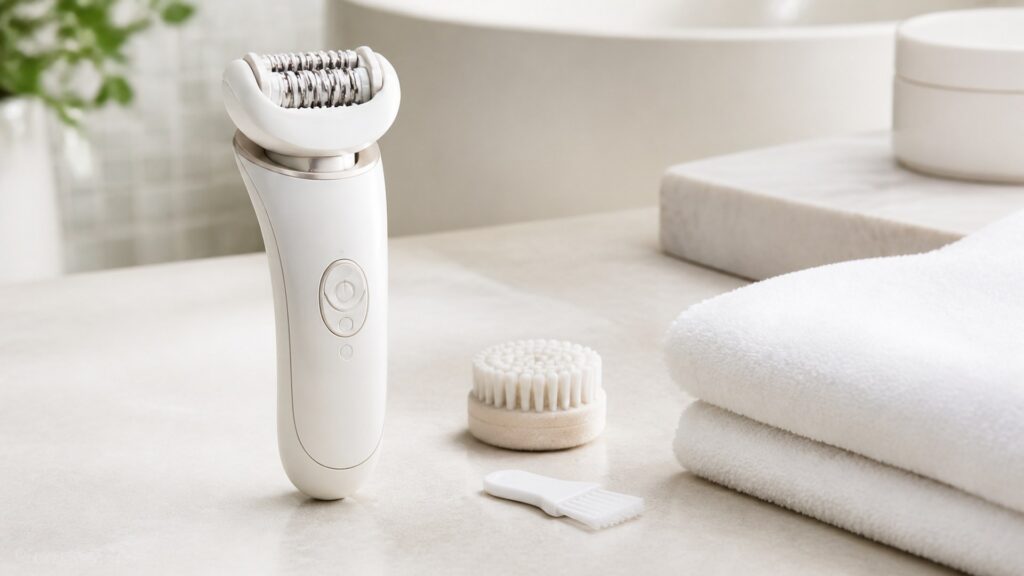
Results framework
Define smoothness as consistent coverage, not aggressive repetition
Good results balance capture, comfort, and skin condition.
Use the recommended hair length: Hair that is too long may pull or break; hair that is too short may be missed. Follow the model's guidance and allow regrowth when necessary.
Keep contact around contours: A pivoting head, stable grip, and deliberate angle help the tweezers follow knees, ankles, and other curves without excessive pressure.
Inspect between sections: Good lighting and a systematic route help identify missed zones before you repeat broad passes over already treated skin.
Use profiles
Match result priorities to your normal areas
Smoothness needs differ by coverage, contour, and frequency.
Large-area routine: Prioritize a wide head, dependable runtime, and comfortable balance so you can work in orderly sections without rushing.
Contour-focused routine: Look for a pivoting head or helpful cap, strong visibility, and a body shape that supports light contact around knees and ankles.
Fine-regrowth tracker: A built-in light and a model designed to capture shorter hairs can help reveal and remove scattered regrowth between full sessions.
Specifications
Connect smooth-result claims to controllable features
Evaluate the full capture system rather than isolated marketing numbers.
Coverage consistency
Illumination, articulation, treatment-edge control, and a measured pace shape how evenly the head follows each section.
Capture conditions
Supported hair length, tweezer geometry, operating method, power reserve, and head cleanliness influence how many visible hairs remain after inspection.
Short-hair capture: Treat minimum-length claims as model-specific guidance, not a guarantee. Hair direction, skin contact, and lighting still affect what the head can collect.
Head articulation: A pivoting head can follow body curves, while a fixed head may offer predictable placement. Choose the design you can hold at the recommended angle.
Speed control: Multiple useful speeds allow deliberate work on contours and efficient coverage on open areas. The transition between settings should be easy to understand.
Illumination: An integrated light can expose missed hairs, but placement matters. Check that shadows from the head do not hide the treatment edge.
Common mistakes
Avoid habits that create uneven results
Technique and skin condition can undermine an otherwise capable device.
Moving too quickly: Rushing can skip hairs or reduce capture. Follow the manufacturer's pace and lift the device before changing direction when instructed.
Chasing perfection with repeated passes: Inspect first and target only visible misses. Repeated broad coverage can add irritation without meaningfully improving smoothness.
Ignoring head cleanliness: Hair and residue can obstruct the tweezer system. Clean the approved components after each use and let them dry completely.
Decision guidance
Choose the smooth-results features you can control
The right model makes systematic technique easier.
Choose a pivoting wide head if: You want efficient coverage across legs and find fixed heads difficult around contours.
Choose strong lighting and precision caps if: Scattered hairs and smaller zones are your main source of unevenness.
Choose wet/dry operation if: Wet use improves your comfort enough to support slower, more consistent sessions and the model is approved for it.
Ownership & compatibility
Protect result quality over time
Clean components and available replacements keep the routine predictable.
Post-session cleaning: Brush or rinse the head as directed, inspect for trapped hair, and dry parts fully before reassembly.
Exfoliation accessories: An exfoliation brush may support a separate skincare routine, but it does not replace careful technique or guarantee prevention of ingrown hairs.
Replacement planning: Check access to caps, brushes, shaving foils, or heads that affect your routine, and follow the manual for service intervals.
FAQ
How to Choose Epilators for Smooth Results FAQ
Result-focused answers about missed hairs, tweezer counts, and choosing between wet and dry operation.
Will a higher tweezer count always give smoother results?
Why does an epilator leave some hairs behind?
Does wet epilation create smoother results than dry use?
Bottom line
Smooth results come from a repeatable capture routine
Choose features that improve contact, visibility, and patient coverage.
Control the variables: Use the recommended hair length, angle, pace, and skin condition.
Buy for visibility and contact: A useful light and well-handled head can matter more than a headline count.
Stop unnecessary repetition: Inspect and target misses rather than repeatedly covering clear skin.
Reading Shortcuts
Jump to the decisions that matter most when how to choose epilators for smooth results.
Decision Reminders
A quick checklist before you commit to an epilator.
- Follow hair-length guidance: Give the tweezers a realistic opportunity to capture regrowth.
- Use light pressure: Maintain the recommended angle instead of forcing the head.
- Inspect before repeating: Target misses rather than redoing complete sections.
Glossary Snippets
Plain-language definitions for common epilator terms.
When to Use a Top 10 Review
Use a ranked shortlist when you want to compare the strongest options by routine, comfort, and value.
- You are still defining your needs: A Top 10 can separate full-size, compact, wet/dry, and attachment-heavy models before you compare details.
- You want a manageable shortlist: Ranked picks help you focus on models that fit your body areas, routine, and preferred cleanup method.
Already down to 2-3 options? A Comparison is usually the faster decision tool.
When to Use a Comparison
Use a direct comparison after you have narrowed the field and need to judge practical tradeoffs.
- You have two or three finalists: Side-by-side coverage clarifies head width, speed control, attachments, runtime, cleaning, and warranty differences.
- The prices are close: A comparison shows whether the extra cost buys better control and useful accessories or merely a larger bundle.
Still exploring? Start with a Top 10 to identify the most suitable epilator type first.