
How to Choose EV Charging Accessories for Garage Electrical Planning
Garage charging accessories must fit a circuit and installation plan established for the actual building and vehicle. For garage electrical planning, begin with the interfaces and restrictions that cannot be corrected by extra padding, stronger materials, faster charging, or more storage.
Begin at the garage and document service load calculation, panel and breaker space, and charging circuit amperage. Those findings set the usable boundary before price, connected features, or charging speed enter the comparison.
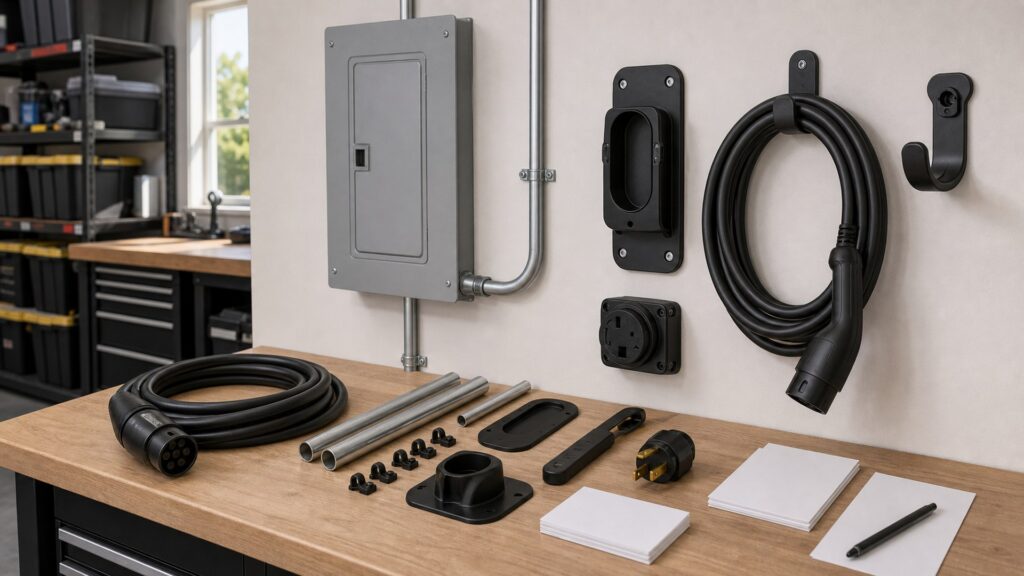
Buying framework
Build the decision in four passes
The sequence moves from site limits to equipment fit, loaded operation, and an inspectable final arrangement. A failed pass removes the product before optional features can distract from the conflict.
Service Load Calculation: Start the electrical site review here. A qualified electrician should evaluate existing service demand instead of inferring spare capacity from the panel label. Record the available boundary before selecting equipment.
Panel And Breaker Space: Resolve this second because it can change the entire layout. An empty breaker position does not prove that the service, bus, feeder, or enclosure can support the planned load. Keep the supporting rating or measurement in the installation worksheet.
Charging Circuit Amperage: Apply the intended charging demand rather than a showroom assumption. The vehicle acceptance rate and daily energy need often allow a smaller practical circuit than the equipment maximum. Exclude any candidate that exceeds the documented limit.
Conductor And Conduit Route: Close the framework with the governing directions. Route length, conductor size, voltage drop, finished walls, and required physical protection all affect installation scope. Proceed only when the exact configuration is expressly supported.
Who this is for
Match equipment to the recurring operating pattern
The right emphasis changes with parking access, energy demand, weather, and who operates the equipment. Use the profile that creates the most frequent constraint at this garage.
Detached-Home Garage Owner: This user should settle service load calculation before comparing hardware. During ordinary charging, track hardwired or receptacle connection and keep the arrangement that requires the fewest special handling steps.
Attached-Garage Household: For this routine, charging circuit amperage is the useful opening screen. Reproduce the longest expected session and observe whether equipment safety listing remains valid from connection through storage.
Older-Service Homeowner: Give this profile a separate check for conductor and conduit route and its controlling documentation. The choice advances only if permit and inspection path stays clear, reachable, and understandable to the operator.
Future Second-Ev Planner: Planning flexibility matters here, but it cannot bypass parking-to-inlet reach. Photograph the accepted layout and schedule a review of future circuit expansion before the return or installation window closes.
What to pay attention to
Read ratings as system limits
A useful specification predicts what happens in the installed charging chain. Translate ratings and dimensions into measurements at the garage, then retain the evidence needed to repeat the check.
Documented boundary
Use product, vehicle, site, and installer information to establish hardwired or receptacle connection.
Operating consequence
Observe load-management option during the full charging and storage sequence, not only while disconnected.
Hardwired Or Receptacle Connection: The equipment instructions and local requirements should decide between permanent wiring and a listed receptacle arrangement. Measure the installed result beside parking-to-inlet reach and note the acceptable range in the installation worksheet.
Equipment Safety Listing: Verify a recognized certification mark on the actual EVSE and confirm that the listing covers its intended use. Confirm the marked or documented limit, then observe whether load-management option changes during connection and removal.
Permit And Inspection Path: Identify permit, inspection, utility, and property-approval steps before buying hardware that may not suit the approved design. Reproduce the highest planned demand and photograph the first point where future circuit expansion would become difficult.
Parking-To-Inlet Reach: Mock up the cable path to each likely inlet position without crossing a driving lane or pulling on the connector. Compare this requirement with service load calculation at the actual mounting position; a catalog maximum does not replace the site result.
Load-Management Option: Managed charging can limit coincident demand when the equipment, controls, and electrical design support it. Use the full cable and vehicle arrangement to test this claim, including the operating condition for panel and breaker space.
Avoid these traps
Avoid assumptions that hide a system conflict
Most costly errors appear when a buyer evaluates one component without its circuit, vehicle, parking position, users, or environment. Resolve each conflict while the design can still change.
Inferring panel and breaker space: A visible panel space, matching plug, or marketing label cannot establish panel and breaker space. Obtain the applicable measurement or documentation for this garage before ordering equipment.
Testing hardwired or receptacle connection without demand: An idle display hides heat, cable force, simultaneous loads, and operator movement. Recreate hardwired or receptacle connection through the intended session while monitoring the related limit at charging circuit amperage.
Improvising around conductor and conduit route: Do not add an extension, adapter, setting, fitting, or routing method merely to make conductor and conduit route appear workable. Use only the complete configuration supported by its governing instructions.
Postponing future circuit expansion: Define who will verify future circuit expansion and when. Early evidence of heat, looseness, water, software failure, or physical damage should trigger correction before another charging session.
Decision guidance
Let the first hard limit narrow the field
Screen candidates in the order that a failure would change the project. Only equipment that clears the documented site, electrical, vehicle, and operating boundaries reaches the convenience comparison.
If service load calculation is limiting: Use the verified range for service load calculation to define the shortlist. Among passing choices, favor the design that keeps equipment safety listing easy to identify and service.
When charging circuit amperage controls capacity: Model the most demanding intended condition for charging circuit amperage. An acceptable option also leaves parking-to-inlet reach stable without a temporary workaround or repeated reset.
Where permit and inspection path controls access: Exclude arrangements that obscure or complicate permit and inspection path. The surviving layout should preserve load-management option for every regular operator and parking position.
If future circuit expansion drives ownership work: Compare the time and access required for future circuit expansion. Favor the candidate that can be examined without moving unrelated electrical equipment or defeating normal cable storage.
Ownership & compatibility
Keep the charging arrangement observable
A passing installation can change as terminals loosen, cables wear, schedules shift, weather enters, or another vehicle joins the site. Short recorded inspections preserve the original safety and compatibility evidence.
Record the accepted state: Save ratings, instructions, installer records, and photographs showing parking-to-inlet reach. After the first demanding session, compare temperature, support, alignment, and equipment messages with that baseline.
Inspect the handled parts: Clean and store connectors and cables as directed, then examine future circuit expansion. Stop using components with damaged insulation, contaminated contacts, looseness, scorching, water entry, or unexplained heat.
Recalculate after a change: A different vehicle, parking position, tariff, charging current, or major household load can alter service load calculation. Repeat the relevant review instead of transferring the old conclusion automatically.
FAQ
Focused questions before installation
These focused checks address decisions that remain after the circuit, vehicle, equipment, and site have been identified.
What establishes service load calculation?
How should I evaluate panel and breaker space?
When does charging circuit amperage eliminate an option?
Which directions govern conductor and conduit route?
How can I test hardwired or receptacle connection?
What makes equipment safety listing credible?
How often should I revisit permit and inspection path?
Can a convenience feature compensate for weak parking-to-inlet reach?
What belongs in the final review of load-management option?
Bottom line
Approve a documented, serviceable configuration
The final choice should fit the real site, remain within every connected rating, and give owners a clear way to notice damage or changed demand. Keep the decision record with the equipment.
Resolve the site limits: Settle the applicable approval requirements first. Retain the measured result for panel and breaker space alongside the established boundary for service load calculation.
Run the intended session: Observe hardwired or receptacle connection, permit and inspection path, and operator movement while the arrangement supplies the expected vehicle demand.
Retain the baseline: Keep the installation worksheet so later checks of future circuit expansion can identify a meaningful change.
Reading Shortcuts
Open the unresolved part of the garage electrical planning decision.
Garage Charging Electrical Plan Checks
Complete these checks at the garage with the intended vehicle and charging demand present.
- Service Load Calculation: Measure the available range.
- Panel And Breaker Space: Follow the applicable instructions.
- Charging Circuit Amperage: Include the completed load.
- Conductor And Conduit Route: Move nearby equipment fully.
- Hardwired Or Receptacle Connection: Record the first conflict.
- Equipment Safety Listing: Keep a reversible exit plan.
Glossary Snippets
Terms that define the installation and operating boundary for garage electrical planning.
When to Use a Top 10 Review
Use a ranked list after service load calculation and permit and inspection path have removed incompatible choices.
- Service Load Calculation: The primary boundary is known.
- Panel And Breaker Space: The permitted interface is documented.
- Charging Circuit Amperage: The loaded condition has been reproduced.
- Conductor And Conduit Route: The recurring ownership demand is understood.
Already down to 2–3 options? A Comparison is usually the faster next step.
When to Use a Comparison
Test two finalists against the same installation worksheet, vehicle, load, and operating sequence.
- Hardwired Or Receptacle Connection: Both candidates preserve this function.
- Equipment Safety Listing: Both remain stable under the normal load.
- Permit And Inspection Path: Both permit direct inspection.
- Parking-To-Inlet Reach: The difference changes a real ownership outcome.
Still exploring? Start with a Top 10 to build a shortlist first.