
How to Choose EV Charging & Electric Vehicle Gear for Garage Electrical Planning
Garage charging adds a long-duration electrical load to a space that may already contain doors, tools, freezers, heat, workshops, storage, and aging wiring. Breaker size alone does not establish available capacity, and an open panel position does not prove the service, conductors, grounding, bonding, equipment location, or utility supply can support the proposed installation.
This guide defines the information a licensed contractor and permitting authority need: charging demand, service and panel condition, load calculation, circuit path, continuous-load treatment under the locally adopted code, protection, hardwired or receptacle connection, equipment working space, impact risk, commissioning, and documentation. It avoids prescribing wiring from a generic product page.
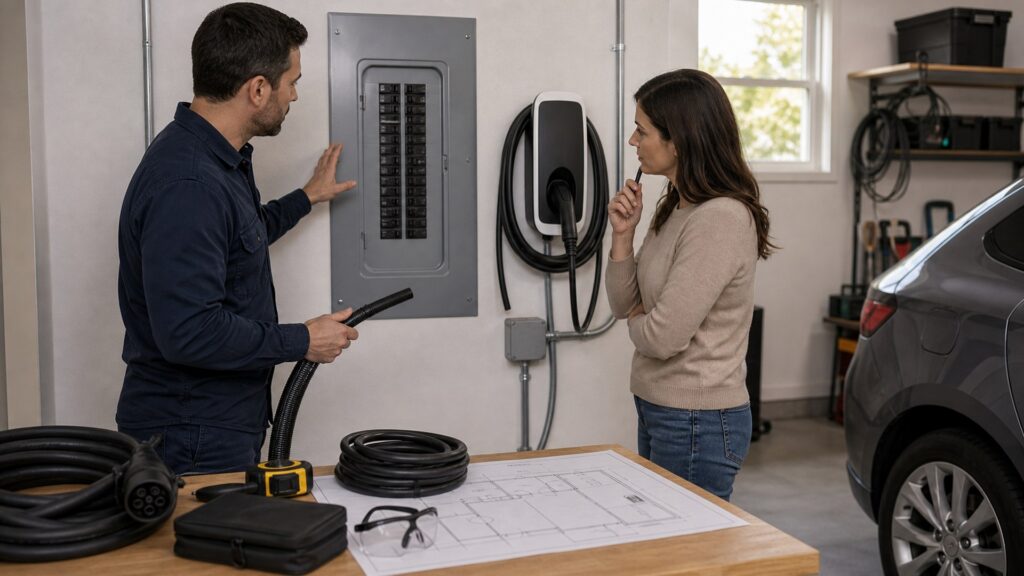
Buying framework
A four-stage test for existing service evidence
Make each stage produce panel evidence that constrains the next one.
Quantify existing service evidence: Quantify existing service evidence with a stated pass condition. Use charging circuit design to reject panel choices whose performance cannot sustain the measured workload.
Confirm charging circuit design: Establish the supported boundary for charging circuit design. Name the approver, source, and corrective action before panel uncertainty reaches route and environment.
Map route and environment: Lay out route and environment at the actual vehicle or site. Include panel movement, access, exposure, and the fault route leading into equipment location.
Test equipment location: Run a realistic trial of equipment location. Confirm commissioning evidence still works when the preferred panel arrangement, control, or service is unavailable.
Who this is for
Match the plan to the user
Workload, authority, parking, and recovery needs separate these buyers.
Garages with modern spare capacity: Confirm the panel schedule against actual equipment, calculated load, conductor route, and termination requirements; an unused breaker position alone proves very little.
Older or altered electrical systems: Budget for investigation of undocumented circuits, obsolete hardware, service condition, bonding, grounding, and previous modifications before selecting charging output.
Detached-garage owners: Account for feeder capacity, trench or overhead routing, voltage drop, communications, weather transitions, physical protection, and the cost of future access.
Renovation and new-build projects: Coordinate charger location, parking geometry, raceway, panel capacity, networking, and commissioning early enough to avoid finished-surface rework.
What to pay attention to
Specifications that change the installed result
Read each characteristic inside the complete panel system.
Existing service evidence: Service size, utility supply, calculated dwelling load, panel rating and condition, spaces, bus limits, and prior modifications
Charging circuit design: Required output, permitted circuit rating, conductors, overcurrent protection, grounding, bonding, disconnects, and local amendments
Route and environment: Distance, walls, finished areas, attic or crawlspace, heat, moisture, physical damage, penetrations, and future service access
Equipment location: Working clearance, mounting surface, vehicle impact, cord reach, garage door, ventilation, ignition or storage concerns, and accessibility
Commissioning evidence: Permit, inspection, torque and settings, labeling, functional and fault tests, photographs, manuals, and as-built records
Avoid these traps
Planning errors that create expensive corrections
These panel failures usually begin before equipment reaches the site.
Using spare breaker space as capacity: Physical space says nothing about calculated load, panel limits, service condition, or utility constraints. Put this using failure in the panel requirements and close it before ordering.
Designing from online wire charts: Method, temperature, terminals, derating, protection, code adoption, and site conditions require professional design. Expose the designing conflict through a realistic panel trial under normal use.
Hiding equipment behind storage: Required access, ventilation, cable handling, inspection, and emergency response cannot depend on moving clutter. Assign a panel reviewer to the hiding gap before the system reaches users.
Skipping final setting verification: Installer and app current limits, vehicle behavior, labels, and circuit rating must agree at commissioning. Define panel recovery from the skipping error; reject unsupported improvisation.
Decision guidance
Choose the least complicated supported route
The supported panel branch meets the measured requirement and remains recoverable.
Use the existing service: The licensed load calculation and inspection support the required charging circuit with adequate margin. This remains the lean panel choice while evidence stays inside every verified panel limit.
Reduce charging output: Measured departure needs are met at a lower verified setting that avoids unnecessary infrastructure. Price the complete panel path, including who operates it, provides panel support, and restores the site.
Use listed load management: A compatible approved system controls charging based on actual building demand. Let a measured panel constraint—not feature appeal—justify the added panel capability.
Upgrade infrastructure: Service, panel, route, condition, future plans, or utility requirements justify coordinated work. Commission the panel option; reject it without proven panel behavior and a usable fallback.
Ownership & compatibility
Keep performance verifiable after installation
Inspection, records, and exit planning protect the original decision.
Keep the electrical record current: Retain the load calculation, permit, inspection, panel and circuit labels, conductor route, torque or test documentation, configured limit, and approved equipment instructions.
Watch the whole route: Inspect the panel, protective devices, raceway, penetrations, disconnects, terminations, charger mounting, and cable area for heat, impact, moisture, or unauthorized changes.
Commission every modification: After service work, firmware changes, or added loads, verify the charging limit, protective operation, fault reporting, and intended vehicle behavior before routine use resumes.
FAQ
Questions buyers ask about existing service evidence
Short answers for unresolved evidence and approval questions.
How should buyers evaluate existing service evidence?
How should buyers evaluate charging circuit design?
How should buyers evaluate route and environment?
How should buyers evaluate equipment location?
How should buyers evaluate commissioning evidence?
How should buyers evaluate using spare breaker space as capacity?
How should buyers evaluate designing from online wire charts?
How should buyers evaluate hiding equipment behind storage?
How should buyers evaluate skipping final setting verification?
Bottom line
A defensible purchase in three checks
Demand, panel fit, and lifecycle responsibility must all remain clear.
Define the need: Base the purchase on measured panel demand and a named pass condition.
Prove the fit: Verify compatibility, panel access, and failure behavior before acceptance.
Own the outcome: Keep inspections, panel support, and replacement planning active.
Reading Shortcuts
Jump to the evidence you need.
Decision Reminders
Keep these checks visible.
- Existing service evidence: Quantify the evidence.
- Charging circuit design: Confirm the evidence.
- Route and environment: Map the evidence.
- Equipment location: Test the evidence.
- Commissioning evidence: Document the evidence.
Glossary Snippets
Terms used in this guide.
When to Use a Top 10 Review
Rank products after compatibility is settled.
- Requirement: Normalize the needed outcome.
- Compatibility: Remove unsupported options.
- Installation: Compare the complete path.
- Ownership: Price support and exit.
Already down to 2–3 options? A Comparison is usually the faster next step.
When to Use a Comparison
Compare finalists under identical verified conditions.
- Same demand: Use one duty cycle.
- Same boundaries: Hold site limits constant.
- Same trial: Observe equivalent use.
- Same horizon: Include lifecycle costs.
Still exploring? Start with a Top 10 to build a shortlist first.