
How to Choose EV Charging & Electric Vehicle Gear for Multi-EV Households
Two EVs turn charging into a scheduling and capacity problem. Nameplate power multiplied by two is rarely the best plan: each vehicle has different efficiency, travel, arrival state, inlet location, acceptance rate, departure time, and backup options, while the home has one service, panel, parking layout, and utility tariff.
This guide builds a shared energy budget before comparing dual-port EVSE, two independent stations, circuit sharing, dynamic load management, vehicle schedules, user priority, cable reach, account access, outage behavior, expansion, and total installed cost. The target is dependable departures without unmanaged coincidence.
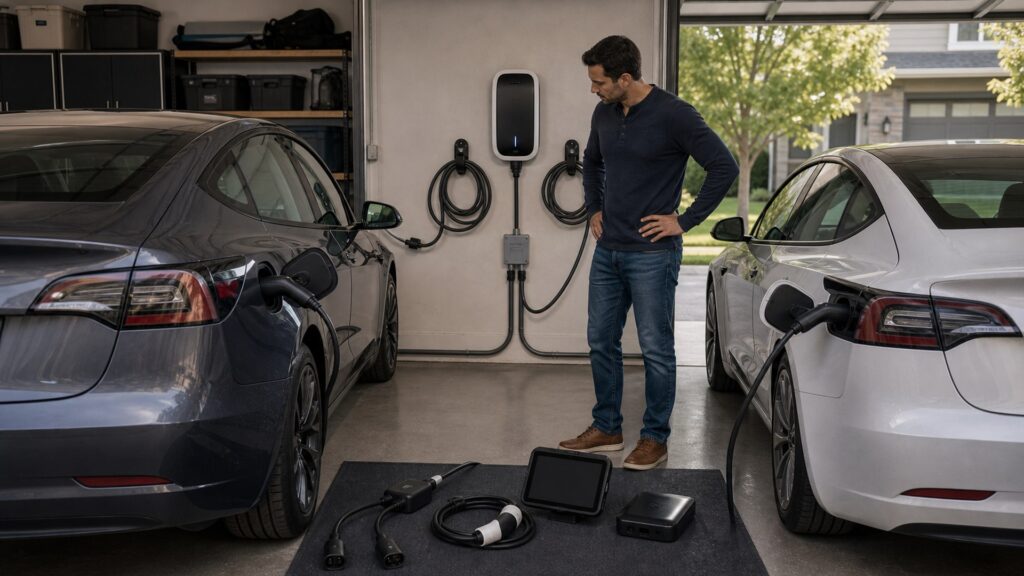
Buying framework
A four-stage test for combined energy demand
Make each stage produce shared evidence that constrains the next one.
Quantify combined energy demand: Quantify combined energy demand with a stated pass condition. Use simultaneous electrical limit to reject shared choices whose performance cannot sustain the measured workload.
Confirm simultaneous electrical limit: Establish the supported boundary for simultaneous electrical limit. Name the approver, source, and corrective action before shared uncertainty reaches parking and connector reach.
Map parking and connector reach: Lay out parking and connector reach at the actual vehicle or site. Include shared movement, access, exposure, and the fault route leading into priority and scheduling.
Test priority and scheduling: Run a realistic trial of priority and scheduling. Confirm system interoperability still works when the preferred shared arrangement, control, or service is unavailable.
Who this is for
Match the plan to the user
Workload, authority, parking, and recovery needs separate these buyers.
Two-car commuter households: Add both vehicles' required departure energy, then allocate limited capacity by leave time and minimum state instead of automatically splitting power equally.
Households with changing parking order: Test every inlet position and cable sweep with both cars present so daily shuffling does not create tension, crossings, or inaccessible connectors.
Mixed vehicle and charger brands: Verify charging standards, account roles, update support, scheduling authority, offline operation, and load-management compatibility across the complete combination.
Families expecting fleet growth: Choose an architecture with documented expansion limits, configurable priorities, usable records, and a service plan rather than buying two isolated maximum-rate stations.
What to pay attention to
Specifications that change the installed result
Read each characteristic inside the complete shared system.
Combined energy demand: Each vehicle’s mileage, efficiency, arrival state, dwell, departure, weather, reserve, and peak recovery
Simultaneous electrical limit: Service and panel calculation, circuit architecture, shared output, dynamic control, and other household loads
Parking and connector reach: Assigned and changing spaces, inlet sides, cable crossing, garage movement, outdoor exposure, and future vehicles
Priority and scheduling: First departure, minimum state, rotation, fairness, override, time-of-use window, and missed-session alerts
System interoperability: Vehicles, EVSE, load manager, utility program, accounts, network, updates, data, and offline behavior
Avoid these traps
Planning errors that create expensive corrections
These shared failures usually begin before equipment reaches the site.
Doubling a single-vehicle design: Coincident load and infrastructure cost rise without proving both vehicles need maximum output. Put this doubling failure in the shared requirements and close it before ordering.
Assuming equal power sharing is fair: Different departure energy and dwell can make a simple half split miss the important trip. Expose the assuming conflict through a realistic shared trial under normal use.
Crossing parking paths with cables: Changing inlet positions create tension, trip hazards, contamination, and damaged connectors. Assign a shared reviewer to the crossing gap before the system reaches users.
Stacking independent schedules: Two cars, chargers, apps, and utility controls can conflict without one priority model. Define shared recovery from the stacking error; reject unsupported improvisation.
Decision guidance
Choose the least complicated supported route
The supported shared branch meets the measured requirement and remains recoverable.
Use one shared connector: Parking and schedules rarely overlap and manual transfer remains dependable. This remains the lean shared choice while evidence stays inside every verified shared limit.
Use a dual-output station: Documented allocation, reach, fault isolation, and support fit both vehicles. Price the complete shared path, including who operates it, provides shared support, and restores the site.
Use two managed stations: Independent access plus coordinated site limits and priorities justify the architecture. Let a measured shared constraint—not feature appeal—justify the added shared capability.
Add electrical capacity: Measured simultaneous need and long-term plans exceed credible managed alternatives. Commission the shared option; reject it without proven shared behavior and a usable fallback.
Ownership & compatibility
Keep performance verifiable after installation
Inspection, records, and exit planning protect the original decision.
Review allocation evidence: Use session records and missed targets to adjust priorities; do not raise site limits until the electrical design and managed-control settings are revalidated.
Test both user journeys: Swap parking positions, accounts, departure priorities, connectors, and overrides so one driver's routine does not conceal a failure affecting the other vehicle.
Plan a coordinated exit: Document device ownership, administrator credentials, data export, load-control dependencies, replacement compatibility, and electrical restoration before a vendor or vehicle changes.
FAQ
Questions buyers ask about combined energy demand
Short answers for unresolved evidence and approval questions.
How should buyers evaluate combined energy demand?
How should buyers evaluate simultaneous electrical limit?
How should buyers evaluate parking and connector reach?
How should buyers evaluate priority and scheduling?
How should buyers evaluate system interoperability?
How should buyers evaluate doubling a single-vehicle design?
How should buyers evaluate assuming equal power sharing is fair?
How should buyers evaluate crossing parking paths with cables?
How should buyers evaluate stacking independent schedules?
Bottom line
A defensible purchase in three checks
Demand, shared fit, and lifecycle responsibility must all remain clear.
Define the need: Base the purchase on measured shared demand and a named pass condition.
Prove the fit: Verify compatibility, shared access, and failure behavior before acceptance.
Own the outcome: Keep inspections, shared support, and replacement planning active.
Reading Shortcuts
Jump to the evidence you need.
Decision Reminders
Keep these checks visible.
- Combined energy demand: Quantify the evidence.
- Simultaneous electrical limit: Confirm the evidence.
- Parking and connector reach: Map the evidence.
- Priority and scheduling: Test the evidence.
- System interoperability: Document the evidence.
Glossary Snippets
Terms used in this guide.
When to Use a Top 10 Review
Rank products after compatibility is settled.
- Requirement: Normalize the needed outcome.
- Compatibility: Remove unsupported options.
- Installation: Compare the complete path.
- Ownership: Price support and exit.
Already down to 2–3 options? A Comparison is usually the faster next step.
When to Use a Comparison
Compare finalists under identical verified conditions.
- Same demand: Use one duty cycle.
- Same boundaries: Hold site limits constant.
- Same trial: Observe equivalent use.
- Same horizon: Include lifecycle costs.
Still exploring? Start with a Top 10 to build a shortlist first.