
How to Choose EV Charging Stations for Multi-EV Households
Two electric cars rarely need a pair of maximum-power chargers. One may return nearly full while the other needs a substantial overnight recovery, and their departure times may be hours apart. The useful question is whether the charging system can deliver the required energy to both vehicles inside the home's electrical limit.
That answer depends on more than port count. Circuit capacity, load-sharing rules, connector reach, parking order, and failure behavior all shape a workable household arrangement. Choose the architecture after mapping a demanding week, including the night when both vehicles arrive low and the rest of the house is using electricity normally.
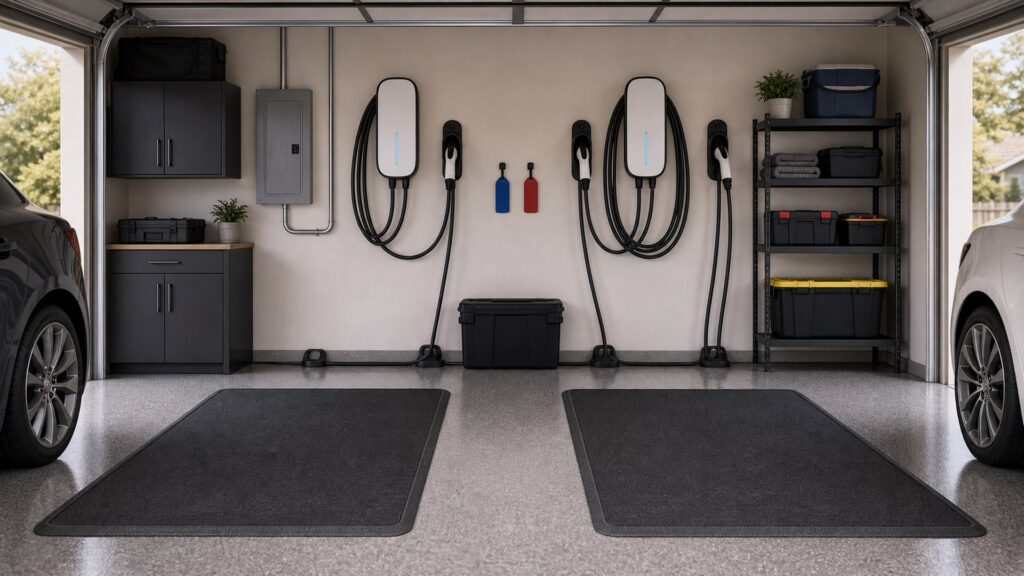
Buying framework
Plan the household before choosing the hardware
Treat the two vehicles as a shared energy schedule. These five questions expose whether the home needs two independent circuits, managed sharing, or simply better timing.
Start with energy, not amperage: Record typical weekday mileage, unusually long days, arrival state of charge, and required departure range for each car. The resulting kilowatt-hour targets are more useful than assuming both vehicles need a complete refill every night.
Find the true overlap: Draw the hours when each vehicle is home and available to charge. A long common window often makes moderate shared power sufficient, while two early departures can justify more simultaneous capacity.
Set an electrical ceiling: Have the dwelling load calculation establish what the service and proposed circuits can support. Load management can allocate an approved limit; it does not create capacity that the electrical design never allowed.
Walk both parking orders: Park the cars in every arrangement the household actually uses. Check inlet position, door clearance, cord slack, wall storage, and the route people take through the garage or driveway.
Decide what must keep working: Consider a lost internet connection, failed shared controller, disabled app account, or one damaged cable. The preferred design should leave an understandable way to charge at least one vehicle safely.
Who this is for
Four households, four different bottlenecks
Daily travel and parking discipline change the value of extra hardware. Identify the pattern that resembles the household on its difficult days, not its easiest weekend.
Two fixed-shift commuters: Reliable morning readiness dominates. Give the earlier departure a protected energy target, then let the later car use the remaining window rather than assigning both an arbitrary equal share.
EV plus plug-in hybrid: The plug-in hybrid may need less energy and can often charge on a lower-power connection. That asymmetry can reduce installation cost while preserving the battery-electric car's longer overnight session.
Tandem driveway users: Parking order is the real design constraint. A second connector is not useful if reaching the rear car requires stretching a lead along the ground or moving a charged vehicle before dawn.
Household expecting a third EV: Reserve conduit routes, wall space, and compatible controls, but do not oversize today's station without an approved electrical plan. Expansion should be a documented path rather than a marketing promise.
What to pay attention to
Read the power-sharing details closely
Product pages often state a total current without explaining how that current moves between ports. The control rules and installed circuit arrangement determine what each driver experiences.
Electrical sharing
Look at the hard current boundary and how power is reassigned, not merely the total amperage printed on both units.
Household choreography
The system also has to work when cars swap places, arrive late, and need different departure times.
Maximum shared current: Confirm the installed limit and whether it applies across one enclosure, several networked stations, or a separate energy controller. The label should agree with the electrician's configured value.
Allocation method: Some systems split current evenly; others release unused power to the active car or honor priorities. Match the behavior to departure needs and verify that the rule continues without cloud access.
Minimum operating current: A vehicle may stop charging if its assigned current becomes too low. Review the station's sharing documentation so a two-car session does not oscillate, stall, or repeatedly restart.
Vehicle acceptance rate: A car controls how much AC power it can accept. Paying for a higher-output station cannot make an onboard charger exceed its own limit, although extra site capacity may help the second vehicle.
Cord length per port: Measure usable reach from the mounted holster, including vertical drop and relaxed handling slack. Two nominally long cords can still serve only one parking orientation safely.
Local controls and records: A clear status display, physical or local override, and session history help diagnose a missed charge. Avoid making basic recovery dependent on one household member's phone.
Avoid these traps
Where two-car plans go wrong
The most expensive errors begin with an idealized routine. A sound plan allows for late arrivals, cold-weather energy use, visitors, and a driver who needs an unexpected trip.
Adding the breaker labels: Two breaker ratings do not prove the service can support both charging loads at once. Capacity belongs to the complete dwelling calculation, not the empty spaces visible in a panel.
Programming every device: Vehicle timers, station schedules, utility events, and a home energy manager can all delay charging. Give one system scheduling authority and document how a driver makes a one-time change.
Assuming cars always park correctly: A safe cable path must survive the rushed or reversed parking job. If one swapped position creates a drive-over cord or trip hazard, change the mounting plan before installation.
Confusing fairness with readiness: An equal current split can be a poor rule when one car leaves at 5 a.m. and the other at 9 a.m. Allocate energy against deadlines, then use remaining capacity where it helps.
Decision guidance
Choose an architecture that matches the pressure point
Use the household's hardest constraint to select among a dual-port unit, paired managed stations, or independent connections. Each option trades simplicity, redundancy, and electrical flexibility differently.
When one circuit is the practical limit: A listed dual-port station or compatible managed pair can share that boundary. Confirm the maximum combined current, the allocation rule, and the behavior after power or network loss.
When departures regularly coincide: Ask the electrical designer whether greater simultaneous capacity is justified by actual energy targets. Two circuits may help, but only when the service calculation and installation support them.
When uptime outweighs tidy installation: Independent stations can reduce a single hardware failure, provided the electrical plan manages their combined demand. Keep cords and controls separate enough that one fault does not confuse both users.
When the vehicles use different connectors: Favor native supported cables at their usual stalls. If an adapter remains necessary, verify vehicle and station documentation and store it where dirt, moisture, and cable weight cannot stress the connection.
When routines change every week: Prioritize visible local controls and deadline-based scheduling over elaborate automation. A driver should be able to request extra energy without erasing the household limit or another car's protected target.
Ownership & compatibility
Keep the shared plan current
The original design can become wrong without any hardware failure. A new commute, replacement vehicle, utility tariff, or parking habit deserves a small commissioning review.
Review charging outcomes: Once a month, compare delivered energy, missed targets, simultaneous sessions, and manual overrides. Patterns reveal whether the allocation rule still matches real departures.
Inspect both cord paths: Look for tire marks, flattened jacket sections, strained connectors, loose holsters, and new obstacles. Wear concentrated in one place usually points to a routing problem rather than careless users.
Reassess material changes: Repeat the load and compatibility checks after adding another EVSE, replacing a vehicle, installing a major electrical load, or changing the service. Preserve the approved configuration with the household records.
FAQ
Questions from two-EV households
These answers address the practical gaps that remain after energy needs, capacity, and parking positions are known.
Do two EVs require two Level 2 circuits?
Is a dual-port charger less reliable than two separate units?
Can one EV charge after the other finishes automatically?
How much charging power should each car receive?
Should both charging cords be the same length?
What happens when home Wi-Fi fails?
Can an EV and plug-in hybrid share one station?
Does a second EVSE always increase the home's peak demand?
When should the household redo its charging plan?
Bottom line
Design around the night when both cars need help
A two-EV system succeeds when it delivers required energy within the home's real capacity and remains simple for every driver to operate. Port count alone answers neither question.
Protect the deadlines: Translate travel into energy-by-departure targets, then choose sharing rules that honor the earlier need without wasting the rest of the charging window.
Prove the physical layout: Test both parking orders with relaxed cable routes and visible connector storage. Geometry should work without a daily workaround.
Preserve a fallback: Know how one car can charge when connectivity, a shared controller, or the other station is unavailable. That recovery path is part of the purchase decision.
Reading Shortcuts
Jump to energy sharing, parking, or the household fallback.
Before You Commit
Complete these checks with both cars parked and connected.
- Combined overnight energy: Write down the demanding requirement.
- Coincident demand: Confirm the installed electrical boundary.
- Load-sharing behavior: Read the control behavior, including offline operation.
- Parking geometry: Reproduce the physical route at the parking space.
- Failure independence: Identify the consequence of one failed component.
Terms in This Guide
Definitions for the two-car energy and charging arrangement.
When a Top 10 List Helps
Browse a ranked list after combined demand and both cable routes are known.
- Combined overnight energy: The actual demand is documented.
- Coincident demand: The electrical limit is established.
- Parking geometry: The site geometry has been measured.
- Failure independence: The important failure mode is understood.
Already choosing between finalists? A Comparison is the more focused format.
When to Compare Two Finalists
Compare finalists only after both meet the home's shared-current plan.
- Coincident demand: Both remain inside the approved boundary.
- Load-sharing behavior: Their control rules are stated clearly.
- Parking geometry: Each works in the measured parking layout.
- Connector strategy: The remaining difference affects daily use.
Need a broader shortlist first? Visit the Top 10 collection.