
How to Choose EV Power Management for Adapter and Connector Compatibility
Power-management software can divide available current accurately and still make the wrong decision when it assumes every connected port has the same usable capability. An adapter may introduce a lower rating, a different charging mode, thermal derating, or a vehicle-specific authorization step.
The controller needs trustworthy inputs from the complete connection, not merely a plug-present signal. Confirm the exact vehicle, EVSE, cable, adapter, software, and station policy before using that port in an allocation plan. During operation, status should separate intentional curtailment from heat-related reduction, failed authorization, or incomplete connector engagement.
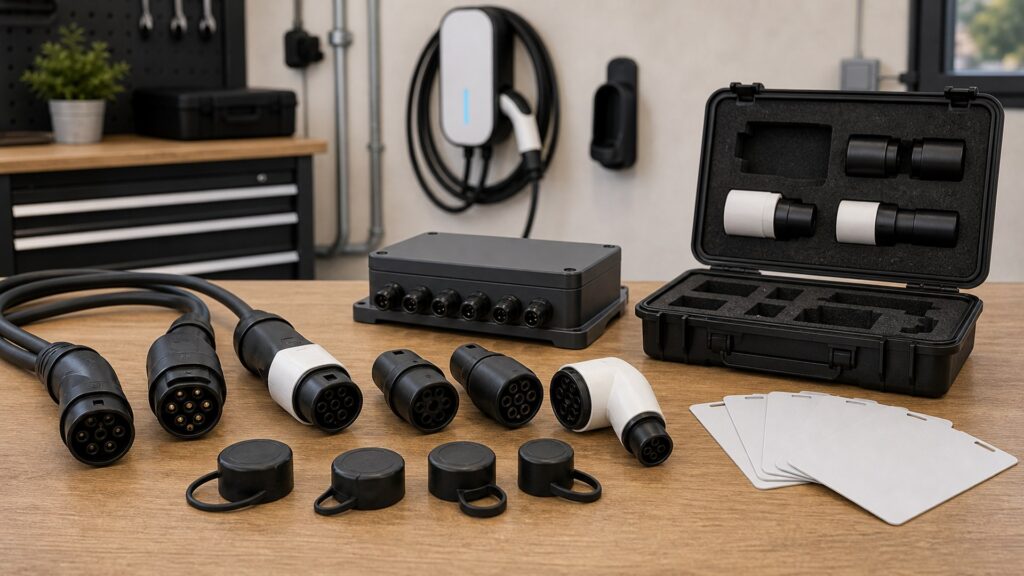
Buying framework
Build a capability table before allocation rules
List every supported connection at the site, then give the manager only limits that are documented for the complete chain.
Identify native interfaces: Record each vehicle inlet, charging mode, accepted power, port location, and supported station connection by model year.
Add adapters as separate configurations: Document direction, AC or DC use, ratings, temperature limits, weather restrictions, software, and network approval for each adapter.
Use the lowest valid limit: The manager should allocate no more than the most restrictive supported component can use. Unused capacity can then move elsewhere.
Name failure signals: Map how the vehicle, EVSE, adapter, and controller report derating, latch trouble, authorization failure, or lost communication.
Who this is for
Mixed connections create different management needs
The value of adapter awareness depends on how often the non-native connection is used and how costly a failed session would be.
Mixed-brand household: A supported adapter may cover the occasional second car. Keep the daily vehicle on a native connection when possible and assign conservative limits clearly.
Transition-period fleet: Vehicles arriving with different inlets need a maintained capability matrix. Driver training and port assignment matter as much as software.
Public multi-standard site: Unknown vehicles and networks increase authorization and support demands. Avoid implying that physical fit guarantees usable power.
Legacy vehicle operator: Lower acceptance rates may make high allocations wasteful. The controller should release unused current without treating the car as faulty.
What to pay attention to
Power limits can change after connection
The manager should respond to the rate the complete chain can actually sustain, while preserving safe site demand.
Declared capability
Use documented vehicle, EVSE, connector, adapter, and charging-mode limits as the allocation inputs.
Observed session behavior
Distinguish managed curtailment from derating, authorization failure, or an incomplete mechanical connection.
Per-port configurable ceiling: Set a documented maximum for the specific native or adapted path rather than one value for every connector.
Dynamic derating visibility: When temperature or vehicle behavior reduces power, status should distinguish that event from site-level curtailment.
Port identity persistence: Logs and priorities should remain tied to the correct physical port when cables or approved adapters are changed.
Mode-aware controls: AC current commands do not translate directly to DC charger behavior. Confirm support for each charging family.
Authorization state: The controller should not reserve scarce capacity indefinitely for a vehicle that cannot authenticate or complete its handshake.
Avoid these traps
Connector shape is not a power-management input
Allocation errors grow from simplified assumptions about fit, rating, and permission.
Copying the EVSE rating to the adapter: The complete path may have a lower limit. Enter only the supported value for the exact assembly.
Combining AC and DC rules: These modes use different equipment and control behavior. Treat each as its own managed resource.
Calling every power reduction site curtailment: Heat, vehicle acceptance, or connection trouble may be responsible. Preserve diagnostic detail instead of masking it behind one status.
Planning around announced compatibility: Use released documentation and current network permission. Future support should not control today's electrical or dispatch plan.
Decision guidance
Use native connections for repeated critical service
Adapters are easier to manage when their purpose, limits, and inspection routine are narrow.
For daily home charging: Favor a native connector for the primary vehicle. Configure any approved adapter path separately for occasional use.
For fleet assignments: Match vehicles to ports using a maintained capability table, then let priorities operate only among valid connections.
For high-power DC charging: Confirm adapter, vehicle, charger, software, thermal, and network support before assigning dispatch-critical energy.
For outdoor adapted connections: Apply the strictest environmental permission across every component and keep cable weight from stressing the adapter.
For unresolved documentation: Remove the path from managed service until the responsible manufacturers or operator confirm its exact use.
Ownership & compatibility
Keep capability data and hardware condition aligned
An allocation table becomes unsafe when adapters, firmware, or vehicles change without review.
Inspect adapters and contacts: Remove equipment for cracks, looseness, bent contacts, damaged seals, scorching, contamination, or abnormal heat.
Update the connection matrix: Record vehicle, adapter, station, mode, rating, software, and network changes before revising priorities.
Investigate repeated derating: Compare connector temperature, vehicle acceptance, station faults, and site allocation rather than increasing limits or swapping adapters casually.
FAQ
Adapter-aware power-management questions
These answers distinguish connection capability from the site's own current allocation.
Can a power manager detect which adapter is connected?
Should adapter current ratings be entered manually?
Why does an adapted vehicle receive less power than allocated?
Can AC and DC ports share one site power limit?
Does physical connector fit prove the manager can control the session?
How should unused vehicle acceptance capacity be handled?
What happens if an adapter overheats?
Can network policy override a technically compatible connection?
When should the managed capability table be reviewed?
Bottom line
Allocate only to proven connections
Power management should use the capability of the entire charging chain, not the appearance or headline rating of one component.
Document each path: Vehicle, mode, adapter, station, and permission belong in one record.
Respect the lowest limit: Move unused capacity instead of forcing a connection beyond support.
Preserve diagnosis: Separate site curtailment from heat, handshake, and authorization problems.
Retire stale assumptions: Update control settings whenever hardware or support changes.
Reading Shortcuts
Go to connection records, derating, authorization, or decisions.
Before You Commit
Verify these points for every native and adapted path.
- Native connection data: Name the exact charging mode.
- Adapter operating limit: Use the lowest supported rating.
- Charging-mode support: Keep port identity in the logs.
- Vehicle acceptance: Separate curtailment from connection faults.
Terms in This Guide
Terms describing adapter-aware power allocation.
When a Top 10 List Helps
Rank systems after all connection capabilities are documented.
- Native connection data: Native interfaces are recorded.
- Adapter operating limit: Adapter limits are explicit.
- Charging-mode support: Vehicle acceptance is known.
- Vehicle acceptance: Authorization has a fallback.
Already comparing finalists? Use a Comparison for a narrower decision.
When to Compare Two Finalists
Compare finalists with the same vehicle, adapter, port, and failure tests.
- Adapter operating limit: Both preserve mode-specific controls.
- Charging-mode support: Both display derating causes.
- Vehicle acceptance: Both protect capability settings.
- Thermal response: The difference affects diagnostic confidence.
Need a broader shortlist first? Visit the Top 10 collection.