
How to Choose Exercise Bikes for Small Spaces
Exercise bikes are among the smaller cardio machines, but a listed footprint still omits the rider's knees, mounting side, saddle travel, ventilation, and the route needed to move or repair the unit. Small rooms fail through those missing inches, not usually through cabinet width alone.
Format changes the geometry. The 48-by-24-inch Concept2 BikeErg needs a recommended 60-by-48-inch use area; the Schwinn IC4 measures 54.6 by 30.7 inches; Schwinn's 230 recumbent extends to 64 inches. Compare a taped operating envelope, not the product silhouette, and reject any model that requires unsafe daily lifting or blocks a household path.
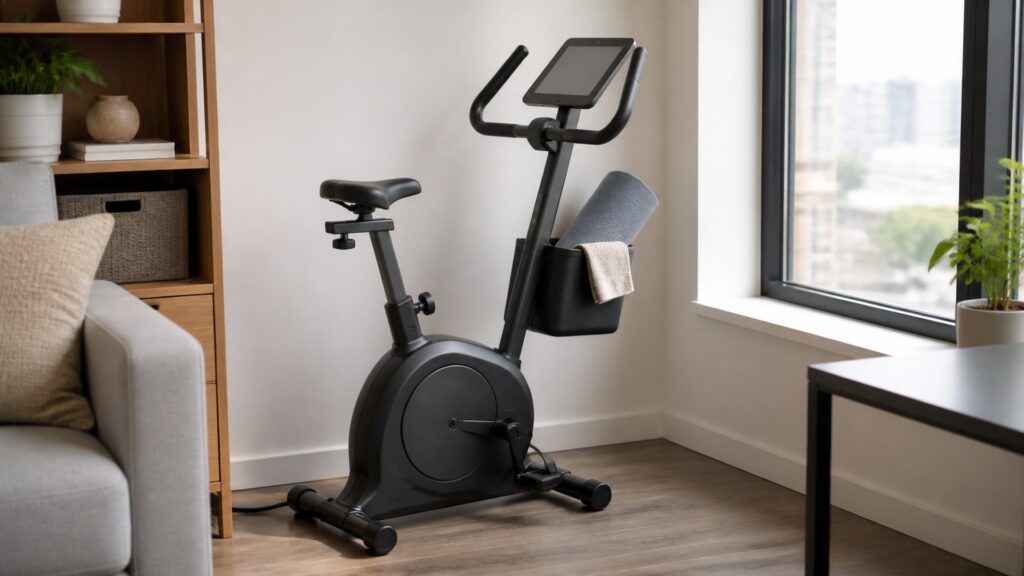
Buying framework
Treat compact-bike shopping as a geometry problem
The bike, rider, adjustments, room traffic, and service points must fit at the same time.
1. Choose the shortest suitable format: Decide whether an upright or indoor cycle supports the intended posture before favoring its shorter cabinet. A recumbent may be easier to enter for some riders but requires substantially more floor length.
2. Draw the moving envelope: Add knees, elbows, moving handles, saddle and handlebar travel, mounting side, dismount, ventilation, bottle reach, screen angle, and fan. Keep the outline clear of doors and emergency paths.
3. Calculate height: Combine maximum saddle or rider elevation, the tallest user's seated height, shoes, and comfortable overhead margin. Check lights, shelves, sloped ceilings, and off-bike movements shown by connected classes.
4. Rehearse every transition: Move from parked room to adjusted bike, complete a ride, wipe it, and return the space. Include transport wheels, thresholds, cords, accessories, and the strength required to stabilize the machine.
5. Protect maintenance access: Locate pedals, cranks, adjustment posts, levelers, power inlet, drive cover, and serial label. Document how a technician can work and how the bike can leave the room.
Who this is for
Compact bike formats and their hidden space costs
A shorter exercise bike can still demand difficult mounting, wider stabilizers, or storage steps that undermine the room plan.
Compact upright: A vertical console and high saddle can reduce floor length. Check step-over, saddle pressure, handle reach, knee-to-console clearance, stability, and whether the shortest rider can use it without overextending.
Indoor cycle: A narrow body can fit a small workout corner, but stabilizer width, forward knees, sweat zone, standing efforts, and shoe storage expand the installation. Heavy frames resist casual relocation.
Bike ergometer: The BikeErg combines a 48-inch cabinet with a specified 60-by-48-inch use area and 68-pound mass. Fan sound and permanent assembled storage may matter more than the short listed length.
Recumbent bike: A backrest and low entry can benefit selected riders, yet a 64-to-66-inch cabinet consumes valuable length. Sliding-seat access and side entry also need clearance that cannot sit under furniture.
Mini pedal exerciser: A portable pedal unit saves frame space but is not equivalent to a stable full bike. Chair movement, knee clearance, resistance behavior, posture, and floor grip require separate evaluation.
What to pay attention to
Small-room measurements worth recording
Measure the installed cycling routine, including the body and every repeated adjustment or storage action.
Assembled dimensions: Record length and maximum stabilizer width rather than the narrow drive casing. Confirm whether dimensions include console, device holder, pedals, seat at midpoint, and any moving arms.
Rider envelope: Tape forward knee travel, elbow width, standing movement when allowed, and the mounting side. A wall can clear the frame while forcing an unsafe twist during entry.
Adjustment travel: Extend saddle and handlebars through every household setting. Rearward seat travel, high posts, rotating screens, and adjustment handles can collide with walls before marked fit limits are reached.
Machine mass: Compare product weight with the actual route, floor, transport-wheel design, and the user's handling ability. A compact 100-pound indoor cycle remains a substantial object on carpet or across thresholds.
Power and accessories: Reserve space for the adapter, outlet, phone or tablet, shoes, bottle, towel, fan, sensor, and approved cleaner. Loose supplies should remain outside pedal travel and walkways.
Sound concentration: Small rooms place the rider near walls and often share floors or bedrooms. Warm the bike, vary cadence, and listen for mechanical sound and vibration at the affected location.
Repair clearance: Leave reach to levelers, pedals, cranks, drive covers, adjustment posts, and electronics. A few saved inches can become expensive when routine tightening or diagnosis requires removal.
Avoid these traps
Compact-bike claims that need a room test
Small-space exercise-bike buyers are often misled by cabinet dimensions, transport wheels, or unrealistic storage plans.
Choosing the narrowest body: Stabilizers, pedals, rider elbows, and safe side entry can determine usable width. Measure the widest operating point rather than the center casing.
Parking against the wall: A wall may block saddle adjustment, rearward knees, screen movement, ventilation, cord routing, cleaning, or cover removal. Preserve every function required by the manual.
Calling wheels portable: Small transport wheels support controlled repositioning on suitable floors; they do not make stairs, carpet, sharp turns, or lifting safe. Test the exact route.
Moving the bike for every ride: Repeated deployment adds time, floor wear, cord handling, and collision risk. A slightly larger permanent location may produce a more usable routine.
Sacrificing fit for length: A cramped pedal circle, restricted saddle range, or awkward reach is not a worthwhile compactness trade. Body fit remains the first rejection test.
Decision guidance
Use cardboard, tape, and a weighted move test
A physical exercise-bike room simulation exposes knee, access, and handling conflicts that a product photo hides.
Tape the stabilizers: Mark the exercise bike's exact assembled length and maximum width in the intended orientation while keeping permanent furniture and door swings unchanged.
Add the rider: Extend the outline for knees, elbows, mounting, dismount, bottle reach, fan, and all saddle or handlebar positions used by the household.
Build vertical references: Use boxes or removable tape to represent saddle, console, screen, and tallest rider height. Check shelves, lights, windows, and viewing angles.
Move comparable weight: Only when safe, test the planned floor route with a controllable object or seller demonstration of similar mass. Include carpet, thresholds, turns, and storage orientation.
Leave the outline in place: Use the room normally for several days. Open doors, carry laundry, reach cabinets, and follow nighttime paths before approving the bike location.
Ownership & compatibility
Keep a compact installation from shrinking further
Dust, bike migration, accessory creep, and blocked service points quickly consume a carefully measured small-room plan.
Recheck levelers: Inspect every floor contact after assembly, relocation, or hard cycling. Correct rocking according to the manual before vibration moves the bike toward a wall.
Control accessories: Store shoes, bottle, towel, sensor, fan, and cleaner in a defined ventilated location. Do not let convenient piles invade pedals, vents, entry, or the room's walking route.
Clean narrow gaps: Remove dust and sweat from reachable areas using approved methods. Move the bike only through the documented transport procedure rather than dragging it sideways.
Preserve adjustment travel: Keep wall gaps and stored items clear of saddle, handlebar, and screen movement. A new rider should not lose fit range because the room gradually fills.
Retain an exit plan: Save the exercise bike's package dimensions, assembly steps, tool requirements, door measurements, and mover contacts for repair, return, relocation, or responsible disposal.
FAQ
Small-Space Exercise Bike FAQ
Answers focus on dimensions, rider movement, relocation, height, sound, and service.
What type of exercise bike uses the least space?
How much extra space should I add around a bike?
Can an exercise bike fit in a closet?
Are exercise bikes easy to move?
Is a recumbent bike too large for a small room?
How do I measure ceiling clearance for a bike?
Can I place an exercise bike next to a wall?
Will a compact bike be quiet?
What should I measure for delivery?
Bottom line
Approve the envelope, not the silhouette
A small-space exercise bike succeeds when the rider, room, routine, and repair path all fit without repeated improvisation.
Body: The compact format still supports comfortable cycling geometry.
Room: Knees, access, adjustments, and traffic clear the taped zone.
Handling: Any planned movement is safe and realistic on the actual floor.
Service: Cleaning and repair points remain reachable after installation.
Compact Bike Route
Use these checkpoints before comparing compact bike products.
Compact Bike Boundaries
Compact cycling still requires complete body fit and a stable operating zone.
- Narrow is not complete: Measure stabilizers.
- Wheels are not lifting aids: Check the route.
- Walls consume adjustment: Extend every setting.
- Service needs inches: Leave cover access.
Compact Bike Terms
Terms used in this compact bike guide.
When a Compact Bike Ranking Helps
Compact-bike rankings should publish operating geometry, not just cabinet size.
- Best suited for: Look for stabilizer width, rider envelope, adjustment travel, machine mass, transport testing, sound conditions, and service clearance.
- Known drawback: Shortest-bike lists can reward poor fit, unstable frames, unusable wall placement, or a relocation routine that buyers cannot sustain.
Method: small-room geometry analysis using current bike dimensions and manufacturer clearance disclosures; no Review Streets hands-on test. Verified September 18, 2026. Sources: Concept2 BikeErg, Schwinn comparison, and current product manuals.
Compare Compact Bike Finalists
Compare compact finalists inside the exact room plan.
- Evidence check: Use dimension drawings, taped envelopes, rider trials, weighted handling checks, and current manuals.
- Ownership check: Price delivery, floor protection, storage hardware, accessories, service access, labor, and removal.
Reject any compact bike that blocks a route, loses rider fit, or must be handled unsafely before each session.