
How to Choose Exterior Accessories & Protection for Paint and Body Protection
Paint and body protection should be mapped to a specific kind of wear. Gravel strikes leading surfaces, shoes scuff sills, luggage crosses bumper lips, doors contact nearby objects, and wheel spray carries grit along rocker panels. One broad promise of protection does not address all those mechanisms.
Decide whether the solution must absorb abrasion, deflect debris, or create a durable loading surface. Then inspect finish compatibility, coverage edges, attachment, and cleaning access. Film and trim protect only while they remain stable and clean; a lifted edge, hard contact point, or dirt-filled pad can mark the clear coat it was installed to preserve.
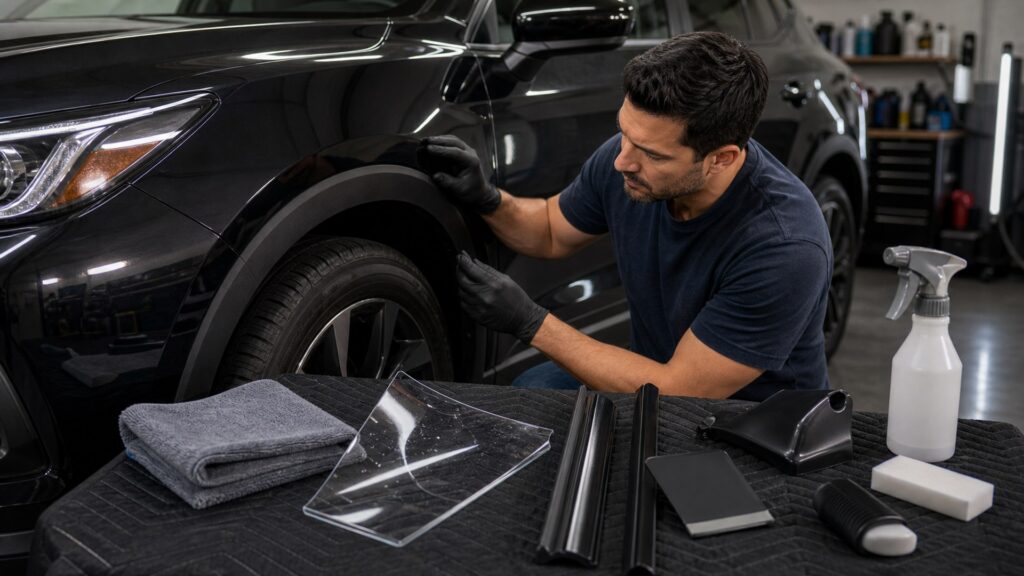
Buying framework
Protect the exact wear path
Begin with evidence on the vehicle and how the damage occurs. Choose the least intrusive layer that interrupts that mechanism.
Map the zone: Mark chips, polished edges, shoe paths, cargo contact, and wheel-spray staining rather than protecting arbitrary panel rectangles.
Choose the mechanism: Use sacrificial film for abrasion, deflectors or splash guards for debris paths, and robust pads for repeated loading contact.
Respect the substrate: Confirm original paint, repaint history, clear-coat condition, texture, coatings, and plastic type before adhesive installation.
Design for inspection: Edges and contact pads should remain visible and cleanable so lift, grit, and paint rub are caught early.
Who this is for
Match coverage to the way the vehicle is used
Protection should follow repeated behavior, not fear of every possible mark. These profiles emphasize different zones.
Highway commuters: Leading hood, mirror caps, bumper faces, and rocker areas see repeat stone and spray exposure. Partial film and shaped splash control can target those paths.
Family and pet loading: Door sills, rear bumper lips, liftgate openings, and handle cups receive shoes, claws, and bags. Durable, cleanable sacrificial coverage matters more than maximum gloss.
Urban parking: Door edges and bumper corners face low-speed contact. Slim guards must fit securely without holding water or creating a hard abrasive line.
Appearance-focused owners: Optical clarity, edge placement, texture match, yellowing resistance, and controlled removal matter. Professional film installation is valuable on complex curves or high-visibility panels.
What to pay attention to
Surface details that decide long-term appearance
Thickness and gloss are incomplete without adhesive, edge, and substrate behavior. Evaluate the entire interface.
Coverage & Appearance
Impact zone, seam placement, clarity, texture, gloss, and visible edges.
Adhesion & Removal
Surface condition, adhesive system, temperature, edge lift, contamination, and removal method.
Pattern coverage: Precut patterns reduce cutting near paint but may leave wider visible margins; wrapped edges hide lines but require suitable access and preparation.
Film construction: Topcoat, base film, adhesive, and total thickness affect clarity, stain resistance, conformability, and impact behavior together.
Protector edge profile: Tapered, supported edges reduce snagging and dirt collection. Thick hard edges at cargo paths can become a new impact point.
Finish compatibility: Obtain guidance for repainted, repaired, oxidized, matte, textured, or coated surfaces before bonding anything.
Cleanability: Choose shapes that allow washing at seams, around fasteners, and beneath removable pads without driving grit deeper into the contact zone.
Avoid these traps
Protection that becomes a paint defect
Damage usually begins at an edge or hidden contact point. Installation and cleaning are part of performance.
Installing over contamination: Film or trim traps particles and makes defects permanent or abrasive. Decontaminate and inspect the surface before coverage.
Extending beyond the real zone: Unnecessary seams add visible edges and future removal without preventing meaningful wear. Place material where the mechanism actually occurs.
Letting hard parts move: A loose guard, pad, or rack foot repeatedly polishes paint. Eliminate movement and use only the specified isolator.
Ignoring repaint history: Adhesion and removal can differ on repaired panels. Ask the installer or repairer before applying large bonded coverage.
Decision guidance
Choose film, deflection, or a contact pad
Each product family addresses a different path to damage. Combine them only when edges and mounts stay independent.
If stones strike painted leading surfaces: Use quality film with suitable coverage and clean edges; a deflector may supplement but cannot guarantee chip elimination.
If tire-thrown grit marks lower panels: Use shaped splash control and targeted rocker film while preserving tire clearance and cleanable mounting pockets.
If cargo crosses one body edge: Choose a contour-matched bumper or sill protector that spreads contact and does not create a grit-catching lip.
If occasional contact is unpredictable: Prefer careful loading and parking habits plus targeted sacrificial zones. Broad hard trim may add more contact edges than it prevents.
Ownership & compatibility
Keep edges clean and movement at zero
Protection remains beneficial only while adhesion and contact surfaces are stable. Inspect before defects travel under the product.
Wash gently at edges: Use methods compatible with the film or trim and avoid forcing high pressure beneath lifted edges.
Respond to movement: Remove and correct loose pads, guards, or mounts as soon as witness marks, noise, or polished paint appears.
Plan controlled replacement: Replace heavily abraded, lifted, cracked, or stained sacrificial material using appropriate temperature and removal technique for the finish.
FAQ
Paint and body protection questions
These answers clarify coverage, compatibility, and upkeep.
Does paint protection film prevent dents?
Can film be installed over ceramic coating?
Is precut film safer than cutting on the vehicle?
Will door-edge guards trap water?
How do splash guards help protect paint?
Can bumper protectors scratch the paint underneath?
Should new paint cure before adhesive protection is applied?
When should paint protection film be replaced?
Is professional installation necessary for small protectors?
Bottom line
Protect paint without hiding a new abrasion source
Good protection targets a known wear mechanism and stays stable, clean, and removable. More coverage is not automatically safer.
Map the wear: Separate chips, scuffs, cargo drag, door contact, and wheel spray.
Match the layer: Use film, deflection, or a hard protector where its mechanism fits.
Inspect the interface: Keep edges clean, stop movement, and replace sacrificial material before failure spreads.
Reading Shortcuts
Move from paint-wear mapping priorities to a usable configuration.
Decision Reminders
Check the vehicle system, not one product claim.
- Zone: Protect the actual wear path.
- Mechanism: Absorb, deflect, or shield.
- Finish: Verify paint and coating condition.
- Edges: Keep them stable and clean.
- Movement: Stop rub immediately.
- Removal: Plan for finish-safe replacement.
Glossary Snippets
Terms that clarify the important tradeoffs.
When to Use a Top 10 Review
Shortlist paint-wear mapping products only after the governing vehicle limits and useful format are settled.
- Need defined: The recurring task is specific.
- Vehicle checked: Limits and interfaces are known.
- Format chosen: The product family is settled.
- Need options: Several valid designs remain.
Have finalists already? Open a Comparison for a closer tradeoff.
When to Use a Comparison
For paint-wear mapping, rank competing designs against one defined vehicle and operating task.
- Fit: Both match the application.
- Duty: Both support the same load.
- Tradeoff: Convenience and protection differ.
- Upkeep: Inspection needs differ.
Need a broader field? Use a Top 10 to form a shortlist.