
How to Choose Exterior Accessories & Protection for Weather and Road Protection
Weather protection is not one problem. Sun attacks exposed polymers and finishes, road salt concentrates in wet seams, gravel chips leading surfaces, and tires throw an abrasive mix of water and grit along rocker panels. Effective accessories begin with the exposure zone rather than a promise to protect the whole vehicle.
Choose whether the part must deflect debris, absorb abrasion, shield an opening, or cover a parked surface. Then examine clearance, drainage, attachment, and access for cleaning behind it. A broad guard can reduce spray yet become harmful if it rubs paint, packs with snow, blocks a drain, or hides salt against unprotected hardware.
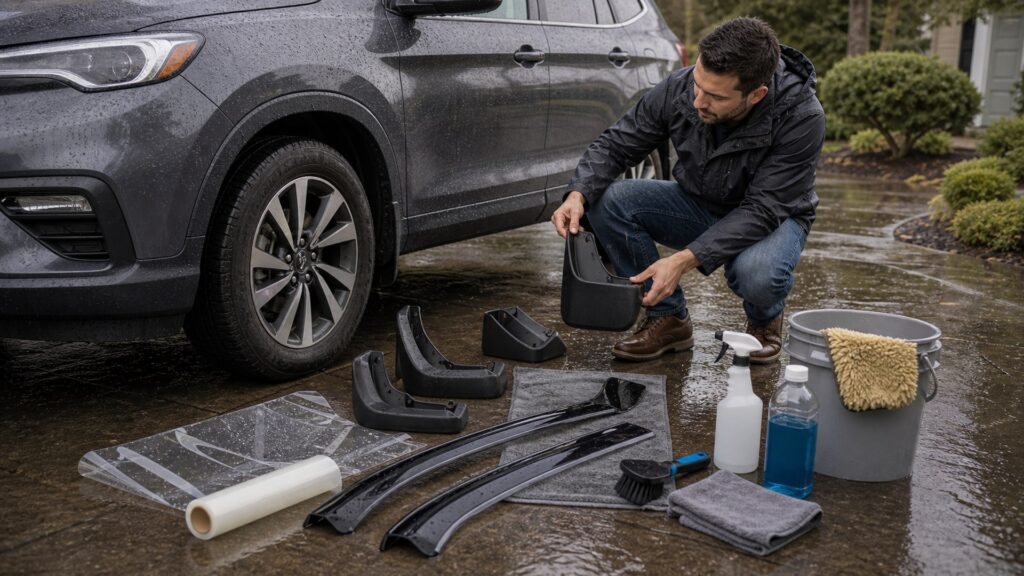
Buying framework
Map the exposure before adding coverage
Protection should follow the direction and type of damage. More material is useful only when water, grit, and airflow still move where the vehicle design expects.
Separate moving and parked exposure: Wheel spray, stone impact, and underbody abrasion occur in motion; UV, sap, dust, and precipitation dominate while parked. Select different products for those environments.
Identify the path: Look for leading edges, tire wake, rocker seams, bumper loading zones, and open underbody areas. Place protection where debris actually travels rather than where a catalog photo looks balanced.
Choose a protection mechanism: Use deflection for spray, sacrificial film for paint abrasion, rigid shielding for openings, and a fitted cover for stationary exposure. Do not expect one mechanism to replace another.
Preserve drainage and clearance: Check gaps around tires, suspension, exhaust, air inlets, panel drains, and packed-snow zones. A protector should not create a new reservoir or contact point.
Who this is for
Match protection to climate and roads
The same vehicle needs a different package in a salted winter than in a hot dry climate. Frequency and cleaning access matter as much as severity.
Salt-belt commuters: Prioritize cleanable splash control, coated brackets, isolated fasteners, and open drainage. Easy removal or access for rinsing is more valuable than sealed-looking trim that holds brine.
Gravel and construction-road drivers: Use coverage at tire wake, rocker panels, lower doors, hood edge, and exposed underbody components. Flexible guards and sacrificial films should be replaceable after repeated abrasion.
Hot and sunny outdoor parking: UV stability, colorfastness, breathable cover construction, and strap durability dominate. Check that a cover or deflector cannot abrade softened or contaminated paint in wind.
Snow and mixed-weather users: Cold-flexible parts, tire and ground clearance, and resistance to packed ice matter. Avoid shapes that create shelves for snow or prevent visual inspection of drains and mounts.
What to pay attention to
Protection features with visible consequences
Material names alone say little without geometry and exposure testing. Read each specification in the context of where the part sits.
Coverage & Flow
Impact zones, spray direction, airflow, drainage, and snow or mud accumulation.
Material & Attachment
Cold flexibility, UV stability, abrasion resistance, coatings, isolation, and replaceable hardware.
Coverage width and setback: Mud flaps and splash guards should intercept the tire plume while retaining tire, ground, and suspension clearance. Wider is not automatically better if the outer edge becomes a lever.
Thickness and compliance: Flexible parts can survive contact that cracks a rigid panel, while rigid shields can bridge an opening. Match stiffness to impact and attachment spacing rather than choosing by thickness alone.
Edge treatment: Rounded edges, sealed film margins, and supported cover hems reduce paint cutting and edge lift. Hard edges that vibrate against bodywork need deliberate isolation.
Hardware exposure: Inspect coating type, metal pairing, protected threads, and replaceability. Salt can attack brackets hidden behind an intact plastic guard.
Service openings: Drain holes, fasteners, tow points, jack locations, and wash access should remain usable. Removable inspection panels are valuable when full disassembly would discourage cleaning.
Avoid these traps
Protection choices that trap the threat
A part can look protective while concentrating water, salt, or abrasion. Judge what happens behind it throughout a season.
Covering contamination: Film, trim, or a vehicle cover placed over dirty paint turns grit into an abrasive. Clean and dry the surface according to the product method before trapping anything against it.
Sealing every edge: Some panels and cavities are designed to drain or vent. Adding sealant or tight trim without understanding the water path can keep moisture inside longer.
Choosing rigid parts for repeated contact: A low, stiff guard can transmit curb, ice, or trail impact directly into its fasteners and body panel. Flexible or breakaway designs may be more appropriate in contact-prone zones.
Ignoring hidden hardware: A plastic shield can remain attractive while steel brackets rust behind it. Inspect mounts, threads, and panel edges rather than judging condition from the visible face.
Decision guidance
Choose by exposure mechanism
Use the smallest system that interrupts the real damage path and remains maintainable. Combine products only when their edges and mounts do not work against each other.
If tire spray is the main problem: Choose shaped splash guards or mud flaps with adequate width and cold flexibility. Confirm full steering and suspension clearance and leave room to rinse the mounting pocket.
If paint chips and scuffs dominate: Use properly installed sacrificial film or contour-matched protectors on leading and loading zones. Coverage should end at stable edges that can be inspected for lift and trapped grit.
If underbody openings need shielding: Select a vehicle-specific splash panel or protective plate that preserves cooling, drains, jack points, and service access. Distinguish light debris shielding from a structure rated for trail impact.
If parked exposure dominates: A fitted, breathable cover can reduce UV and contamination when used on clean paint and secured against wind. Indoor dust control and outdoor precipitation demand different fabrics and tie-down behavior.
Ownership & compatibility
Cleaning is part of the protection system
Road protection moves contamination; it does not make contamination disappear. Maintenance must reach the edges and backside of each part.
Rinse the collection zones: Flush behind guards, along rocker seams, above shields, and around brackets after salt or mud exposure. Confirm drains remain open instead of directing high pressure into sealed connectors.
Inspect sacrificial parts: Replace torn flaps, lifted film, cracked clips, worn pads, and stretched cover straps before they expose paint or let a loose part strike the body.
Treat corrosion early: Clean rust staining, identify the actual metal interface, and restore the specified coating or hardware. Hiding an active joint beneath trim allows section loss to continue unseen.
FAQ
Weather and road protection questions
These answers clarify the limits and upkeep of common protective accessories.
Do mud flaps protect the entire side of a vehicle?
Can a vehicle cover damage paint outdoors?
Is thicker paint protection film always better?
Should underbody shields have drainage holes?
What material works best for mud flaps in winter?
Do hood deflectors prevent all stone chips?
How do I prevent corrosion around accessory fasteners?
Can I leave splash guards installed through automatic washes?
When should protective film or trim be replaced?
Bottom line
Protection must release water and reveal wear
Good exterior protection interrupts the damage path without concealing a new one. Coverage, clearance, drainage, and inspection access belong in the same decision.
Map the threat: Separate UV, spray, salt, gravel, and parked contamination by location and mechanism.
Match the mechanism: Use deflection, sacrificial coverage, shielding, or a cover where each performs best.
Keep it cleanable: Preserve drains and clearances, then inspect the hidden mounts and contact zones through the season.
Reading Shortcuts
Jump from exposure mapping to a maintainable protection choice.
Decision Reminders
Protection should not trap the problem.
- Zone: Locate the actual impact or exposure.
- Mechanism: Deflect, absorb, shield, or cover.
- Clearance: Check tires, ground, and panels.
- Drainage: Keep water paths open.
- Hardware: Inspect coatings and isolation.
- Cleaning: Reach the backside and edges.
Glossary Snippets
Exposure terms that sharpen product claims.
When to Use a Top 10 Review
Use a roundup after identifying the exposure zone and protection mechanism.
- Exposure known: Weather or debris path is mapped.
- Zone known: Coverage boundaries are clear.
- Mechanism chosen: Deflection, film, shield, or cover.
- Need options: Several fit-specific products remain.
Have finalists already? Open a Comparison for a closer tradeoff.
When to Use a Comparison
Compare two protectors by coverage, drainage, and long-term access.
- Coverage: Impact zones overlap differently.
- Compliance: Rigid and flexible behavior differ.
- Hardware: Salt exposure protection varies.
- Upkeep: Cleaning access is not equal.
Need a broader field? Use a Top 10 to form a shortlist.