
How to Choose Fragrances for Beginners
Learn how to choose a first fragrance using scent contrasts, blotters, skin trials, dry-down notes, discovery sets, wearing radius, sensitivity, and bottle sizing.
The beginner fragrance worksheet pairs opening, heart, and base with scent family, then reviews projection beside concentration. It holds sample format apart from bottle commitment so one strength cannot conceal another. The final route is checked through the one-bottle beginner, the curious explorer, the gift-funded beginner, the sensitivity-conscious beginner, and the budget beginner; each route earns a distinct configuration rather than a demographic label. Beginner Fragrance roadmap: Learn contrasts before families; Narrow on paper; Skin-test one finalist; Delay the full bottle; The one-bottle beginner; The curious explorer; The gift-funded beginner; The sensitivity-conscious beginner; The budget beginner; Opening, heart, and base; Scent family; Projection; Concentration; Sample format; Bottle commitment; Buying from online notes; Testing many on one arm; Choosing by gender aisle; Calling stronger better; Skipping samples to save money; For a first signature; For learning preferences; For work or school; For evenings only; For gifting a beginner; Keep a scent notebook; Space the trials; Store samples clearly; Retire misconceptions.
Buying framework
Learn contrasts before families
Build the beginner fragrance purchase around its title-specific routine.
Learn contrasts before families: Start with bright or warm, dry or sweet, airy or dense, clean or earthy, and quiet or projecting.
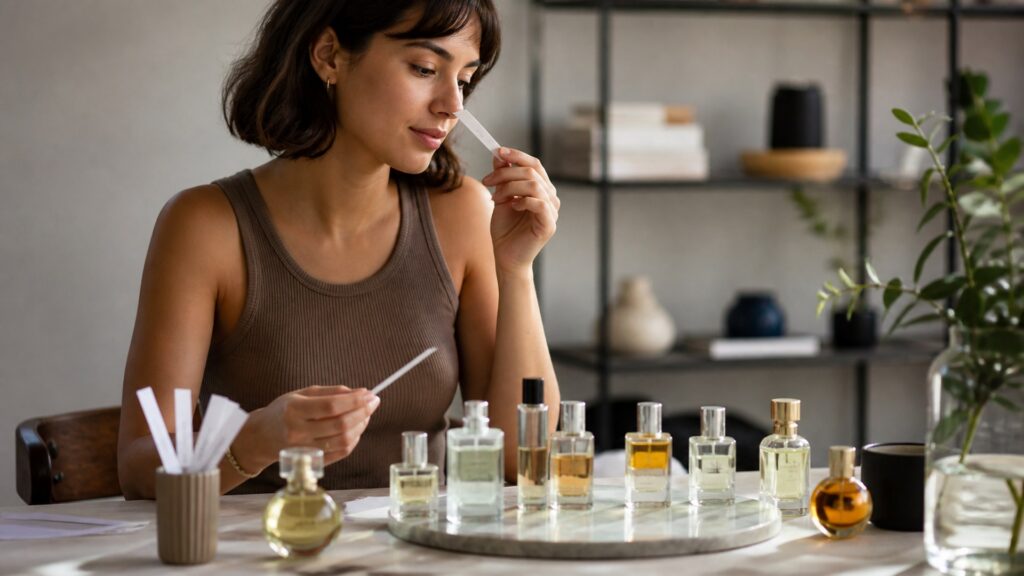
Narrow on paper: Use blotters to reduce a large field, label every strip, and revisit after the openings settle.
Skin-test one finalist: Wear a single candidate through its opening, heart, and base in an ordinary setting with a conservative dose.
Delay the full bottle: Complete the sample, compare a second finalist, and choose travel or small format until a role becomes repeatable.
Who should buy what
Match the beginner fragrance system to the actual user
These beginner fragrance profiles require materially different configurations.
The one-bottle beginner: Needs a comfortable versatile base, controlled radius, and multiple routine-day successes before commitment.
The curious explorer: Benefits from a structured discovery set spanning contrasts rather than many samples from one fashionable family.
The gift-funded beginner: Should retain exchange choice and avoid letting a giver’s taste or decorative bottle define the wardrobe.
The sensitivity-conscious beginner: Should introduce one product cautiously, read labeling, stop after unexpected effects, and seek appropriate guidance.
The budget beginner: Should spend on samples and learning first, then compare cost per likely wear rather than discounted volume.
What to pay attention to
Read the characteristics that change beginner fragrance
Translate beginner fragrance label language into observable use consequences.
Opening, heart, and base: Treat these as time checkpoints, not rigid ingredient disclosures; note what changes and what remains.
Scent family: Use floral, woody, fresh, amber, aromatic, or gourmand labels as navigation, not verdicts about gender or strength.
Projection: Assess from normal social distance after settling; nose-to-wrist smell does not describe the room.
Concentration: Use the label as context while testing the exact formula’s radius, development, and useful duration.
Sample format: Compare dabber versus spray, volume, labeling, seller traceability, and whether delivery matches the bottle.
Bottle commitment: Check atomizer, closure, storage, return terms, and likely rotation before paying for packaging or size.
Avoid these traps
Correct the shortcuts that undermine beginner fragrance
Every beginner fragrance mistake needs a concrete test or stopping rule.
Buying from online notes: A note list cannot reveal personal comfort, balance, projection, or late dry-down.
Testing many on one arm: Overlapping developments make comparison unreliable and can increase exposure.
Choosing by gender aisle: Retail placement is not a scent specification; use smellable contrasts and context.
Calling stronger better: High projection may reduce versatility and beginner control.
Skipping samples to save money: An unused discounted bottle costs more than a discovery process that prevents mismatch.
Decision guidance
Choose the route that matches the dominant beginner fragrance constraint
Use one beginner fragrance path, then verify it under real conditions.
For a first signature: Require several ordinary full wears with an enjoyable base and manageable radius.
For learning preferences: Choose a labeled discovery set with meaningful contrasts and record every sample separately.
For work or school: Verify rules, use conservative dose, and judge at conversational distance after commute.
For evenings only: A richer or more expressive scent can fit, but test transport, close seating, and late comfort.
For gifting a beginner: Offer samples, redemption credit, or a requested bottle with exchange flexibility.
Ownership & compatibility
Keep the beginner fragrance routine interpretable after purchase
Maintenance determines whether the beginner fragrance product remains useful.
Keep a scent notebook: Record strip code, skin date, dose, setting, opening, base, comfort, and whether a role emerged.
Space the trials: Give the nose and skin time between candidates and avoid forcing testing after discomfort.
Store samples clearly: Keep labels readable, caps secure, and vials away from heat and light.
Retire misconceptions: Update the shortlist from actual wears rather than collecting rules about gender, concentration, or fashionable notes.
FAQ
How to Choose Fragrances for Beginners FAQ
Answers tied to the exact beginner fragrance category, routine, and ownership burden.
How should buyers evaluate opening, heart, and base for beginner fragrance?
How should buyers evaluate scent family for beginner fragrance?
How should buyers evaluate projection for beginner fragrance?
How should buyers evaluate concentration for beginner fragrance?
How should buyers evaluate sample format for beginner fragrance?
How should buyers evaluate bottle commitment for beginner fragrance?
How should buyers evaluate buying from online notes for beginner fragrance?
How should buyers evaluate testing many on one arm for beginner fragrance?
How should buyers evaluate choosing by gender aisle for beginner fragrance?
Bottom line
For a first signature
Make the beginner fragrance decision from evidence gathered in its intended routine.
Set the baseline: Define what success means for beginner fragrance before opening another product.
Run the decisive test: Use the hardest realistic beginner fragrance condition to separate the finalists.
Own the result: Keep the beginner fragrance routine measurable, maintainable, and within its stopping rules.
Reading Shortcuts
Navigate the beginner fragrance decision.
Decision Reminders
Keep the beginner fragrance comparison controlled.
- Beginner Fragrance baseline: Write the starting condition for beginner fragrance before testing.
- One beginner fragrance change: Alter only one beginner fragrance variable in each comparison cycle.
- Beginner Fragrance stopping rule: Know when beginner fragrance shopping should pause or escalate.
Glossary Snippets
Working terms for beginner fragrance.
Using a Fragrances Top 10
Apply the beginner fragrance baseline before accepting a ranked order.
- Apply beginner fragrance: Remove options that fail the central beginner fragrance requirement.
- Normalize beginner fragrance: Compare finalists with the same beginner fragrance method.
- Check beginner fragrance burden: Include upkeep and repeat use in the beginner fragrance score.
- Keep beginner fragrance evidence: Record why each beginner fragrance finalist advanced.
Popularity cannot replace the buyer’s beginner fragrance baseline.
Comparing Beginner Fragrance Finalists
Hold the beginner fragrance technique and context steady between candidates.
- Start beginner fragrance equally: Use the same beginner fragrance preparation for every candidate.
- Observe beginner fragrance midway: Check performance after the beginner fragrance opening impression fades.
- Stress the beginner fragrance weak point: Test the condition most likely to break the beginner fragrance routine.
- Review beginner fragrance ownership: Price the full beginner fragrance cycle rather than one use.
Restart when the beginner fragrance baseline changes materially.