
How to Choose Fragrances for Everyday Wear
An everyday fragrance succeeds through repeatability, not spectacle. It must survive the commute, sit comfortably around coworkers or classmates, remain pleasant through its base, and fit the wearer’s appetite for reapplication without turning every morning into a dosing experiment.
That makes the buying test unusually practical: wear each finalist on ordinary days, in the expected climate and spaces, with the same number of sprays. The winner is the scent whose radius, evolution, comfort, and maintenance fit the routine most consistently.
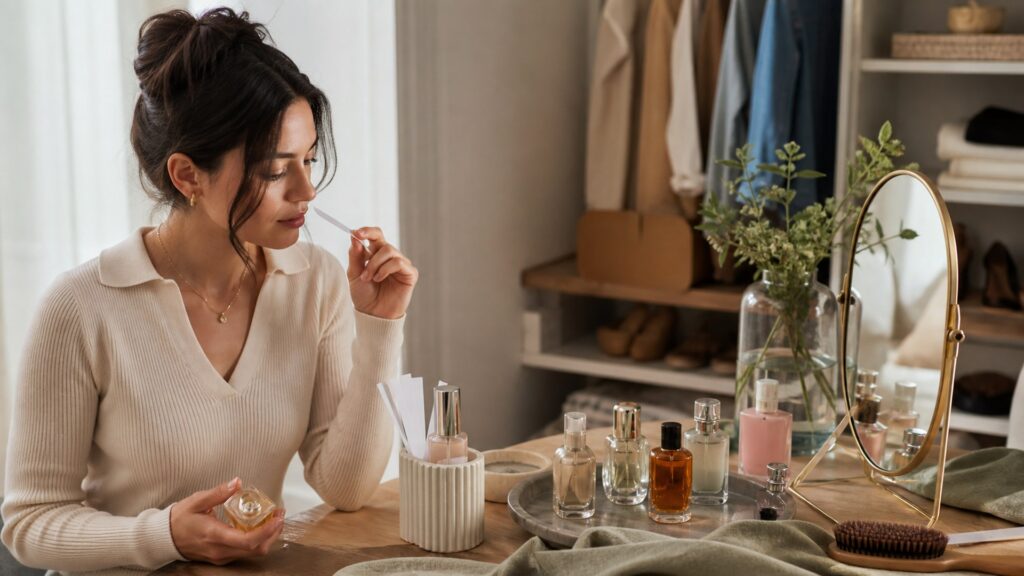
Buying framework
Start with the wearing situation
Turn the title angle into a testable fragrance brief.
Draw the daily route: Map commute, desk or classroom, errands, exercise, caregiving, and evening transitions. Note fragrance restrictions, close-contact periods, heat, and opportunities to refresh.
Set a radius ceiling: Decide how far the scent may travel in the most restrictive setting. A pleasant perfume can still be unsuitable when it reaches beyond the wearer’s space.
Run matched wear tests: Use the same spray count and placement on comparable days. Check the opening, midwear, late base, clothing transfer, and whether the scent becomes tiring.
Price the routine: Calculate likely sprays, days per week, portable-decant needs, and replacement frequency. Cost per wear matters more than bottle size alone.
Who should buy what
Match the fragrance to the wearer’s real job
Different routines call for different scent structures, formats, and projection limits.
The close-office wearer: Choose low-to-moderate projection, a smooth base, and easy dose control. Verify workplace policy and test from a colleague’s distance, not only nose-to-wrist.
The long-commute wearer: Look for a comfortable opening in confined transit, a stable midwear phase, secure portable packaging, and a refresh method that does not spray nearby passengers.
The warm-climate wearer: Test in heat and humidity, where sweetness and projection may feel amplified. Favor a composition and dose that stay readable without becoming dense.
The active multitasker: Prioritize bottle portability, cap security, quick application, and a scent that remains pleasant as body temperature and surroundings change.
The fragrance rotator: Use small bottles or travel sprays and assign distinct daily roles. Rotation can improve variety while reducing the risk of oversized bottles aging unused.
What to pay attention to
Read the scent beyond its note list
The useful specifications describe evolution, radius, handling, and repeatability.
Real-world projection: Measure the conversational radius after settling, during movement, and in warm spaces. Marketing labels such as intimate or bold are not measurements.
Dry-down comfort: Everyday wear spends more time in the base than the opening. Watch for sweetness, musk, woods, powder, or ambers that become tiring after several hours.
Duration and reapplication: Separate skin persistence from useful presence. A scent may remain detectable up close after it stops serving the desired radius.
Climate behavior: Temperature, humidity, clothing layers, and heated indoor air can change perception. Test in the season where the bottle will be used most.
Atomizer and portable format: A fine, consistent spray makes dose easier to repeat. Check cap security, leak resistance, travel size, refill directions, and whether decanting is supported.
Cost per routine: Estimate wears from actual spray count and rotation. Include samples, travel atomizers, shipping, and the chance that a large bottle will remain unfinished.
Avoid these traps
Prevent an exciting opening from becoming an expensive mismatch
Sampling and context expose errors that packaging cannot.
Testing only on a weekend: A relaxed outdoor trial does not reveal office radius, transit comfort, or a rushed morning. Test on the hardest normal day.
Equating long-lasting with wearable: A persistent base that becomes tiring is a liability. Score pleasant usable hours, not the final faint trace.
Overspraying to avoid reapplication: Front-loading the dose can make the commute and workplace uncomfortable. Choose a controlled refresh plan instead.
Ignoring personal-care overlap: Scented lotion, hair products, deodorant, and laundry products can compete with the perfume. Test the complete morning routine.
Buying a large bottle for savings: Unit price is irrelevant if rotation, fatigue, or seasonal change leaves most of the bottle unused.
Decision guidance
Choose by role, setting, and wearing radius
Use the closest matching route, then confirm it with repeated wear.
For a scent-restricted workplace: Follow policy first. Where fragrance is allowed, favor minimal radius, repeatable atomization, and a base that stays close.
For a twelve-hour day: Choose comfortable evolution and a discreet portable refresh rather than maximizing the initial cloud.
For hot or humid conditions: Test outdoors and after transit; reduce dose or choose a lighter-wearing structure when warmth magnifies density.
For frequent rotation: Select travel sprays or small formats with clear labels and secure storage. Variety is the goal, not maximum milliliters.
For one dependable bottle: Require successful tests across several ordinary days and settings before buying the full size.
Ownership & compatibility
Keep application, storage, and shared-air use intentional
Good ownership protects the formula and the people around the wearer.
Standardize application: Use a repeatable spray count and placement so changes in weather or routine are interpretable.
Carry it safely: Use an approved travel format with a secure closure; protect it from heat in cars, direct sun, and impact inside bags.
Respect shared air: Do not reapply in elevators, transit, deskside, or other confined shared spaces. Follow fragrance-free rules without exception.
Review the role seasonally: Reassess dose, climate behavior, and frequency when temperatures, clothing, commute, or workplace changes.
FAQ
How to Choose Fragrances for Everyday Wear FAQ
Practical answers about sampling, projection, formats, sensitivity, and storage.
What makes a fragrance suitable for everyday wear?
How many sprays should an everyday fragrance require?
Should everyday perfume last all day?
How do I test fragrance for an office?
Which scent families work best in hot weather?
Is a travel spray better than a bottle?
Can I reapply perfume during the day?
How do scented body products affect the choice?
How should an everyday bottle be stored?
Bottom line
Choose the wear, then the bottle
The right fragrance earns its place through the whole experience.
Test the hardest day: Commute, close spaces, climate, and late dry-down reveal everyday fit.
Control the radius: Shared-air compatibility is a core specification, not an etiquette footnote.
Buy for actual wears: Choose format and volume from the real rotation and refresh plan.
Reading Shortcuts
Move through the ordinary-day wearing routine from brief to bottle.
Decision Reminders
Keep the ordinary-day wearing routine observable.
- Run a weekday trial: Use the real commute, desk, errands, and evening transition.
- Measure shared-air fit: The closest regular room determines the practical projection limit.
- Count usable wears: Price the format against rotation and refresh habits.
Glossary Snippets
Terms used in the wear test.
Using a Top 10 for the Ordinary-Day Wearing Routine
Use daily rankings only after the commute and shared-room limits are known.
- Reject excessive radius: Remove scents that exceed the closest routine space.
- Compare usable hours: Distinguish pleasant function from a faint residual trace.
- Simulate the morning: Include deodorant, lotion, clothing, and travel conditions.
- Check portable upkeep: Score cap security, refresh access, and heat exposure.
The best daily option is the one that remains easy to repeat.
Comparing Finalists for the Ordinary-Day Wearing Routine
Compare finalists across matched weekdays rather than an idealized counter visit.
- Start at departure: Record dose, weather, layers, and transit comfort.
- Check the desk phase: Assess radius and fatigue in the longest shared setting.
- Review late afternoon: Separate useful presence from a base that merely persists.
- Test tomorrow’s reset: Confirm storage, portability, and planned reapplication.
Restart the comparison if the morning grooming stack changed.