
How to Choose Fragrances for Women
The words “for women” describe a retail aisle, not a reliable scent profile. A bottle marketed to women may be crisp, smoky, woody, salty, floral, gourmand, or nearly weightless, while the color of the liquid and the shape of the cap reveal very little about how it will wear.
A better purchase starts with the wearer’s scent vocabulary, daily setting, existing wardrobe, and tolerance for projection. Sample on skin, follow the opening into the dry-down, and decide what role the bottle will fill before comparing concentration, size, or presentation.
Buying framework
Start with the wearing situation
Turn the title angle into a testable fragrance brief.
Translate taste into contrasts: Replace broad labels such as feminine or elegant with choices the wearer can test: bright versus warm, transparent versus dense, dry versus sweet, close-wearing versus room-filling, and linear versus changing.
Map the wardrobe gap: List fragrances already owned by season, setting, mood, and intensity. Buy for an uncovered role rather than a slightly different opening that dries down like an existing bottle.
Test the full arc: Wear one candidate from first spray through the late dry-down on ordinary skin and clothing conditions. Note comfort, projection, persistence, and whether the base remains appealing.
Choose the commitment last: After several wears, select travel spray, small bottle, or larger format according to expected rotations and shelf life—not the discount per milliliter.
Who should buy what
Match the fragrance to the wearer’s real job
Different routines call for different scent structures, formats, and projection limits.
The signature-scent seeker: Prioritize a structure that remains comfortable across common settings, has a satisfying late dry-down, and can be reapplied discreetly. Test it on routine days, not only during an exciting store visit.
The fragrance-wardrobe builder: Look for a missing function—warm evening scent, quiet office option, humid-weather fresh scent, or textured cold-weather choice—and compare it against bottles already owned.
The gender-neutral explorer: Ignore department labels and sample across the store. Use notes, texture, sweetness, woods, resins, musks, and projection to define fit instead of treating gender marketing as an ingredient.
The sensitivity-conscious wearer: Use controlled sampling, check the ingredient declaration, keep exposure limited, and stop after irritation, headache, breathing discomfort, or another unexpected reaction. Seek appropriate medical guidance when needed.
The gift buyer: Obtain a wish list, known favorite, discovery set, or redeemable sample option. A decorative bottle and a gender label cannot substitute for the recipient’s skin test and preferences.
What to pay attention to
Read the scent beyond its note list
The useful specifications describe evolution, radius, handling, and repeatability.
Scent family and texture: Treat floral, woody, amber, fresh, gourmand, and aromatic families as starting coordinates. Compare sweetness, dryness, density, spice, musk, and contrast within the family.
Opening, heart, and base: The first minutes can emphasize volatile citrus or aromatics; the later wear may become musky, woody, sweet, or powdery. Judge the stage that occupies most of the day.
Concentration in context: Parfum, eau de parfum, eau de toilette, cologne, and mist labels can suggest formulation style, but they do not guarantee projection or duration across brands. Test the exact product.
Projection and wearing radius: Decide whether the scent should remain near the body, reach conversational distance, or announce itself. Evaluate in the actual office, commute, climate, and social setting.
Bottle, atomizer, and size: Check spray distribution, cap security, grip, travel rules, refill design, and the quantity likely to be used. A small bottle can be better value when the wardrobe rotates.
Ingredient and seller transparency: Confirm the ingredient panel, responsible company, batch or lot information, return rules, and authenticity. In the United States, components may appear collectively as fragrance, so contact the manufacturer with specific concerns.
Avoid these traps
Prevent an exciting opening from becoming an expensive mismatch
Sampling and context expose errors that packaging cannot.
Shopping by gender cues: Pink glass, flowers, celebrity imagery, and a women’s label do not predict sweetness, strength, or compatibility. Translate the brief into smellable contrasts.
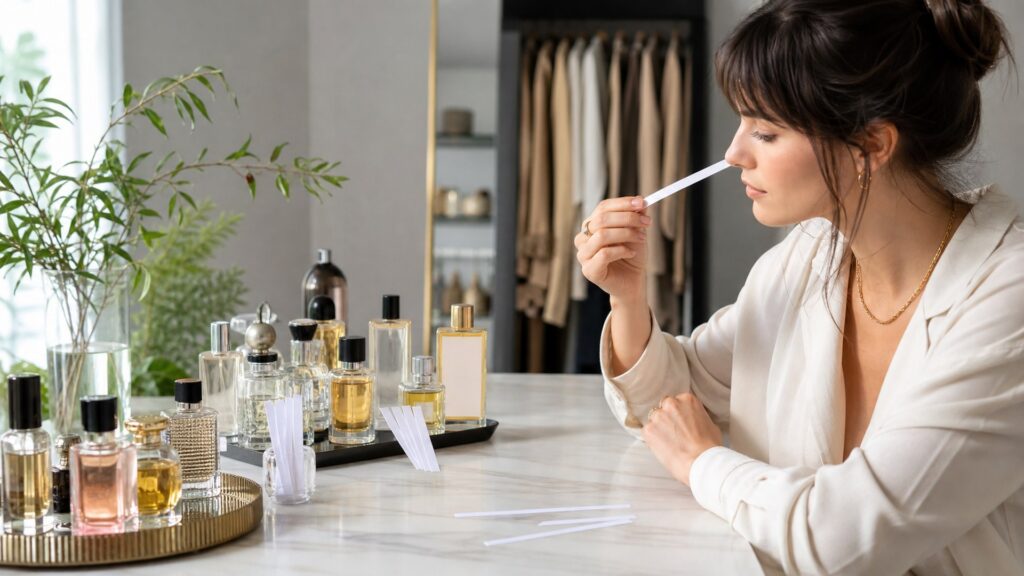
Buying from the blotter opening: Paper helps compare openings but cannot show skin development or personal comfort. Give finalists separate full wears.
Calling stronger better value: High projection can reduce usability in close settings, while a quieter scent may be worn more often. Value depends on the intended radius and frequency.
Assuming natural means gentle: Natural and synthetic materials can both be unsuitable for an individual. Read labels, sample cautiously, and do not treat botanical language as a safety guarantee.
Buying the largest gift bottle: If preference is uncertain, a discovery set or redeemable sample reduces the chance of an expensive mismatch and gives the recipient control.
Decision guidance
Choose by role, setting, and wearing radius
Use the closest matching route, then confirm it with repeated wear.
For an everyday signature: Favor an enjoyable base, controllable radius, comfortable wear, and a format that supports modest reapplication.
For a varied collection: Choose by uncovered role and contrast with current bottles; record late dry-down similarities before buying.
For traditionally feminine tastes: Sample the desired floral, fruity, powdery, amber, or gourmand direction, but still compare sweetness, texture, projection, and base rather than the label alone.
For nontraditional tastes: Cross-shop woods, leather effects, aromatics, smoke, salt, mineral notes, and drier compositions without treating the department boundary as a rule.
For a gift: Buy the named product or offer a discovery route with exchange flexibility. Never infer skin chemistry or scent tolerance from age or gender.
Ownership & compatibility
Keep application, storage, and shared-air use intentional
Good ownership protects the formula and the people around the wearer.
Store for stability: Keep the bottle upright, closed, and away from sustained heat, sunlight, and large temperature swings. A bathroom windowsill is poor long-term storage.
Control dose and placement: Start with fewer sprays, observe the real wearing radius, and respect scent-restricted spaces. Avoid spraying irritated skin and follow label directions.
Track rotation honestly: Mark the opening date and notice which occasions actually draw the bottle. A rarely used large format is not economical because its unit price was lower.
Respond to unexpected reactions: Stop use after rash, redness, burning, breathing discomfort, or another unexpected effect. Preserve the packaging and lot information if reporting a problem.
FAQ
How to Choose Fragrances for Women FAQ
Practical answers about sampling, projection, formats, sensitivity, and storage.
Are women’s and men’s fragrances formulated differently?
How can I describe fragrance preferences without knowing perfume terms?
Should I test perfume on paper or skin?
Is eau de parfum always stronger than eau de toilette?
What bottle size is best for a first purchase?
How do I choose fragrance as a gift for a woman?
Can fragrance be worn in an office?
What should sensitivity-conscious shoppers check?
How should perfume be stored?
Bottom line
Choose the wear, then the bottle
The right fragrance earns its place through the whole experience.
Use scent, not stereotypes: Define texture, sweetness, warmth, projection, and evolution in the wearer’s own language.
Test the late dry-down: The longest stage deserves more weight than the first attractive minutes.
Match bottle to role: Commit only after the scent earns a place in the real wardrobe.
Reading Shortcuts
Move through the women's fragrance wardrobe from brief to bottle.
Decision Reminders
Keep the women's fragrance wardrobe observable.
- Follow the dry-down: Give the longest stage more weight than the first spray.
- Set the social radius: Judge from normal distance in the tightest shared setting.
- Earn the volume: Let repeated successful wears justify a larger bottle.
Glossary Snippets
Terms used in the wear test.
Using a Top 10 for the Women'S Fragrance Wardrobe
Filter ranked options through the real wearing brief before comparing popularity.
- Remove setting mismatches: Exclude options whose radius or format conflicts with the actual day.
- Compare complete wears: Use separate skin trials instead of ranking openings side by side.
- Normalize application: Hold spray count, placement, climate, and supporting products steady.
- Price likely use: Compare samples, travel sizes, and bottles by realistic wears.
A ranking cannot supply the wearer’s setting, tolerance, or skin trial.
Comparing Finalists for the Women'S Fragrance Wardrobe
Keep dose and context fixed while each finalist moves from opening to base.
- Record the first hour: Note settling time and early radius without judging from the nozzle.
- Return at midwear: Check comfort, recognizability, and fit with the surrounding routine.
- Score the late base: Decide whether the longest stage still earns the intended role.
- Audit the format: Inspect spray quality, closure, portability, seller, and bottle commitment.
Retest when weather, clothing, or scented grooming products changed between trials.