
How to Choose Gym Accessories for Travel Workouts
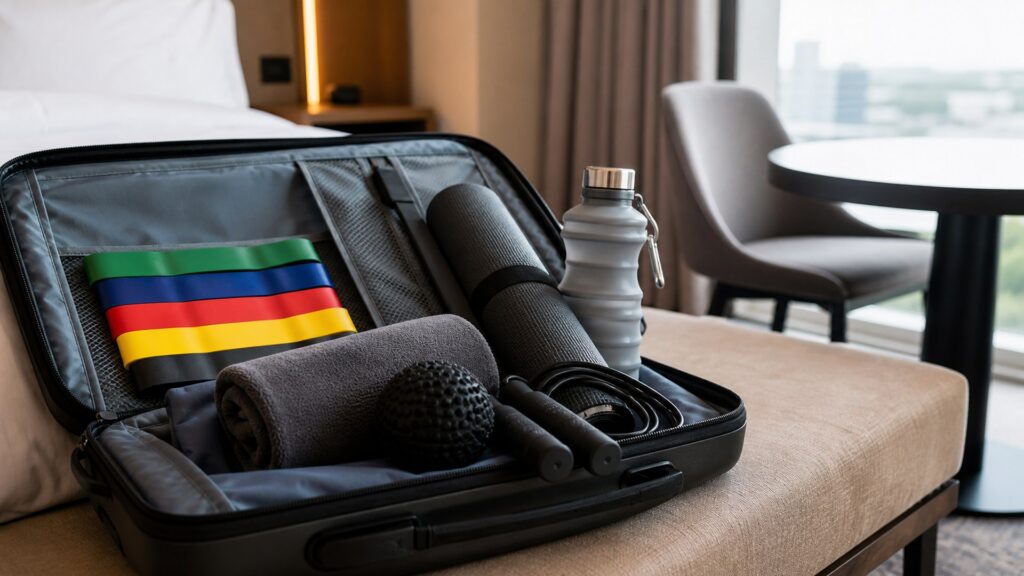
Travel-workout accessories must work in two environments: the bag and the destination. A compact item is not useful when it requires an unavailable anchor, damages a floor, creates too much noise, or returns damp to luggage.
Write a short routine for the smallest likely room and list the exact floor, clearance, privacy, and attachment assumptions. Weigh and pack the complete kit, including handles, chargers, bags, towels, and cleaning supplies. Rehearse every exercise without improvising door, furniture, railing, or wall anchors. Check current carrier, accommodation, venue, and security rules close to departure because transport permissions can change. Keep a no-accessory fallback for delays, lost luggage, or an unsuitable space.
Buying framework
Design the workout for the destination first
A travel accessory earns bag space by supporting a known exercise on uncertain floors and in limited clearance without depending on an improvised structure or difficult cleanup.
Write the minimum-space routine: Choose exercises that fit the smallest expected floor area, ceiling height, noise limit, and privacy level. Mark which movements truly need a band, slider, rope, strap, mat, handle, or timer.
List every destination assumption: Record floor type, footwear, furniture, doors, outdoor surfaces, weather, ventilation, washing access, and storage. Treat anchor availability and structural permission as unknown until the exact location confirms them.
Calculate the complete packed burden: Weigh the accessory plus pouch, handles, anchors, charger, batteries, towel, cleaner, adapters, and replacement parts. Measure the packed shape inside the actual personal item, carry-on, or checked bag.
Separate anchored and anchor-free plans: Create an exercise list that uses only the floor, body, or handheld accessory. Add attached movements only when the product, structure, property, and setup all explicitly permit the connection.
Build a zero-equipment fallback: Keep a short walking, bodyweight, mobility, or isometric option appropriate to the user and plan. Travel disruption should reduce complexity rather than trigger an unsafe improvised anchor or unsuitable space.
Who this is for
Match the kit to the way you travel
Carry-on trips, road travel, hotel-room sessions, outdoor stops, and destination gyms create different limits for weight, surfaces, security, cleaning, and replacement.
Carry-on-only traveler: Prioritize low packed weight, compact shape, simple security screening, no loose liquids, minimal chargers, and an anchor-free routine. Verify current airline and security requirements before each trip rather than relying on an old experience.
Road-trip traveler: Vehicle space permits more equipment but exposes materials to heat, cold, moisture, and theft. Secure hard or heavy items so they do not move in transit and keep damp gear separate.
Hotel-room exerciser: Choose quiet movements, limited floor contact, fast setup, and cleaning that respects the room. Do not attach to doors, furniture, fixtures, balconies, or walls without explicit product and property permission.
Outdoor travel exerciser: Check ground abrasion, dirt, moisture, temperature, sun, wind, visibility, and public-space rules. Accessories should remain controllable on the actual surface and cleanable before returning to luggage.
Destination-gym user: Confirm day access, supplied equipment, attachment policies, chalk rules, storage, and hygiene before packing duplicates. Personal straps, wraps, collars, or handles still need exact compatibility with unfamiliar machines and bars.
What to pay attention to
Translate portability into a complete travel setup
Useful travel specifications include the packed system, exercise coverage, destination interfaces, surface tolerance, noise, hygiene, and a realistic way to replace or abandon a failed item.
Packed dimensions and weight: Measure the whole kit in its pouch with attachments, chargers, care supplies, and spares. Check rigid lengths, sharp edges, dense items, and how the load changes bag balance and access.
Exercise coverage per component: List the exact movements each piece supports and remove redundant items. A versatile band or strap earns space only when its setups remain permitted, controllable, and useful in the expected destination.
Anchor and attachment options: Read allowed anchor types, load direction, setup, and inspection. Verify the destination structure and property permission; do not assume a closed door, bed, railing, tree, or fixture is suitable.
Floor and surface tolerance: Test sliders, mats, bands, rope, blocks, and footwear on likely carpet, tile, wood, rubber, concrete, or outdoor ground. Check grip, abrasion, marking, edge curl, dirt pickup, and controlled movement.
Noise and clearance: Rehearse rope arcs, band recoil, overhead reach, lateral steps, floor transitions, and any impact within the smallest room. Replace jumping, dropping, or vibration-heavy movements when building or quiet-hour limits require it.
Cleaning and drying: Choose materials that can be wiped or washed with available supplies and dried before repacking. Consider sweat, floor residue, outdoor dirt, porous handles, hook-and-loop, and separate wet-storage pouches.
Transport rules and replaceability: Check current carrier, security, customs, accommodation, facility, and event rules for the exact items. Favor common or nonessential parts when a confiscated, lost, or broken accessory cannot be replaced locally.
Avoid these traps
Avoid packing an accessory that needs an imaginary room
Travel kits fail when portability is measured without attachments, destination structures are assumed safe, surfaces remain untested, or damp gear is sealed before the next transit leg.
Counting only the main item: Bands, handles, anchors, bags, chargers, batteries, towels, cleaners, and adapters add real weight and volume. Pack and weigh the complete working system rather than quoting the lightest component.
Assuming any door is an anchor: Door direction, gap, hinges, latch, construction, surrounding space, product instructions, and property rules all matter. Use only explicitly permitted setups and keep an anchor-free alternative ready.
Testing sliders on one home surface: Carpet sliders may move abruptly or not at all on tile, wood, rubber, or hotel carpet. Begin with short controlled travel and replace the exercise when destination friction is uncertain.
Packing a damp accessory: Sweat, cleaning water, outdoor dirt, and closed luggage encourage odor and contamination. Allow complete drying when possible, separate wet items, and avoid materials whose care cannot fit the itinerary.
Checking transport rules too early: Airline, security, border, venue, and property policies can change or be interpreted for the exact item. Recheck close to travel and accept that staff may require a different disposition.
Decision guidance
Run a packed rehearsal before departure
The best trial begins with the closed bag, uses the smallest plausible destination, avoids unverified anchors, and ends only after the cleaned kit is dry enough to repack.
Pack the exact itinerary kit: Place every accessory, attachment, charger, adapter, towel, cleaner, pouch, and spare in the intended bag. Measure weight, shape, access, and interference with work, clothing, medication, or other travel essentials.
Create the smallest room: Mark reduced floor dimensions and ceiling clearance at home, then remove assumed furniture and anchors. Complete the planned quiet routine with only surfaces and permissions reasonably expected at the destination.
Test every setup and fallback: Attach only to approved test points, inspect bands and hardware, rehearse controlled release, and switch to the anchor-free version. Confirm the workout still functions after removing the largest or most specialized item.
Simulate destination cleanup: Use the towel, wipes, soap, sink access, hanging method, and wet pouch expected on the trip. Time cleaning and drying, then check whether residue or moisture reaches clothing and electronics.
Recheck rules and failure plans: Review current transport and property policies, label the kit, save instructions, and identify local replacement or disposal options. Decide which movement replaces any item that is delayed, prohibited, damaged, or lost.
Ownership & compatibility
Reset the kit at every stop
Travel accessories move between floors, bags, climates, and inspection points. A consistent unpack, check, clean, dry, and repack sequence prevents one destination from compromising the next.
Inspect after transit: Check bands, webbing, seams, handles, sliders, mats, cords, chargers, containers, and hard edges for crushing, cuts, heat damage, leaks, or missing parts before the next exercise.
Separate floor and skin contact: Use pouches, washable covers, or a packing order that keeps dirty surfaces away from clean handles, clothing, and toiletries. Clean according to each material and destination water availability.
Dry before sealing: Open loops, unroll mats, separate layers, and hang permitted textiles where air can circulate. Use a temporary wet pouch only until proper cleaning and drying are possible, not as long-term storage.
Retest unfamiliar anchors and floors: Treat every new room, gym, and outdoor area as a fresh setup. Verify permission, condition, movement clearance, surface friction, and recoil path instead of repeating the last destination's assumptions.
Keep the fallback current: If an accessory is lost, damaged, prohibited, or unsuitable, use the planned no-equipment routine. Replace parts only with compatible items and never improvise a connector merely to preserve the original workout.
FAQ
Travel-workout accessory questions
These answers address useful travel tools, resistance bands, door anchors, mats, sliders, jumping rope, transport rules, cleaning, and a dependable no-equipment backup.
Which accessories are best for travel workouts?
Are resistance bands practical for travel?
Can I use a travel band on a hotel door?
Should I pack a workout mat?
Will exercise sliders work while traveling?
Is a jump rope suitable for hotel workouts?
Can workout accessories go in carry-on luggage?
How should travel workout gear be cleaned?
What if my travel accessories are unavailable?
Bottom line
Pack a routine that survives the missing item
The right travel kit fits the complete bag, works on verified destination surfaces, avoids improvised anchors, cleans and dries between stops, and has a simple zero-equipment fallback.
Design for the room: Write the smallest-space, quiet, anchor-free version of the workout before choosing accessories.
Pack the whole system: Count handles, anchors, chargers, towels, cleaners, pouches, spares, weight, and rigid dimensions.
Recheck every destination: Verify floors, clearances, permissions, rules, material condition, and recoil paths anew.
Protect the next stop: Clean, dry, inspect, separate dirty contact, and keep the no-equipment fallback ready.
Reading Shortcuts
Jump to the destination-first framework, travel profiles, packed-system specifications, or common band, mat, slider, rope, and transport questions.
Decision Reminders
Keep packed weight and size, exercise coverage, destination floor, permitted anchors, noise, cleaning, drying, current carrier rules, and the fallback visible.
- Room: Plan the smallest floor area, lowest ceiling, quietest routine, and no-anchor version.
- Bag: Weigh accessories with handles, chargers, care supplies, pouches, and replacement parts.
- Destination: Verify surface friction, structure permission, clearance, privacy, weather, and local rules.
- Fallback: Keep a suitable no-equipment session for delays, damage, lost luggage, or prohibited items.
Glossary Snippets
Terms for comparing the packed burden, destination assumptions, and backup value of travel-workout accessories.
When a Top 10 Helps
Use travel-accessory rankings after defining the itinerary, packed limit, routine, destination floors, attachment permissions, noise, cleaning, drying, transport rules, and fallback.
- Bag filter: Reject systems whose complete weight, rigid shape, chargers, or care supplies displace essentials.
- Destination filter: Rank only accessories that work without improvised anchors and tolerate expected floors and cleanup.
A travel ranking cannot guarantee transport permission, accommodation approval, structural suitability, destination friction, or available workout space.
When a Comparison Helps
Compare finalists from packed bag through the smallest-room workout, anchor-free fallback, destination-style cleanup, drying, inspection, and repacking.
- Trip burden: Compare total weight, shape, attachments, rule uncertainty, replacement, and access inside the bag.
- Workout reality: Inspect floor behavior, clearance, noise, setup, recoil, cleaning, drying, and backup coverage.
Choose the travel accessory that still adds value after its ideal anchor, floor, and room are removed.