
How to Choose Hair Care Products for Curly Hair
Choose curly-hair products by scalp cleansing, curl density, strand diameter, porosity behavior, conditioning slip, clumping, hold, drying time, and climate.
The curly-hair routine worksheet pairs scalp cleansing with conditioning slip, then reviews styler film beside formula layering. It holds drying architecture apart from refresh behavior so one strength cannot conceal another. The final route is checked through the loose-curl low-density user, the tight-curl dense user, the humidity-sensitive user, the dry-scalp product-heavy user, and the heat-stretched curly user; each route earns a distinct configuration rather than a demographic label. Curly-Hair Routine roadmap: Map more than curl type; Build around wash day; Balance moisture and hold; Plan residue removal; The loose-curl low-density user; The tight-curl dense user; The humidity-sensitive user; The dry-scalp product-heavy user; The heat-stretched curly user; Scalp cleansing; Conditioning slip; Styler film; Formula layering; Drying architecture; Refresh behavior; Buying only by curl number; Avoiding shampoo categorically; Adding oil to create moisture; Layering every curl product; Brushing by straight-hair rules; For soft definition; For strong humidity hold; For fine curls; For dense coils; For recurring flakes or itch; Record wash-day variables; Keep the scalp reachable; Dry completely before enclosing; Change with climate.
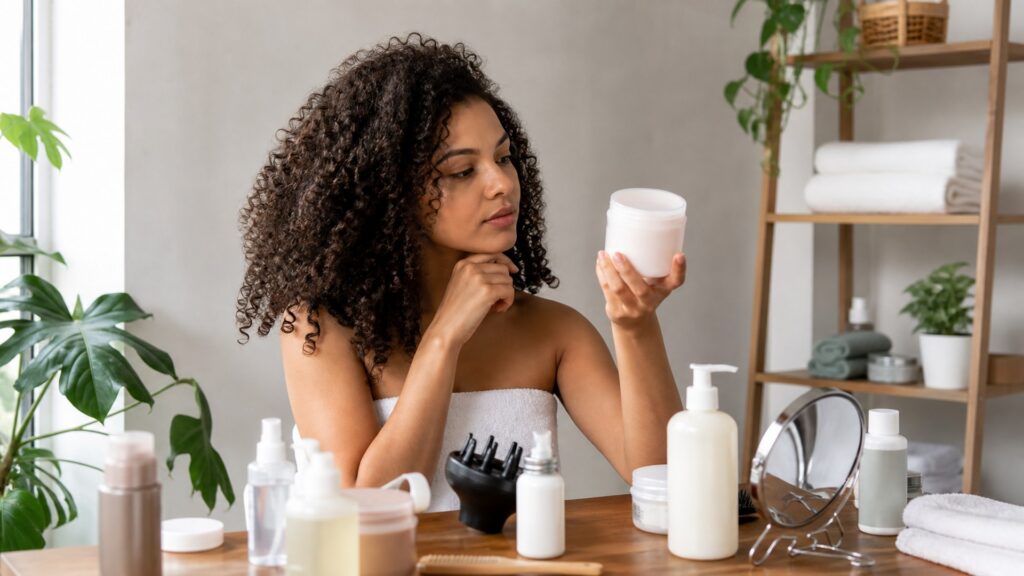
Buying framework
Map more than curl type
Build the curly-hair routine purchase around its title-specific routine.
Map more than curl type: Record scalp needs, strand diameter, density, length, porosity behavior, damage, climate, and desired finish.
Build around wash day: Sequence scalp cleansing, conditioning, detangling, leave-in, styler, drying, protection, and refresh.
Balance moisture and hold: Use enough conditioning for manageable detangling, then choose film strength and flexibility for the desired style life.
Plan residue removal: Oils, creams, gels, butters, edge products, and dry shampoo need an intentional cleansing interval rather than permanent layering.
Who should buy what
Match the curly-hair routine system to the actual user
These curly-hair routine profiles require materially different configurations.
The loose-curl low-density user: Often needs lighter placement and flexible hold that preserves movement without coating roots.
The tight-curl dense user: May need sectioned washing, abundant slip, complete distribution, longer drying plans, and protective nighttime handling.
The humidity-sensitive user: Should compare film formation, cast, frizz, shrinkage, and refresh behavior in the actual dew point and weather.
The dry-scalp product-heavy user: Needs scalp evaluation and targeted cleansing rather than assuming more oil solves flakes, itch, or buildup.
The heat-stretched curly user: Should verify heat protection and recovery goals while minimizing passes, tension, and repeated high temperatures.
What to pay attention to
Read the characteristics that change curly-hair routine
Translate curly-hair routine label language into observable use consequences.
Scalp cleansing: Choose frequency and strength around oil, sweat, flakes, residue, and protective styles while applying treatment shampoos as directed.
Conditioning slip: Measure distribution and detangling force in sections; richness that never rinses or dries may not improve the routine.
Styler film: Compare gel, mousse, cream, and custard by clumping, cast, flexibility, flaking, drying time, and refresh.
Formula layering: Test compatibility by rubbing and real styling; pilling or flakes can come from amounts, order, or incompatible films.
Drying architecture: Diffuser size, airflow, heat, section depth, root clips, towels, and product load affect drying time as much as one hero product.
Refresh behavior: Record water response, added product, frizz, residue, scalp comfort, and whether refreshing delays needed cleansing.
Avoid these traps
Correct the shortcuts that undermine curly-hair routine
Every curly-hair routine mistake needs a concrete test or stopping rule.
Buying only by curl number: Two heads with similar curl shapes can differ in density, diameter, damage, climate, and scalp needs.
Avoiding shampoo categorically: Inadequate removal can leave scalp and fiber coated; match cleansing to the actual product load.
Adding oil to create moisture: Oil can reduce friction or seal a finish but does not replace water-based conditioning and appropriate cleansing.
Layering every curl product: Leave-in, cream, gel, oil, and spray can extend drying and create residue without improving hold.
Brushing by straight-hair rules: Detangling timing and tool choice should respect texture; tightly curled hair may be handled damp with conditioner and sections.
Decision guidance
Choose the route that matches the dominant curly-hair routine constraint
Use one curly-hair routine path, then verify it under real conditions.
For soft definition: Choose moderate conditioning plus a flexible film and test whether the style survives touch and sleep.
For strong humidity hold: Prioritize even distribution and film integrity, then assess crunch release, flakes, and refresh.
For fine curls: Use lighter root placement and smaller product increments while preserving enough slip to avoid breakage.
For dense coils: Plan sections, saturation, detangling, drying capacity, and scalp access before judging product amount.
For recurring flakes or itch: Separate product residue from scalp disease and seek evaluation when symptoms persist.
Ownership & compatibility
Keep the curly-hair routine routine interpretable after purchase
Maintenance determines whether the curly-hair routine product remains useful.
Record wash-day variables: Track section count, product amounts, wetness, clumps, dry time, cast, frizz, and next-day refresh.
Keep the scalp reachable: Part dense hair during washing and application so styling layers do not substitute for scalp hygiene.
Dry completely before enclosing: Avoid trapping damp curls under tight coverings or closed storage; clean bonnets and tools regularly.
Change with climate: Retest film strength, humectant behavior, richness, and refresh frequency when humidity or indoor heating shifts.
FAQ
How to Choose Hair Care Products for Curly Hair FAQ
Answers tied to the exact curly-hair routine category, routine, and ownership burden.
How should buyers evaluate scalp cleansing for curly-hair routine?
How should buyers evaluate conditioning slip for curly-hair routine?
How should buyers evaluate styler film for curly-hair routine?
How should buyers evaluate formula layering for curly-hair routine?
How should buyers evaluate drying architecture for curly-hair routine?
How should buyers evaluate refresh behavior for curly-hair routine?
How should buyers evaluate buying only by curl number for curly-hair routine?
How should buyers evaluate avoiding shampoo categorically for curly-hair routine?
How should buyers evaluate adding oil to create moisture for curly-hair routine?
Bottom line
For soft definition
Make the curly-hair routine decision from evidence gathered in its intended routine.
Set the baseline: Define what success means for curly-hair routine before opening another product.
Run the decisive test: Use the hardest realistic curly-hair routine condition to separate the finalists.
Own the result: Keep the curly-hair routine routine measurable, maintainable, and within its stopping rules.
Reading Shortcuts
Navigate the curly-hair routine decision.
Decision Reminders
Keep the curly-hair routine comparison controlled.
- Curly-Hair Routine baseline: Write the starting condition for curly-hair routine before testing.
- One curly-hair routine change: Alter only one curly-hair routine variable in each comparison cycle.
- Curly-Hair Routine stopping rule: Know when curly-hair routine shopping should pause or escalate.
Glossary Snippets
Working terms for curly-hair routine.
Using a Hair Care Top 10
Apply the curly-hair routine baseline before accepting a ranked order.
- Apply curly-hair routine: Remove options that fail the central curly-hair routine requirement.
- Normalize curly-hair routine: Compare finalists with the same curly-hair routine method.
- Check curly-hair routine burden: Include upkeep and repeat use in the curly-hair routine score.
- Keep curly-hair routine evidence: Record why each curly-hair routine finalist advanced.
Popularity cannot replace the buyer’s curly-hair routine baseline.
Comparing Curly-Hair Routine Finalists
Hold the curly-hair routine technique and context steady between candidates.
- Start curly-hair routine equally: Use the same curly-hair routine preparation for every candidate.
- Observe curly-hair routine midway: Check performance after the curly-hair routine opening impression fades.
- Stress the curly-hair routine weak point: Test the condition most likely to break the curly-hair routine routine.
- Review curly-hair routine ownership: Price the full curly-hair routine cycle rather than one use.
Restart when the curly-hair routine baseline changes materially.