
How to Choose Hair Masks for Hair Treatments Routine Building
A hair mask earns its place when it solves a defined wash-day problem without making the routine harder to repeat. Choose a purpose, then compare rinse sequence, contact time, frequency, and conditioner overlap. The right mask fits cleansing, scalp care, detangling, and styling without turning every wash into an overloaded treatment session.
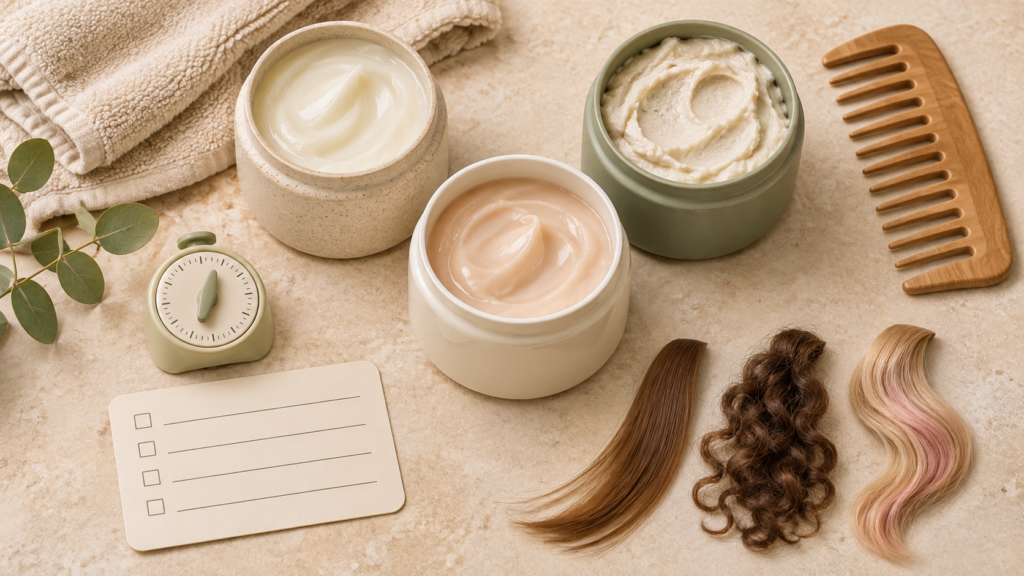
Buying framework
Map the Treatment Before You Buy
Choose the mask by its job and its exact place in a complete wash day. The useful option is the one whose timing and overlap you can follow consistently.
Identify the format: Decide whether the jar belongs before shampoo or after cleansing, and reject any option whose sequence conflicts with the wash day you actually follow.
Protect the required contact time: Compare the stated waiting period with your available shower time; a ten-minute mask is a poor routine fit when it is repeatedly rinsed after two.
Keep cleansing and scalp care distinct: Keep the formula on lengths and ends unless scalp use is explicit, because a rich strand product should not displace normal cleansing.
Decide what it replaces: Determine whether the mask substitutes for conditioner or sits beside it, then remove redundant softening layers before judging weight and slip.
Change one variable at a time: Introduce the mask alone for several washes so changes in tangling, softness, volume, residue, and style hold have a clear source.
Who this is for
Choose a Format That Fits the Existing Routine
Different routines tolerate different amounts of richness, waiting time, and product overlap. Let the existing wash pattern narrow the format.
Minimal wash-day routines: For a short routine, favor one rinse-out mask that can replace a usual conditioning step without adding another return to the shower.
Dry or high-friction routines: For dry or friction-prone lengths, prioritize workable slip after rinsing and enough softness to detangle with the same gentle method.
Fine or easily weighed-down hair: For fine hair, choose a controllable amount and targeted placement, then judge root lift and movement only after hair is fully dry.
Coloring or frequent chemical services: For color-treated hair, check service timing and color-care directions while avoiding the assumption that the richest formula is automatically the safest choice.
Protective-style or infrequent-wash schedules: For long intervals between washes, select a mask that rinses cleanly and does not require several leave-on layers that may accumulate.
What to pay attention to
Read the Label for Routine Consequences
Routine consequences live in the directions: starting condition, amount, waiting period, rinse method, frequency, and relationship to conditioner.
Wash-Day Slot Lens
Identify the exact point at which the jar enters the wash, the step it displaces, and what still follows after rinsing.
Finished-Result Lens
Use dry movement, residue, tangling, volume, and next-day feel to decide whether amount, placement, or cadence should change.
Application stage: The label should state whether hair is dry, wet, freshly shampooed, or merely damp when application begins; that instruction fixes the mask position.
Frequency: Compare suggested weekly or per-wash use with your real wash frequency, since the same direction produces very different monthly exposure.
Dose and coverage: Estimate the amount needed to coat the intended zones, especially when length, density, or sectioning makes a small jar last only a few uses.
Rinse status: A clear rinse instruction matters more than how thick the cream looks; texture cannot tell you how completely residue should be removed.
Conditioning role: Read whether conditioner is optional, required, or replaced, because duplicated conditioning can create weight while an omitted step can reduce detangling slip.
Styling compatibility: Consider the products applied after rinsing, including heat protectant, curl cream, mousse, gel, or oil, and test the smallest workable combination.
Avoid these traps
Avoid Routine-Building Errors
Hair-mask routines become confusing when several conditioning steps change together or wet feel is mistaken for the finished result.
Stacking several intensive steps immediately: Do not start a treatment shampoo, mask, conditioner, and leave-in together; the combined change hides which product caused softness, stiffness, residue, or irritation.
Skipping conditioner by default: Do not delete conditioner by habit; use the mask directions and the finished detangling result to decide whether another conditioning step remains useful.
Using extra product to compensate for missed time: More cream cannot compensate for ignoring the waiting period, so measure dose and contact time as two separate routine decisions.
Applying a strand product to the scalp: Avoid spreading a lengths-focused mask onto the scalp merely to use the whole portion, particularly when buildup or sensitivity is already a concern.
Judging only on wet-hair feel: Do not decide while hair is still coated and wet; check dry movement, root volume, style longevity, and next-day feel as well.
Treating breakage as a single-product diagnosis: Do not ask a cosmetic mask to explain sudden shedding, severe breakage, or scalp symptoms; persistent or concerning changes need appropriate professional assessment.
Decision guidance
Adjust the First Step That Fails
Use the first repeatable failure after rinsing or drying to choose the next adjustment instead of adding another product.
If detangling becomes harder: When knots increase, simplify the sequence and restore enough slip before trying a higher mask dose or a longer waiting period.
If hair feels stiff or rough: When lengths feel rigid, reduce strengthening layers and mask frequency, then compare the next wash with the same cleanser and styling products.
If hair feels coated or limp: When hair dries flat or coated, use less product, keep it farther from roots, rinse more thoroughly, or choose a lighter formula.
If the routine takes too long: When the mask makes wash day impractical, replace it with a shorter-contact option instead of repeatedly disregarding the instructions.
If nothing is measurable: When benefits remain vague, select one outcome such as easier detangling or less roughness and compare it under the same wash and styling conditions.
Ownership & compatibility
Run a Controlled Routine Trial
A brief, consistent trial separates a useful mask from a one-wash impression and shows whether the jar fits the full routine.
Set a baseline: Record the normal wash interval, cleanser, conditioner, detangling method, drying method, and styling stack before the first masked wash.
Follow the label first: Use the stated amount, placement, waiting time, rinse method, and frequency before adjusting any variable for convenience or preference.
Hold other variables steady: Keep heat exposure, chemical services, and finishing products as steady as practical while evaluating the new jar.
Record wet and dry results: After every trial, note wet slip, detangling time, dry softness, root volume, residue, style hold, and the feel before the next wash.
Stop for an adverse reaction: Stop using the product if irritation develops, follow the label guidance, and seek suitable professional advice for persistent or concerning symptoms.
FAQ
Hair Mask Routine Questions
These answers address sequence, conditioner overlap, frequency, placement, layering, and evaluation.
Where does a hair mask go in a hair routine?
Do I use conditioner after a hair mask?
Can I use a hair mask every wash?
Can I use two hair masks together?
Should hair mask go on the scalp?
Can I use a mask on the same day?
How long should I test a hair-mask routine?
What if my hair feels stiff after a mask?
Does a hair mask fix all breakage?
Readiness check
Choose the Routine You Can Repeat
A durable routine gives one mask a specific job, a defined slot, and a result you can observe.
Place the step: Define the job the mask must perform before comparing jars.
Preserve the basics: Place it precisely within cleansing and conditioning.
Start with one treatment: Begin with one new intensive product, not a stack.
Track the completed style: Evaluate both wet handling and the completely dry result.
Adjust deliberately: Adjust amount, placement, or frequency in response to a repeatable problem.
Mask-Routine Shortcuts
Jump to the choice that changes sequence or frequency.
Six Mask-Fit Checks
Use these before adding another intensive-conditioning step.
- Format: Name one result the mask should improve.
- Sequence: Place it before or after shampoo exactly as directed.
- Timing: Calculate realistic minutes from application through rinse.
- Frequency: Count every conditioner and leave-on softener in the session.
- Layers: Keep the first trial to one new jar.
- Reset: Use the dry result to set the next wash.
Useful Mask-Routine Terms
Plain language for comparing treatment directions.
When a Top 10 List Helps
Use rankings after the routine slot is defined.
- The format is clear: Shortlist only jars that address the chosen wash-day problem.
- The timing is realistic: Remove options whose waiting period will regularly be cut short.
- The conditioning plan is clear: Estimate uses from jar size, hair length, density, and target area.
- The trial is measurable: Prefer directions that make conditioner overlap unambiguous.
Already have a shortlist? A Comparison can help resolve the remaining tradeoffs.
When a Comparison Helps
Compare finalists on the same routine constraints.
- Placement differs: Compare whether each mask begins on dry, damp, or shampooed hair.
- Frequency differs: Normalize cost by realistic full-head or targeted applications.
- Conditioning differs: Note which finalist replaces conditioner and which adds another step.
- Reset signs differ: List the specific signs that would trigger less product or less frequent use.
Still discovering options? Start with a Top 10 to build a relevant shortlist.