
How to Choose Hair Oils for Hair Treatments Routine Building
A hair oil becomes useful when it has one defined job in the routine. Decide whether you need a pre-wash buffer, a small post-wash seal, or a dry-hair finishing step before comparing bottles. Then choose a dispenser and texture that let you repeat a controlled dose. Routine fit matters more than collecting several oils that all add shine but compete for the same place.
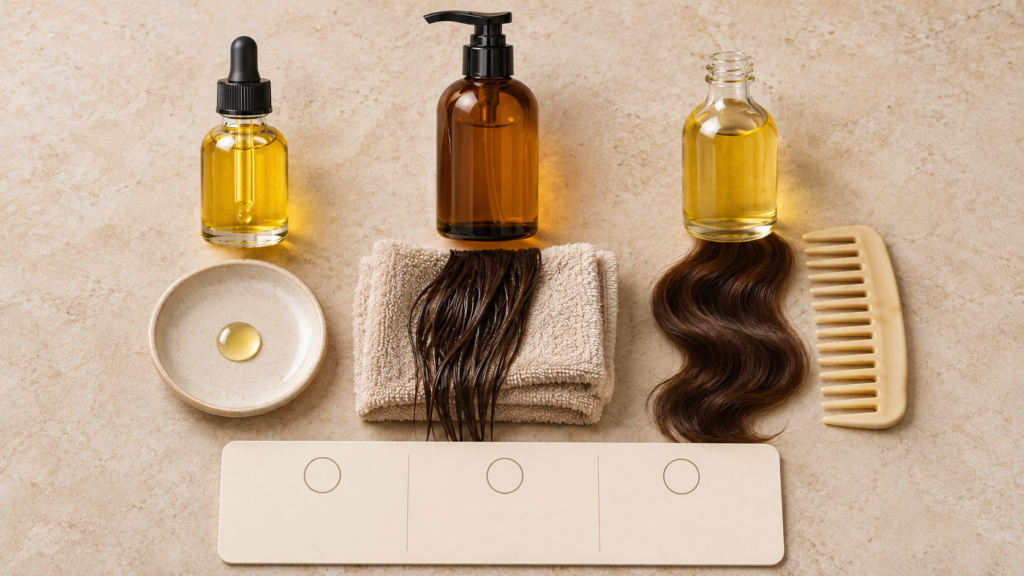
Buying framework
Give the Oil One Job First
Routine building starts with placement. One bottle can sometimes work at more than one stage, but the first purchase should solve the step you can describe and measure.
Pre-wash buffer: Use oil before cleansing when the goal is to reduce a stripped feeling on the lengths or make detangling easier before shampoo. The routine must include a realistic contact period and a cleanser that removes the amount used.
Damp-hair seal: Apply a very small amount after leave-in or conditioner when the goal is to slow the loss of a smooth, conditioned feel. Oil does not add water, so it should not replace the step that provides slip or hydration.
Dry-hair finish: Reserve a drop-level dose for flyaways, gloss, or rough ends after hair is dry. This position needs the most precise dispenser because excess shows immediately in separation and lost movement.
Scalp step only when intended: Do not assume every hair oil belongs on the scalp. Check the product directions and your own tolerance; a lengths-focused routine can keep oil away from the roots entirely.
One variable per trial: Add the oil at one stage and keep the surrounding wash routine stable. You can then tell whether the change came from the oil, the dose, or a different conditioner or styler.
Who this is for
Match the Routine to Hair State and Schedule
Useful profiles differ by application condition and tolerance, not by a vague hair-type label.
Fine hair that loses movement: Start with a narrow-opening or pump bottle, use the smallest repeatable dose on the ends, and favor dry-hair finishing only when needed. A rich pre-wash step may be easier to cleanse than daily layering.
Dense or long hair with uneven coverage: Choose a dispenser that can be counted and distribute the dose across sections in your palms before touching the hair. Sectioning matters more than pouring extra product over the surface.
Textured hair in a layered routine: Identify whether the oil sits over a leave-in, under a styling product, or only on dry ends. The surrounding creams and gels determine how much additional coating the routine can tolerate.
Frequent washers: A light, repeatable post-wash or finishing dose may fit better than a long pre-wash treatment. Judge the routine by cumulative feel across several washes, not the gloss after one use.
Infrequent washers or protective styles: Plan where oil can be placed without repeatedly disturbing the style. Keep scalp application separate from length maintenance and set a reset point rather than adding more whenever shine fades.
What to pay attention to
Choose Characteristics That Control the Routine
The most useful product characteristics tell you how accurately the oil can be placed, spread, and removed.
Application lens
Compare dose increment, spread, placement, and whether the dispenser stays clean.
Reset lens
Compare residual feel, transfer, cleansing demand, and how many uses occur before hair needs a reset.
Dispenser control: Droppers, pumps, and reducer openings deliver different increments. Choose the format that lets you repeat a dose without free-pouring, especially for fine hair or dry finishing.
Viscosity and spread: A fluid oil travels quickly and can cover a section with less rubbing; a thicker blend may stay where placed but require more deliberate distribution. Neither feel is universally lighter once the total dose changes.
Slip versus residual film: Immediate glide can help detangling or finishing, while the remaining film controls how hair moves later. Evaluate both the application feel and the dry result before increasing frequency.
Rinse and cleansing demand: A pre-wash amount that needs repeated shampooing may cancel the comfort you wanted. The usable dose is the amount your normal cleansing step removes without turning wash day into a correction cycle.
Scent exposure: Oil left on dry hair can keep fragrance close to the face for hours. Treat scent intensity and persistence as routine variables, particularly for frequent use.
Packaging and storage: Dark or opaque packaging, a secure cap, and a clean dispensing path can make daily handling easier. Store the bottle according to its label and keep water out of the opening.
Avoid these traps
Avoid Routine-Building Traps
Most failed oil routines use an undefined job, an uncontrolled dose, or too many overlapping products.
Adding oil because hair looks dry: A dull or rough appearance does not reveal whether hair needs conditioning, less heat, a trim, or a finishing film. Define the observable job before adding another layer.
Free-pouring into the palm: An unmeasured puddle makes it hard to repeat a good result or diagnose a heavy one. Use countable drops or pumps and record the starting amount.
Applying at every stage: Pre-wash, damp-hair, and dry finishing applications can stack. Begin at one position; add a second only when it solves a separate problem without erasing movement.
Using more to fix uneven coverage: Surface gloss with dry inner sections usually calls for better sectioning and palm distribution, not a larger total dose. Divide the existing amount before increasing it.
Treating oil as heat protection: Do not infer thermal protection from shine, slip, or the word oil. If heat protection is required, use a product with directions that explicitly cover the intended heat-styling step.
Never defining a reset: Repeated coating can make the routine progressively harder to read. Set a wash, cleansing, or pause condition that returns hair to a useful baseline.
Decision guidance
Build the Routine in Five Controlled Steps
A small trial grid is more useful than buying several oils at once.
Step 1: name the job: Write one outcome such as easier pre-wash detangling, smoother damp lengths, or polished dry ends.
Step 2: choose one stage: Place the oil before washing, on damp conditioned hair, or on dry hair. Do not test all three positions together.
Step 3: set a starting dose: Use the smallest countable amount that can reach the intended sections after being spread across both palms.
Step 4: hold the routine steady: Keep cleanser, conditioner, leave-in, styling products, and drying method consistent for several comparable uses.
Step 5: route the result: If coverage is patchy, improve sectioning. If movement is lost, reduce dose or frequency. If the job is not solved, reconsider stage or product rather than automatically adding more.
Ownership & compatibility
Keep the Routine Legible Over Time
A workable oil routine includes handling, storage, and a rule for change.
Write down the dose and stage: Record drops or pumps, application condition, placement, and wash interval. “A little” is not precise enough to repeat.
Protect the dispensing path: Close the bottle promptly, wipe residue from the neck, and avoid touching a dropper to wet hair or skin. Follow the maker’s storage and use directions.
Watch transfer points: Check collars, pillowcases, headwear, and phone surfaces when oil is used on dry hair. Transfer can reveal excess before the mirror does.
Review after several cycles: Judge movement, separation, detangling, finish, and cleansing demand across comparable wash cycles. One unusually humid day or one heavy conditioner can distort the result.
Change one control: Adjust dose first, then frequency, then stage. Switching product, application position, and wash routine together destroys the evidence you built.
FAQ
Hair-Oil Routine Questions
These answers resolve placement and dosing decisions that remain after choosing a routine job.
Should hair oil go on wet or dry hair?
How many drops of hair oil should I use?
Can I use hair oil before every wash?
Do I need both a serum and a hair oil?
Should I put hair oil on my scalp?
Can hair oil replace leave-in conditioner?
Why does hair oil look greasy on me?
How do I know when to clarify or reset?
Can hair oil protect against heat styling?
Readiness check
Choose the Oil That Fits a Repeatable Slot
The best first bottle is the one you can dose, place, and evaluate without rebuilding the rest of wash day.
Assign one job: Choose pre-wash buffering, damp-hair finishing, or dry-hair polish.
Control the amount: Favor a dispenser that produces countable increments.
Match the stage: Apply under the same hair condition during the trial.
Plan the reset: Know when reduced frequency or cleansing returns the baseline.
Earn extra steps: Add another oil position only when it solves a separate, observed problem.
Routine-Building Shortcuts
Jump to the control that changes where oil belongs.
Six Routine Controls
Set these before adding another bottle.
- Job: Name the result this oil must deliver.
- Stage: Choose pre-wash, damp, or dry use.
- Dose: Count drops or pumps.
- Placement: Define roots, lengths, or ends.
- Frequency: Tie use to a wash schedule.
- Reset: Know when to reduce or cleanse.
Useful Routine Terms
Plain language for evaluating oil in use.
When a Top 10 List Helps
Use rankings after defining the routine slot.
- The stage is fixed: Compare oils meant for the same application moment.
- The dose can be controlled: Prioritize bottles that dispense repeatably.
- The finish is defined: Separate gloss, slip, and pre-wash goals.
- The reset is realistic: Choose an amount your normal wash can handle.
Already have a shortlist? A Comparison can help resolve the remaining tradeoffs.
When a Comparison Helps
Compare finalists using the same routine controls.
- Dispensers differ: Compare countable increments and mess risk.
- Textures differ: Compare spread, placement, and residual film.
- Stages differ: Keep pre-wash and finishing products in separate lanes.
- Schedules differ: Compare cumulative feel across your wash interval.
Still discovering options? Start with a Top 10 to build a relevant shortlist.