
How to Choose Hair Oils for Ingredient and Formula Checks
A hair oil may be a plant-oil blend, a silicone-led serum, an ester-rich finisher, or a mixture of all three. Read the current ingredient list to identify the base, then compare aromatics, oxidation risk, package protection, dose, and washability. One featured oil never describes the whole formula.
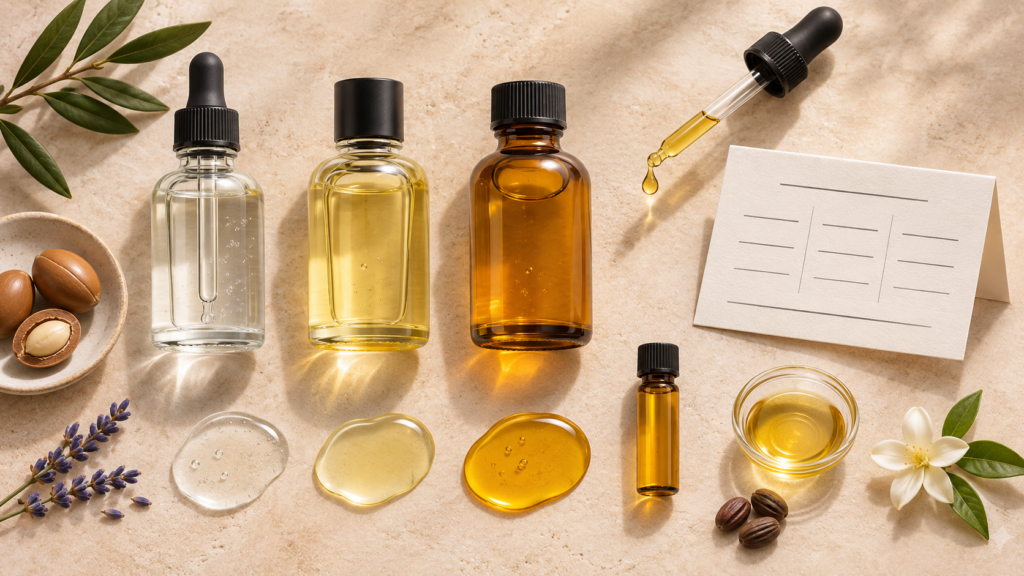
Buying framework
Read the Formula Before Chasing a Hero Ingredient
Start by naming the liquid system in the bottle. Then use directions, ingredient roles, packaging, and a controlled amount to decide whether that system belongs in your routine.
Identify the base system: Separate oil-dominant blends from silicone- or ester-led serums and mixed formulas. Similar bottles can deliver very different spread, evaporation, coating, and wash-out behavior.
Read directions beside INCI: Placement, starting dose, rinse status, and contact time explain how the finished formula is meant to be used. Ingredient order alone cannot supply those instructions.
Screen the complete current list: Check every ingredient when avoiding fragrance, an essential oil, a botanical, a silicone, a nut-derived material, or another personal exclusion. Verify the physical package because formulas change.
Group ingredients by function: Fixed oils, volatile carriers, silicones, esters, antioxidants, fragrance, essential oils, colorants, and stabilizers solve different formulation jobs. A chemical name is not a hazard score.
Compare at the same dose: A heavy pour and a single controlled drop cannot reveal which formula is lighter. Use the smallest repeatable amount and the same placement when comparing finalists.
Who this is for
Match the Check to Your Purchase Constraint
Make the decisive screen the property most likely to rule out the bottle, from aromatic exposure to persistent coating or weak package protection.
Fragrance- or aromatic-sensitive shoppers: Look for fragrance or parfum, essential oils, and separately declared fragrance allergens where applicable. Fragrance-free, unscented, and a faint natural odor are not equivalent claims.
Fine or easily coated hair: Prioritize low-dose control and identify whether volatile carriers, silicones, esters, or fixed oils dominate the opening list. Judge dry movement and next-wash residue at a counted dose.
Plant-oil-focused shoppers: Confirm where the named plant oil appears and whether the formula is single-oil or a blend. Do not infer concentration, sourcing quality, or performance from front-label prominence.
Scalp-contact users: Choose a finished product explicitly directed for scalp use, review fragrance and essential oils carefully, and follow contact-time and wash instructions. Do not improvise with neat aromatic oils.
Oxidation- and storage-conscious shoppers: Check package protection, closure, storage guidance, and period-after-opening information. A markedly changed odor, color, or texture is more useful than a generic “clean” claim.
What to pay attention to
Translate the Ingredient List Into Useful Signals
The panel suggests the likely base and declared components. Read those clues with the dispenser and storage design because neither exact percentages nor real-world afterfeel appears on the list.
Evidence available on the bottle
Use INCI order to recognize the likely base, locate declared exclusions, and note materials related to aroma or stability.
Evidence that requires use
Only a repeatable dose can show spread, evaporation, coating, transfer, scent persistence, and next-wash removal.
Ingredient sequence: The order offers a rough map of the dominant system, then becomes less informative among small additions. It cannot supply percentages, dose, or a prediction of finished feel.
Fixed oils and butters: Argan, coconut, jojoba, seed oils, and similar materials differ in composition and feel, yet the finished blend and dose determine spread and residue. Count neither names nor botanicals.
Silicones, esters, and volatile carriers: These can change slip, shine, evaporation, and coating. Identify the formula family before calling the product a pure oil or assuming every unfamiliar name is undesirable.
Essential oils and fragrance: Aromatic materials can affect scent and tolerance, especially with scalp contact. Plant origin does not guarantee gentleness, and concentrated essential oils should not be applied neat.
Antioxidants and stability support: Tocopherol and other antioxidants may help protect a formula, but their presence does not establish freshness or shelf life. Package, storage, closure, and observed change still matter.
Bottle, dispenser, and light exposure: Dark or opaque packaging can reduce light exposure, while a pump, dropper, or nozzle controls air contact and dose differently. Evaluate the ingredient list and delivery system together.
Avoid these traps
Avoid Ingredient-List Shortcuts
The fastest way to misread an oil is to turn one clue—botanical prominence, ingredient order, or an unfamiliar name—into a conclusion the bottle cannot support.
Buying for the featured oil: A large argan, rosemary, or coconut claim does not reveal the complete base or exact concentration. Read the current list and directions before assigning the formula a job.
Treating silicone as automatic buildup: Coating depends on the specific material, dose, frequency, other products, and cleansing. Compare finished feel and wash recovery instead of rejecting a name by category.
Applying essential oil neat: Concentrated aromatic oils can irritate skin. Choose a finished formula with clear scalp directions rather than improvising dilution from social-media recipes.
Equating natural with gentle: Botanical origin does not guarantee tolerance or stability. Screen personal exclusions and stop use if burning, swelling, or worsening irritation occurs.
Ignoring reformulation: Retailer pages can lag behind package changes. Verify the bottle you receive whenever a fragrance, allergen, silicone, botanical, or other exclusion is important.
Comparing unequal doses: More product magnifies residue and cleansing burden. Count drops or pumps and hold placement constant before deciding that one formula is heavier.
Decision guidance
Use a Fast Formula Check at the Shelf
Move from composition to ownership in a fixed order so a highlighted botanical never overrides the base system, exposure, package, and measured-dose evidence.
Step 1: identify the formula family: Classify it as fixed-oil dominant, silicone or ester led, volatile serum, or a mixed system.
Step 2: verify intended use: Confirm scalp, lengths, ends, pre-wash, damp-hair, dry-hair, and rinse directions.
Step 3: screen exclusions: Read the complete current package list for ingredients that matter to you.
Step 4: check stability and delivery: Compare bottle protection, closure, dispenser, storage guidance, and period after opening.
Step 5: compare equal doses: Use the same drops-or-pumps amount and judge spread, scent, residue, movement, transfer, and next-wash recovery.
Ownership & compatibility
Run a Bottle-and-Dose Trial
Keep the test narrow enough to connect the observed result to this formula rather than to the rest of the routine.
Capture the label: Photograph the ingredient panel, directions, batch details, and period-after-opening mark so a later formula or stability question is traceable.
Prime the dispenser consistently: Use the same pump, dropper fill, or counted drops each time; an uncontrolled pour makes formula comparisons unreliable.
Hold placement steady: Choose ends, lengths, or a directed scalp zone and avoid expanding coverage during the first comparison.
Track formula signals: Record spread, evaporation, aroma, shine, strand separation, tack, fabric transfer, and the feel before and after the next wash.
Stop when tolerance changes: Discontinue as directed for burning, swelling, marked redness, or worsening discomfort, and obtain appropriate care when a response is severe or persists.
FAQ
Ingredient and Formula Questions
These answers keep ingredient checks evidence-based and practical.
What can the opening ingredients tell me?
Does a long oil list mean a richer formula?
Should I reject a hair oil that contains silicones?
How can I tell whether an oil is plant-oil based?
Is fragrance-free the same as unscented?
Can I calculate percentages from ingredient order?
What does tocopherol mean in hair oil?
Is a retailer page enough for an exclusion check?
Does a clean ingredient screen guarantee tolerance?
Readiness check
Choose the Formula Behind the Featured Oil
A defensible purchase connects label evidence to package design and a dose you can repeat.
Classify the base: Know whether fixed oils, silicones, esters, or volatile carriers lead the formula.
Verify this bottle: Use the current physical ingredient panel when an exclusion matters.
Check aromatic exposure: Account for fragrance, essential oils, placement, and contact time.
Inspect delivery and storage: Match the closure, dispenser, and light protection to realistic ownership.
Compare equal amounts: Let controlled afterfeel, transfer, and wash recovery settle the choice.
Formula-Check Shortcuts
Go straight to the evidence that separates one oil system from another.
Six Formula Checks
Use these before choosing a bottle.
- Base: Fixed oil, silicone, ester, volatile, or blend?
- Directions: Check zone, dose, timing, and rinse status.
- Exclusions: Screen the complete current list.
- Aromatics: Review fragrance and essential oils.
- Stability: Check package, closure, and storage.
- Trial: Compare the same measured dose.
Useful Formula Terms
Plain language for reading hair-oil labels.
When a Top 10 List Helps
Rankings become useful only after the formula family and exclusions are fixed.
- The base is classified: Keep plant-oil blends separate from serum-style finishers.
- The exclusion is explicit: Filter fragrance, aromatics, or other restricted materials first.
- The package is workable: Demand a dispenser that makes the intended dose repeatable.
- The label is current: Verify the physical bottle before application.
Already have a shortlist? A Comparison can help resolve the remaining tradeoffs.
When a Comparison Helps
Put finalists side by side using the same label and ownership questions.
- Opening systems differ: Contrast fixed oils with silicone, ester, and volatile-carrier bases.
- Aromatics differ: Compare fragrance, essential oils, and intended contact zone.
- Protection differs: Compare amber glass, opaque packs, closure, and storage guidance.
- Dose differs: Normalize pumps or drops before comparing residue and washability.
Still discovering options? Start with a Top 10 to build a relevant shortlist.