
How to Choose Hair Pomade for Ingredient and Formula Checks
A pomade label can tell you what is present, but not exactly how the product will scoop, spread, hold, or wash out. Use the ingredient list as a formula map: identify the base, structure, film formers, conditioning materials, fragrance, and colorants, then confirm those clues against directions and a controlled first use.
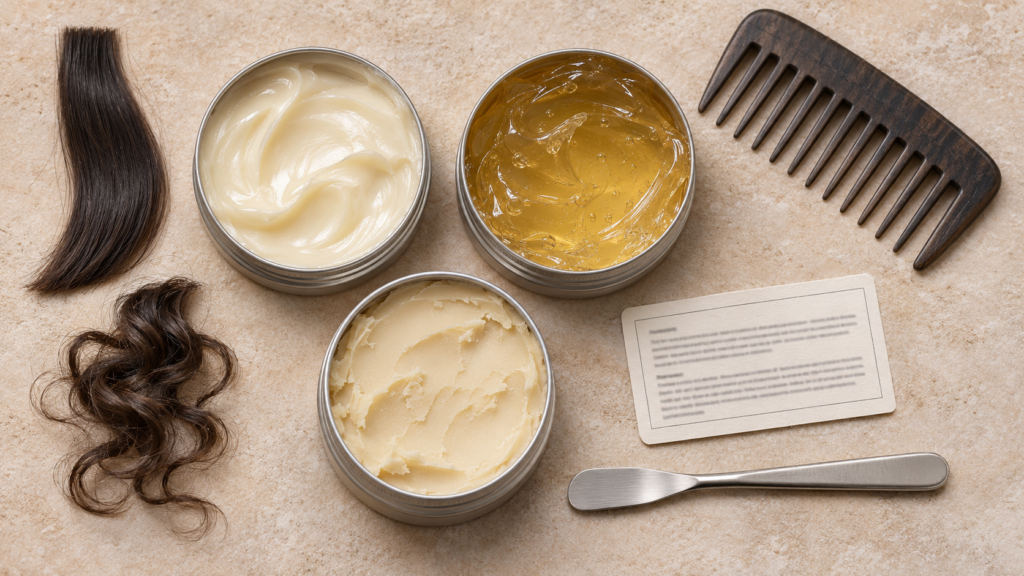
Buying framework
Read the Formula in Layers
No single ingredient predicts the finished pomade. Start with the formula architecture, then connect it to use.
Base: Water, oils, silicones, or mixed systems shape spread, shine, and removal, but the complete blend matters more than the first ingredient alone.
Structure: Waxes, fatty materials, clays, and thickeners build firmness and texture. Their proportions and processing determine whether the product feels creamy, tacky, or stiff.
Hold system: Film-forming polymers and resins can add set and durability. Look for the hold claim and directions because an ingredient name does not reveal its concentration or final performance.
Finish modifiers: Oils, powders, silicones, and pigments influence gloss, slip, separation, and visual weight. Matte does not automatically mean dry, and shine does not mean conditioning.
Optional extras: Fragrance, colorants, botanical extracts, and preservatives serve different functions. Evaluate them through personal preferences, label disclosures, and actual tolerance rather than a universal good-or-bad list.
Who this is for
Match the Check to Your Priority
Different buyers need different label questions; the longest ingredient list is not automatically the worst.
Easy washout: Compare the stated base, directions, and cleansing guidance, then confirm removal with your normal wash. Water appearing first is a clue, not a guarantee.
Low-fragrance routine: Look for explicit fragrance-free wording and inspect the ingredient declaration for fragrance or parfum. Unscented can still contain materials used to mask odor.
Firm structure: Expect waxes, clays, fatty alcohols, or film formers to contribute, but judge drag and breakability in use rather than counting them.
Flexible restyling: Favor claims and directions that describe pliability or reactivation. A polymer-rich formula may still flex, while a wax-heavy product may become increasingly tacky when layered.
Known sensitivities: Use the exact ingredient declaration to avoid a personally identified trigger. Broad clean, natural, or hypoallergenic language cannot replace that specific check.
What to pay attention to
Translate Label Clues Into Product Behavior
Treat each clue as a hypothesis to verify during a controlled first use.
Label clue
What functional group appears to build the base, structure, hold, finish, or preservation system?
Use check
Does the pomade actually spread, set, wear, and wash out the way the complete label and directions suggest?
Ingredient order: Cosmetic ingredients are generally listed in descending order of predominance until the lower-concentration portion, where ordering rules allow more flexibility. Order does not provide exact percentages.
Water and humectants: Water can support easier spreading, while humectants help manage moisture in the formula. Neither predicts hold, humidity response, or washout by itself.
Waxes and fatty structurers: Beeswax, plant waxes, petrolatum, and fatty alcohols can build body, glide, or occlusion. The blend determines whether the pomade scoops cleanly or drags.
Polymers and resins: Film formers can support hold and humidity resistance. Performance depends on polymer type, amount, neutralization, and the rest of the vehicle.
Fragrance and color: Fragrance or parfum may represent a mixture disclosed under one label term; color additives may appear by standardized names. Decide whether these functions matter to your routine.
Preservation and packaging: Water-containing products need contamination control. Keep the jar clean, follow storage directions, and do not treat the absence of a familiar preservative name as proof that a formula is safer.
Avoid these traps
Avoid Ingredient List Shortcuts
Fast label rules often erase concentration, formulation, exposure, and individual response.
Judging the first ingredient alone: The leading ingredient describes predominance, not the complete sensory or hold system.
Treating chemical names as danger signals: Cosmetic ingredients use standardized technical names. Familiarity is not a measure of safety or suitability.
Assuming natural means gentler: Plant-derived materials can be fragrant, allergenic, or simply unsuitable for a particular person, just as synthetic materials can be well tolerated.
Using free-from claims as a full review: A claim about one omitted material says nothing about dose control, fragrance, hold, residue, or every other ingredient.
Reading order as percentage: The list does not disclose exact concentration, and ingredients at lower levels may not be strictly ordered relative to one another.
Testing several variables at once: Switching pomade, shampoo, and styling routine together makes it hard to identify which change produced the result.
Decision guidance
Run a Controlled Formula Check
A short, consistent trial answers what the ingredient list cannot.
Verify the current label: Check the package you will use; online retailer lists and older photos can be incomplete or outdated.
Choose one target area: Use the smallest practical amount on a limited styling zone so spread, finish, and removal are easy to observe.
Keep the routine stable: Use the same shampoo, tools, dose method, and wear window when comparing two formulas.
Record the full cycle: Note scoop, emulsification, drag, hold, shine, transfer, residue, and washout—not just the first five minutes.
Stop at a concerning reaction: Remove the product as directed and discontinue use if burning, swelling, marked itching, sores, or another worrying response occurs; seek appropriate professional guidance when symptoms are severe or persist.
Ownership & compatibility
Keep Formula Checks Current
Labels, packaging, and handling can change what you are actually evaluating.
Save the lot and label details: Photograph the ingredient panel and note the purchase date so a future reformulation is easier to recognize.
Use clean hands or a tool: Avoid adding water, hair, or debris to a jar, especially when the formula is repeatedly opened.
Follow the period-after-opening mark: The open-jar symbol and storage directions help define the intended use period; discard a product that changes unexpectedly.
Recheck after reformulation: A familiar product name does not guarantee identical ingredients or behavior across versions.
Compare cost per successful use: A concentrated pomade may last longer, but only if its dose, comfort, wear, and removal fit the routine.
FAQ
Hair Pomade Ingredient and Formula Questions
Use these answers to interpret labels without overpromising what they reveal.
Does the first ingredient tell me whether a pomade is water based?
Are shorter ingredient lists better?
What ingredients create pomade hold?
What makes a pomade shiny?
Does alcohol in pomade always dry hair?
How can I check for fragrance?
Is water-based pomade always easier to wash out?
Can I patch test a pomade?
When should I stop using a pomade?
Readiness check
Use the List as a Map, Not a Verdict
The strongest formula check connects label evidence with one controlled, observable use cycle.
Map the system: Identify base, structure, hold, finish, fragrance, and preservation.
Verify the package: Use the current label rather than a copied retailer list.
Test one variable: Hold dose, routine, and wear window steady.
Observe the cycle: Judge application through washout.
Keep personal triggers specific: Avoid known ingredients without turning the whole list into a fear score.
Formula Check Shortcuts
Jump to the label question you need.
Six Formula Checks
Use these before accepting a label claim.
- Base: Identify the main vehicle.
- Structure: Find waxes, clays, and thickeners.
- Hold: Look for film formers and directions.
- Finish: Separate shine from conditioning.
- Extras: Check fragrance and color preferences.
- Reality: Confirm behavior through washout.
Useful Formula Terms
Plain-language label vocabulary.
When a Top 10 List Helps
Use rankings after defining your formula priorities.
- The base matters: Filter for the wear and washout pattern you need.
- Fragrance matters: Verify current label disclosures.
- Hold matters: Compare claims with the formula system.
- Finish matters: Choose shine or matte intentionally.
Already have a shortlist? A Comparison can help resolve the remaining tradeoffs.
When a Comparison Helps
Compare finalists under the same use conditions.
- Spread differs: Check scoop and emulsification.
- Hold differs: Keep dose and styling zone steady.
- Residue differs: Inspect tools and strands after wear.
- Washout differs: Use the same cleansing routine.
Still discovering options? Start with a Top 10 to build a relevant shortlist.