
How to Choose Hair Serums for Hair Treatments Routine Building
A serum earns a place in a hair-treatment routine only when it fills a defined gap. Decide whether the missing job is scalp care, damp-hair slip, heat styling, humidity control, or dry-end finishing. Then choose a formula whose dose and position work with the products you already use.
Buying framework
Give Every Treatment Step One Job
Routine building starts by finding the uncovered need, not by adding another promising bottle.
Map the routine before shopping: List shampoo, conditioner, masks, leave-ins, heat protectants, stylers, oils, and scalp products in application order. Mark which result each already provides.
Find the untreated moment: A serum may belong before styling for slip, before heat for labeled protection, after drying for flyaways, or on the scalp on its own schedule. The timing should follow the missing job.
Separate scalp care from strand care: Scalp serums are applied by part and follow skin-contact directions. Strand serums are distributed through lengths. Do not make one product serve both zones unless its label clearly allows both.
Set a coating budget: Conditioner, leave-in cream, mousse, oil, and serum can all leave material on the hair. Fine hair reaches its weight limit sooner, while coarse or porous lengths may tolerate more.
Choose the result you will measure: Define success as easier detangling, less halo frizz, protected heat styling, smoother ends, or comfortable scalp feel. A visible target prevents routine creep.
Who this is for
Match the Serum to the Existing Routine
The same serum can be useful or redundant depending on what surrounds it.
Minimal wash-day routine: If you use only cleanser and conditioner, a light damp-hair serum can add slip or frizz control without requiring several styling layers.
Leave-in and cream already in place: Choose a low-dose finisher only if the current pair leaves flyaways or rough ends. Another all-over conditioning serum may simply repeat their coating.
Heat-tool routine: Make an explicit heat-protection claim and directions the entry requirement. Decide whether the serum replaces a spray or sits beneath it, because duplicate coverage can flatten the result.
Curly or textured styling routine: Place serum according to the desired effect: beneath gel when it improves slip without weakening hold, or after the cast is set when a tiny amount softens and adds surface gloss.
Scalp-treatment routine: Use a precision nozzle or dropper product designed for scalp contact. Keep it distinct from wash-day strand layers and follow the labeled frequency rather than applying automatically every day.
What to pay attention to
Read Formula Clues Through the Routine
A useful label reading asks what the serum adds, where it sits, and what it may conflict with.
Sequence lens
Which step comes immediately before and after the serum, and does the formula disturb spread, hold, or drying time?
Load lens
How much total conditioning and film remains on the hair after all leave-ins, and can the serum replace rather than duplicate a step?
Water-led fluids: These usually spread easily on damp hair and can fit early in the leave-in sequence. Humectants and film formers still determine whether the dried result feels soft, tacky, or humidity-sensitive.
Silicone-led finishers: These can reduce friction and improve surface smoothness. Volatile and persistent silicones behave differently, so judge the final movement and wash-out rather than treating the ingredient family as one texture.
Oil and ester blends: Richer blends can seal the feel of dry ends but may duplicate an oil step. Replace the oil during the trial instead of stacking both from the first use.
Hold and film-forming ingredients: Some serums leave a flexible film that supports humidity control; others mainly add slip. A formula that changes curl hold or cream spread should be tested beneath one styler at a time.
Claim and direction match: Heat, scalp, bond, or anti-frizz language matters only when the directions explain the intended placement and timing. A hero ingredient alone does not define the routine role.
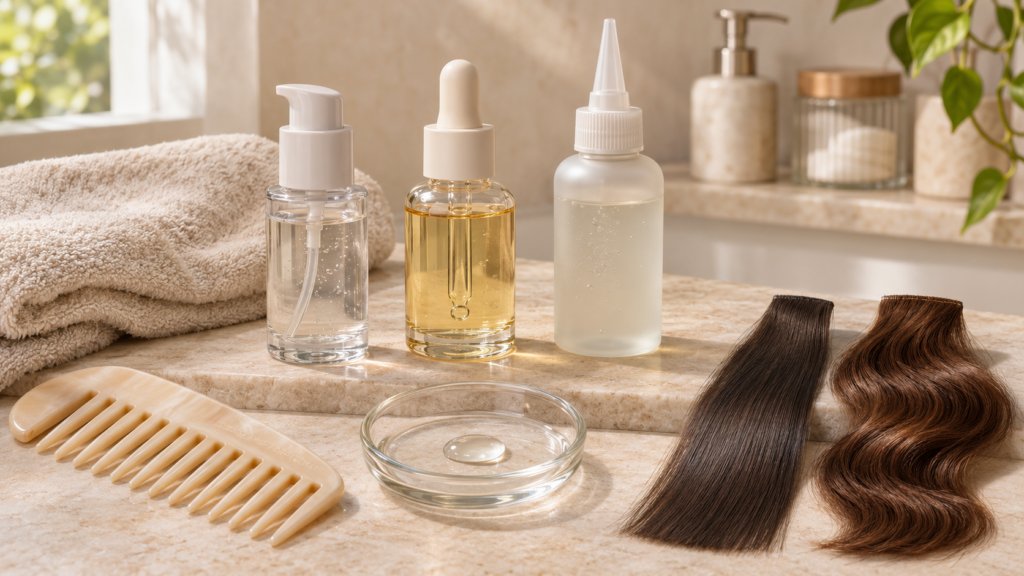
Dispenser output: A pump suits repeatable palm dosing, a dropper allows small increments, and a nozzle targets scalp parts. Package control matters because one excess dose can distort every later layer.
Avoid these traps
Avoid Routine-Building Dead Ends
Most crowded routines grow from adding products without removing overlap or fixing the application order.
Buying before identifying the gap: A popular serum cannot improve a routine whose missing result is undefined. Write down the problem and the stage when it appears first.
Adding instead of substituting: When testing a smoothing serum, pause the oil or overlapping finisher. Otherwise a good formula can look heavy because the combined routine exceeded the hair’s coating budget.
Applying every leave-in at full dose: Label amounts assume different hair lengths and may not account for other products. Start at the low end and divide the total coating across the routine.
Using the wrong order: A rich oil under a water-based treatment can change spread, while a serum over wet gel may disturb hold. Follow directions and place lighter water-led steps before richer finishers when compatible.
Judging before the hair is dry: Wet slip does not reveal volume, tack, cast formation, flyaways, or residue. Evaluate the complete dried style and the next morning before changing the sequence.
Changing several steps together: A new mask, serum, and styler introduced at once make cause impossible to trace. Hold the rest of the routine constant for a few comparable uses.
Decision guidance
Choose the Serum by the Gap in the Sequence
Use the first point of failure to decide whether a serum belongs in the routine at all.
Tangling starts after rinsing: Try a light damp-hair serum after leave-in conditioner, or use it as the only leave-in if conditioning is otherwise adequate. Prioritize spread and combing with minimal weight.
Frizz appears as hair dries: Choose an anti-frizz film that can be distributed before the main styler. Test whether it preserves curl or blowout structure instead of adding it automatically on top.
Heat tools are the fixed step: Select a product explicitly directed for heat styling, then remove any redundant protectant during the trial. Coverage and labeled use matter more than shine.
Ends look rough only after styling: Use a tiny dry-hair finishing dose on the last few inches. This late placement avoids loading the roots and leaves the wash-day base unchanged.
The concern begins at the scalp: Choose a scalp-directed formula with clear frequency and contact instructions. Persistent pain, sores, marked redness, or sudden or patchy shedding should not be managed by routine expansion alone.
Ownership & compatibility
Run a Controlled Routine Trial
A simple change log shows whether the serum improves the full routine rather than one moment of application.
Establish a baseline wash: Repeat the current routine once and record tangling, drying time, volume, frizz, hold, end feel, and next-day residue.
Replace one overlapping step: Introduce the serum while pausing the closest duplicate, such as oil or smoothing cream. Keep cleanser, conditioner, tools, and technique stable.
Fix dose and sequence: Count pumps or drops and note whether hair was wet, damp, or dry. Use the same order for two or three comparable styling sessions before adjusting.
Check three time points: Assess the fully dried result, the next morning, and the next wash. A useful serum should not demand extra cleansing or shorten the style just to improve initial gloss.
Keep, move, reduce, or remove: If the result is too heavy, reduce dose or move application lower on the lengths. If the benefit duplicates another step, keep the simpler or more reliable product.
FAQ
Hair Serum Routine Questions
These answers cover sequencing, substitution, frequency, and troubleshooting.
Where does hair serum go in a treatment routine?
Should serum go before or after leave-in conditioner?
Can serum replace hair oil?
Do I still need serum if I use a hair mask?
Can I layer serum under mousse or gel?
How often should serum be used?
Why does my routine feel greasy after adding serum?
Should heat-protectant serum replace heat spray?
How long should I test a serum routine?
Readiness check
Build the Smallest Routine That Solves the Problem
A serum should clarify the treatment sequence, not make it harder to understand.
Name the missing job: Shop only after you can point to the stage and result that need help.
Prefer replacement over accumulation: Trade a serum for the closest duplicate before adding another permanent layer.
Sequence by formula and directions: Place water-led treatments, stylers, finishers, and scalp products where each can work without blocking the next.
Measure the whole style cycle: Judge dry finish, hold, next-day feel, and wash-out rather than the first minute of slip.
Keep the routine explainable: If every product has one distinct job and a repeatable dose, troubleshooting stays possible.
Routine-Building Shortcuts
Jump to the step that resolves overlap or order.
Six Routine Checks
Use these before adding a permanent step.
- Gap: Which result is still missing?
- Moment: When does the problem first appear?
- Zone: Scalp, roots, lengths, or ends?
- Overlap: Which current product does the same job?
- Order: What sits directly before and after?
- Proof: What dried result will justify keeping it?
Routine Terms
Plain language for sequencing and troubleshooting.
When a Top 10 List Helps
Use rankings after the missing routine job is clear.
- The gap is defined: Filter by wash-day, heat, finishing, or scalp role.
- One step will be replaced: Shortlist formulas that can take over that job.
- Dose control matters: Compare pumps, droppers, and nozzles.
- The trial is planned: Check directions, sequence, and wash-out burden.
Already have a shortlist? A Comparison can help resolve the remaining tradeoffs.
When a Comparison Helps
Compare finalists within the same routine position.
- Sequence is fixed: Compare formulas intended for the same application moment.
- Overlap differs: See which product can replace an existing step.
- Finish differs: Compare movement, hold, volume, and residue.
- Frequency differs: Compare wash-day use with touch-up or scalp schedules.
Still discovering options? Start with a Top 10 to build a relevant shortlist.