
How to Choose Hair Serums for Heat Styling Support
A serum can make heat-styled hair feel smoother, but shine and slip do not prove heat protection. Start with the label: if protection is the job, require an explicit heat-styling claim and usable directions. Then match the formula, dispenser, timing, and dose to the tool routine so every exposed section receives even coverage without excess coating.
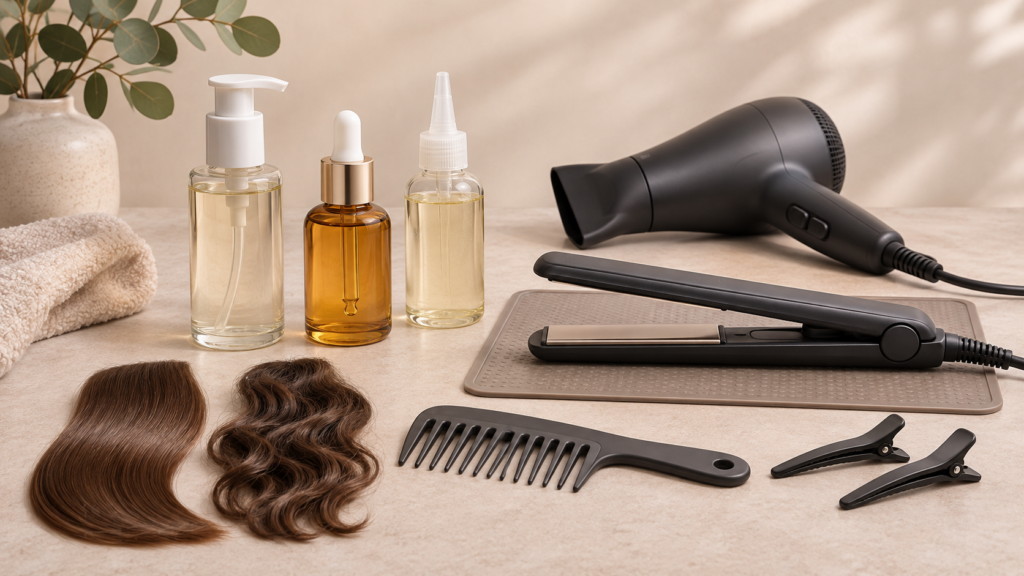
Buying framework
Define the Heat Routine Before the Serum
The same bottle can behave differently under a dryer, a brush, or repeated flat-iron passes. Map the exposure before comparing formulas.
Name the tool and sequence: Record whether you diffuse, round-brush, straighten, curl, or combine tools. Include drying stage, pass count, and whether hair is reheated between washes.
Require an explicit claim: When heat support is the purchase reason, look for a clear heat-protection or heat-styling statement plus directions. A silicone, oil, gloss claim, or slippery feel alone is not proof.
Separate protection from finish: Protection is the minimum filter. Smoothing, detangling, gloss, and frizz control are secondary benefits that help choose among products with suitable claims.
Identify the application window: Some products belong on damp hair before blow-drying; others allow dry-hair use before an iron. Follow the stated timing because water content, spread, and tool safety change with the stage.
Reduce avoidable exposure: A serum does not make unlimited heat harmless. Use the lowest effective tool setting, complete coverage, controlled passes, and appropriate drying technique alongside the product.
Who this is for
Match Coverage to Hair and Tool Pattern
Strand diameter, density, condition, and the tool determine how thinly the serum must spread and where coverage can fail.
Fine or low-density hair: Favor a light, precisely metered fluid. Begin with a small dose through mid-lengths and ends; too much coating can collapse volume before styling begins.
Dense, curly, or coily hair: Prioritize working time and section-by-section spread. A larger total amount may be appropriate, but divide it across consistent sections instead of concentrating one palmful on the surface.
Bleached or weathered lengths: Fragile zones need careful coverage and conservative heat. Concentrate the labeled product where exposure and damage overlap without treating a cosmetic serum as repair of broken structure.
Blow-dry routines: Choose directions that fit damp-hair distribution and brush technique. The product should spread before airflow and tension, then dry without leaving persistent tack on hair or tools.
Flat irons and curling tools: Confirm that dry-hair timing is allowed if applying immediately before the tool. Never place a hot tool on visibly wet or product-saturated hair, and avoid repeated passes to chase a coated finish.
What to pay attention to
Read the Claim, Formula, and Dispenser Together
The front label opens the comparison; directions, dose control, and dry-down determine whether protection can be applied consistently.
Coverage lens
Can a measured amount coat every heat-exposed section before the dryer, brush, iron, or curler reaches it?
Routine lens
Do the stated timing and dry-down fit the real tool sequence without requiring unsafe wet-tool contact or excess passes?
Claim wording and directions: Prefer a product that names heat styling and explains when, where, and how much to apply. Treat a temperature number as context, not permission to ignore your tool or hair condition.
Spread and working time: A serum must travel across each section before it dries or pools. Very fast dry-down can create missed zones; slow or tacky dry-down can interfere with brush glide and tool contact.
Film and finished movement: Film formers can reduce friction and smooth the surface. Compare flexibility, separation, and movement after styling rather than assuming a thicker or shinier film is more protective.
Dose control: A pump, dropper, or narrow nozzle should deliver repeatable increments. Coverage improves when the amount can be allocated per section instead of guessed from an uncontrolled pour.
Layering compatibility: Leave-in conditioner, cream, mousse, gel, oil, and serum may all leave films. Check the recommended order and test the actual stack because pilling, tack, or drag can undermine even distribution.
Fragrance and scalp exposure: Heat can intensify perceived fragrance. Keep a strand serum off the scalp unless directions permit it, and stop if irritation, coughing, or discomfort develops during use.
Avoid these traps
Avoid Heat-Styling Serum Mistakes
The most common errors are assuming protection, applying unevenly, and using the product to justify more heat.
Inferring protection from ingredients: A familiar silicone or oil may contribute to a film, but the finished formula and its substantiated claim matter. Buy for the labeled use, not an ingredient shortcut.
Confusing shine with protection: A glossy finish can appear after uneven application. Inspect section coverage and follow directions instead of using shine as a coverage map.
Applying one large surface dose: Coating the outer layer leaves hidden sections untreated and creates heavy spots. Divide hair first, then allocate a small repeatable amount to each section.
Using too many overlapping layers: Several leave-ins can increase drag, smoke-like vapor, residue, or slow drying. Simplify the stack and let each product keep one job.
Turning up heat to overcome coating: A tacky or damp section needs more drying time or less product, not a hotter iron. Review dose, dry-down, and tool technique before increasing temperature.
Skipping the next-day check: Residue on plates, brushes, or hair and a stiff next-day feel are part of ownership cost. A serum that requires repeated reheating to look smooth is a poor routine fit.
Decision guidance
Choose by Tool, Timing, and Finish
Use the first route that matches the actual exposure, then compare finish only among products that pass the protection and direction checks.
If you mainly blow-dry damp hair: Choose a labeled heat-support serum designed for damp application, easy section spread, and clean dry-down under airflow and brush tension.
If you iron or curl fully dry hair: Choose directions that explicitly permit the intended dry-hair timing. Apply sparingly and allow any carrier to settle as directed before tool contact.
If fine hair loses volume: Use the smallest controllable dose and keep it away from roots unless instructed. Compare light fluids by coverage per pump, not by marketing words such as weightless.
If porous ends remain rough: Use zoned application and conservative settings. More serum can improve surface feel but cannot reverse structural damage or make repeated high heat consequence-free.
If layering creates drag or residue: Remove redundant oil or cream, retest the serum alone with the core routine, and choose the combination that gives complete coverage with the fewest films.
Ownership & compatibility
Run a Controlled Three-Style Trial
A repeatable test reveals whether the product covers sections, survives the routine, and leaves acceptable residue.
Trial one: establish coverage: Keep tool, attachment, setting, section size, and pass count stable. Record pumps or drops and distribute the low labeled amount across every section.
Trial two: correct distribution first: If control is patchy, reduce section size or improve application before increasing the total dose. If hair feels coated, lower the amount and remove an overlapping layer.
Trial three: confirm repeatability: Repeat the better setup on a comparable style day. Check drying time, brush or plate glide, movement, flyaways, odor, and whether extra passes were needed.
Inspect hair and tools later: Look for residue on brushes or plates, tack, stiffness, early root collapse, or a need to reheat the style. Clean tools according to their instructions after they are unplugged and cool.
Set stop rules: Stop using the product if irritation or respiratory discomfort appears. Reduce heat and seek appropriate professional guidance for persistent scalp symptoms, sudden breakage, or marked hair loss.
FAQ
Hair Serum and Heat Styling Questions
Use these answers to check claims, timing, application, and routine limits.
Does every hair serum protect against heat?
Can I tell from the ingredient list whether a serum protects from heat?
Should heat-styling serum go on wet or dry hair?
How much serum should I use before heat styling?
Can serum replace a separate heat protectant?
Can I use heat serum with leave-in conditioner or styling cream?
Does a higher temperature claim mean I should use that setting?
Why does my hair feel stiff after using heat serum?
Should I reapply serum before touching up with heat?
Readiness check
Choose Protection You Can Apply Evenly
A credible claim is the entry ticket. The best serum is the one whose timing, spread, dose, and finished film work across every heat-exposed section without encouraging hotter settings or more passes.
Filter by the claim: Require explicit heat-styling support when that is the product's job.
Match the tool sequence: Choose directions for damp blow-drying or permitted dry-tool use.
Dose by section: Count pumps or drops and improve distribution before adding product.
Judge the whole style: Check dry-down, movement, residue, odor, and extra passes.
Keep heat conservative: Product support complements careful temperature, technique, and exposure control; it does not cancel them.
Heat-Styling Shortcuts
Jump to the check that changes protection, coverage, or tool fit.
Six Heat-Styling Checks
Use these before buying or increasing heat.
- Claim: Does it explicitly support heat styling?
- Tool: Dryer, iron, curler, or combination?
- Timing: Damp or dry application as directed?
- Coverage: Can every exposed section receive a thin film?
- Dose: Can pumps or drops be repeated?
- Exposure: What setting and pass count are actually needed?
Heat-Styling Terms
Plain language for claim and coverage decisions.
When a Top 10 List Helps
Use a shortlist after defining the tool routine.
- Claims are filtered: Compare only products intended for the heat step.
- Timing is fixed: Separate damp blow-dry use from permitted dry-tool use.
- Coverage is practical: Compare spread and dose control by section.
- Finish is defined: Compare movement, residue, and volume after styling.
Already have a shortlist? A Comparison can help resolve the remaining tradeoffs.
When a Comparison Helps
Compare finalists in the same controlled tool routine.
- Directions differ: Compare application stage and coverage guidance.
- Dose differs: Compare pump or drop output across equal sections.
- Dry-down differs: Compare tack, glide, drying time, and residue.
- Finish differs: Compare movement, flyaways, volume, and next-day feel.
Still discovering options? Start with a Top 10 to build a relevant shortlist.