
How to Choose Hair Spray for Heat Styling Support
Hair spray can support a blowout, curl set, or smooth finish, but ordinary hold language does not establish thermal protection. Choose it by the job it performs around the tool step: working grip only when the current label directs it, or finishing hold after the hair has cooled. The right spray reinforces the result without encouraging extra heat, wetting a section before direct-contact tools, or leaving a film that turns brittle when the style moves.
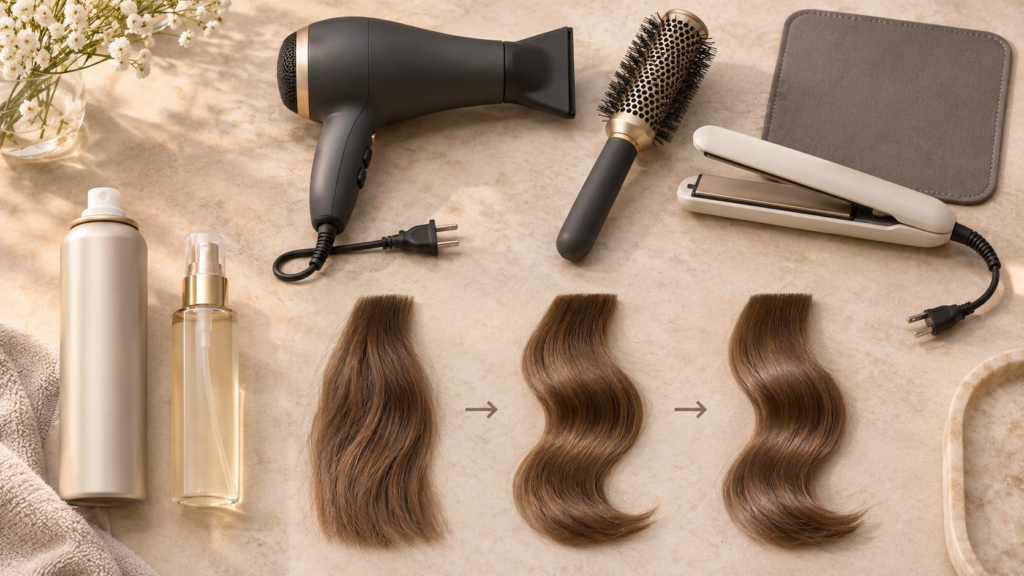
Buying framework
Separate Protection, Shape, and Hold
Assign every product and tool one job. Hair spray supports the shape; it does not inherit a protection claim it does not make.
Verify thermal protection: Use only a finished product whose current label explicitly provides thermal-protection directions for the tool and routine. A hold number, polymer list, or heat-themed image is not proof.
Name the spray job: Decide whether it adds label-directed working grip before airflow, supports sections during a set, controls flyaways, or provides final hold after cooling. One precise job prevents unnecessary layers.
Place it in sequence: Follow spray and tool directions for dampness, distance, drying, and timing. Do not close direct-contact tools over a visibly wet or tacky coating unless both manufacturers explicitly direct that use.
Match the cooled shape: Judge support only after the section cools. A touchable style needs a flexible film; a structured event shape may justify firmer hold in targeted areas.
Keep heat out of corrections: If the film is sticky, stiff, or uneven, do not add tool passes to force it into place. Cool the section and change dose, placement, or formula on the next trial.
Who this is for
Match the Spray to the Tool Routine
Start with when the spray is applied and what the finished shape must still be able to do.
Blowout finisher: For volume or smoothness after a dryer and brush, look for a fine, dry-feeling mist that settles without collapsing roots or spotting the surface.
Curl-set supporter: A flexible spray can help cooled curls retain separation while allowing gentle arrangement. A wet burst or rigid coat can join curls and make touch-ups uneven.
Sleek-style detailer: Hairline control and flyaways need precision more than maximum coverage. Targeted application limits film on the lengths when directions allow.
Pre-blow-dry user: Choose this role only when the label directs application before airflow. Spread, drying behavior, brush drag, and compatibility with the separate protectant matter most.
Frequent restyler: If the style will be brushed, wrapped, or reshaped, prioritize flexibility and clean reworkability. A film that fractures or pills is a poor match.
What to pay attention to
Read the Mist, Film, and Timing
Delivery and dried-film behavior reveal whether the spray supports the sequence or interferes with it.
Sequence lens
Does the label place the spray before airflow, after styling, or only on fully dry hair, and is every layer dry before the next directed step?
Cooled-film lens
Does the film preserve shape with the movement, finish, and reworkability the look requires?
Application timing: Look for explicit damp-hair, dry-hair, blow-dry, or finishing directions. Do not infer compatibility from the product name, imagery, or ingredient list.
Mist pattern: A fine broad mist covers a cooled shape with a small dose; a narrow pattern offers local control. Large droplets create wet spots that dry unevenly.
Set speed: Fast setting locks a detail but leaves less correction time. A workable spray allows arrangement yet must dry fully before the next directed step.
Film flexibility: Flexible films move when curls are separated or a blowout is brushed. Firmer films preserve structure but may mark, crack, or feel rough when reworked.
Layer compatibility: The spray must coexist with the actual protectant, leave-in, mousse, or serum. Beading, pilling, tack, residue, or drag call for fewer layers and a retest.
Finish and transfer: Check shine, separation, touch, and residue after cooling. Repeated passes can dull a finish that looked clean after one application.
Avoid these traps
Avoid Tool-and-Spray Mismatches
Failures usually begin by confusing hold with protection, applying wet film at the wrong time, or using heat to compensate for excess product.
Assuming hold means protection: Styling support does not prove thermal protection. Keep a separate label-directed protection step unless this exact spray explicitly covers the relevant use.
Spraying toward a hot tool: Use aerosols and pumps only as labeled, with ventilation and away from ignition or heat hazards. Never aim at a running dryer or heated plate.
Closing an iron over damp spray: Meet the tool-required moisture state. Do not put visibly wet or tacky film under plates or barrels unless explicit directions support it.
Using maximum hold by default: Rigid film can preserve an event shape yet limit brush-out and separation. Choose the least hold that keeps the cooled result intact.
Stacking wet passes: Repeated bursts before the prior coat sets create droplets and concentrated film. Use a light pass, wait, then reinforce only the section that fails.
Reheating product buildup: More passes do not remove tack or excess film. Stop, cool the section, and correct amount or sequence in a clean comparison.
Decision guidance
Let the First Failure Choose the Change
Keep the tool, setting, section size, and protectant constant. The earliest failure points to mist, timing, dose, or film type.
Roots collapse: Reduce root coverage, increase distance within directions, or choose a finer, drier mist. More hold will not restore volume already weighed down.
Curls stick together: Wait for full cooling, use less product, and separate only as the film allows. A flexible spray may suit touchable sets better.
Droplets show: Check the actuator, distance, burst length, and nozzle condition. Choose a finer pattern rather than brushing wet spots through the finish.
Film flakes: Test fewer underlying layers, reduce dose, and avoid hard brushing through a rigid coat. Repeated heat is not a remedy.
Shape falls after cooling: Confirm complete drying, section control, cool-down, and even coverage before increasing hold. Change only one variable.
Ownership & compatibility
Run a Controlled Heat-Styling Trial
Keep safety-critical tool steps fixed while the spray is the variable.
Follow every current label: Use the tool, protectant, and spray within stated moisture, distance, ventilation, drying, temperature, and sequence directions.
Hold the routine steady: Keep tool, setting, section size, brush, pass count, and cool-down time constant so the spray can be judged.
Measure application: Record burst count, distance, placement, and whether use was before airflow or after cooling. A repeatable small dose is informative.
Inspect after cooling: Check shape, movement, shine, tack, flakes, and transfer only after the section settles.
Maintain and store safely: Clean an actuator only as directed. Follow label rules for heat, flame, storage, and disposal; never puncture or incinerate an aerosol.
FAQ
Hair Spray and Heat-Styling Questions
Keep protection, tool technique, and styling hold in their proper roles.
Does hair spray protect hair from heat?
Should hair spray go before or after heat protectant?
Can I flat iron hair after spraying hair spray?
Can spray help a blowout last longer?
Why do curls feel crunchy?
Is strong hold best for heat-styled hair?
Why does spray flake when brushed?
Can I spray onto a hot brush or curling iron?
How do I compare two blowout sprays?
Readiness check
Build Around a Cooled Result
The best spray supports the shape without taking over protection or tool-safety jobs.
Verify protection: Use explicit current-label directions for the thermal step.
Choose the spray role: Place working grip or finishing hold at its directed point.
Control the mist: Use even, limited coverage and let each pass set.
Judge after cooling: Evaluate movement, finish, residue, and retention after settling.
Change one variable: Adjust dose, timing, or film without adding heat to correct a mismatch.
Heat-Styling Shortcuts
Jump to the decision that affects the tool sequence.
Six Heat-Styling Checks
Use these before increasing hold or temperature.
- Protection: The label supports the thermal step.
- Moisture: Hair meets tool directions.
- Sequence: Every layer is in place.
- Mist: Coverage is even.
- Cool-down: Shape settles first.
- Tool limit: Heat does not fix film.
Heat-Styling Spray Terms
Terms for spray behavior around tools.
When a Top 10 List Helps
Use a shortlist after sequence and role are clear.
- Directions fit: Supports the intended stage.
- Mist fits: Coverage matches the area.
- Hold fits: Shape stays without excess rigidity.
- Finish fits: Residue and movement suit the look.
Already have a shortlist? A Comparison can help resolve the remaining tradeoffs.
When a Comparison Helps
Compare finalists with tool settings unchanged.
- Mist differs: Note droplet size.
- Set differs: Compare working time.
- Film differs: Check cooled movement.
- Retention differs: Observe without added heat.
Still discovering options? Start with a Top 10 to build a relevant shortlist.