
How to Choose Hair Straighteners for Smooth Finishes
A glassy finish is not the same as hair pressed flat. A useful straightener should quiet the surface, preserve a little body, and leave the ends deliberate rather than brittle.
Judge this purchase through plate contact and restraint. Fully dried, protected hair should pass between aligned plates without catching, while a moderate setting should create polish before repeated exposure becomes necessary.
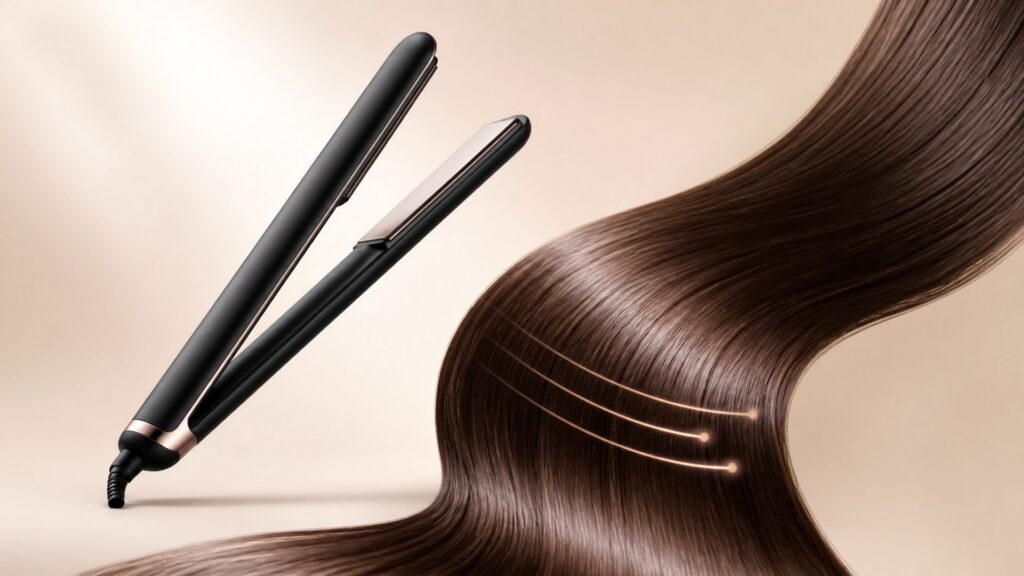
Frame the real job
Start with the result you want from a hair straightener
Describe the finish in advance: controlled flyaways, even reflection, and ends that still move.
Write a finish brief: Photograph the unstyled starting point under normal room light.
Rehearse the sequence: Use the same light afterward, since bright bathroom bulbs can disguise ridges and dry tips.
Choose a stopping rule: Reject a result that depends on oil hiding roughness.
Fit tool to user
Who benefits from this hair straightener setup?
Fine or fragile strands benefit from narrow temperature steps and a light hand.
Occasional finisher: Dense hair may favor broader plates, although width becomes clumsy around a fringe or short layers.
Routine stylist: Anyone with limited grip strength should test hinge resistance.
Technique-minded buyer: Frequent users should prioritize balance over decorative trim.
Translate the specification sheet
Features that affect smooth finishes
Close an unplugged tool and inspect whether the plates meet evenly from front to back.
Evidence from the first session
Rounded edges help prevent a crease when the wrist turns.
Evidence after repetition
Automatic shutoff and a cord that swivels freely reduce everyday worry.
Control under load: Rounded edges help prevent a crease when the wrist turns.
Contact and release: A readable temperature display is more useful than a high maximum.
Settings you can repeat: Automatic shutoff and a cord that swivels freely reduce everyday worry.
Avoid misleading trials
Common errors when testing for smooth finishes
Never test on damp hair unless the manufacturer explicitly designed the appliance for that condition.
Chasing the hottest result: Detangle, apply protectant according to its label, and let the hair dry completely.
Using showcase sections: Work with clean narrow panels.
Ignoring tool boundaries: If steam, scorching odor, or persistent snagging appears, stop rather than increasing pressure.
Spend for demonstrated value
Choose a basic model, upgrade, or keep waiting
A basic model is enough when alignment is sound, the useful heat range is accessible, and the casing feels secure.
Choose the straightforward option: Pay more for demonstrably steadier regulation or better ergonomics.
Upgrade for a named constraint: Skip premium modes that do not address the reason your present straightener fails.
Wait when evidence is thin: For how to choose hair straighteners for smooth finishes, record this point during a complete session before reaching a verdict.
Include life after checkout
Cleaning, storage, and safe use of a hair straightener
Unplug the iron, place it on a heat-resistant surface, and allow it to cool open.
Build a cooling habit: Wipe product residue using the maker's directions; never scrape a coated plate.
Clean without damaging parts: Inspect the cord near both strain-relief points.
Inspect before restarting: Retire equipment with cracks, exposed wiring, or temperature surges.
Practical answers
Questions buyers ask about a hair straightener for smooth finishes
Answers to the decisions that most often change a how to choose hair straighteners for smooth finishes shortlist.
What matters first when choosing for Smooth Finishes?
How should I test the tool at home?
Does the headline feature guarantee better results?
What is a clear reason to reject or replace it?
Make the final call
Your final hair straightener check
The final choice should create an even finish at a conservative setting with one calm pass per panel.
Return to the brief: It should also fit the hand, storage space, and actual styling frequency.
Review the whole session: If achieving shine requires gripping harder or revisiting sections, the apparent upgrade is false economy.
Record the reason: Retire equipment with cracks, exposed wiring, or temperature surges.
Reading Shortcuts
Jump to the evidence you need for a smooth finishes decision.
Decision Reminders
Keep these hair straightener checkpoints beside your shortlist.
- Desired result: Polish flyaways while retaining movement and avoiding ridges.
- Fair trial: Narrow sections and a single deliberate pass.
- Safety limit: Work on completely dry hair, use a protectant as directed, and stop if plates snag.
Glossary Snippets
Terms that clarify a hair straightener comparison.
When a Top 10 List Helps
Use a ranked list to discover credible hair straightener formats, then screen them against the smooth finishes routine.
- The format is undecided: A broad list reveals plausible forms and price levels.
- A shortlist is needed: Rankings narrow discovery but do not replace fit testing.
Have finalists already? Open the comparison section.
When a Direct Comparison Helps
Place finalists side by side only after confirming that each can perform the smooth finishes job safely.
- Two candidates remain: Side-by-side evidence exposes meaningful tradeoffs.
- An upgrade is uncertain: Compare whether added cost corrects the original weakness.
Still exploring? Start with the Top 10 section.