
How to Choose Hair Styling Products for Curly Hair
Curly-hair styling products should be chosen for a defined result: larger curl groups, stronger hold, softer movement, root lift, stretch, edge control, or longer wear in humidity. A product cannot be judged apart from water level, section size, application motion, and drying method.
Begin with one normal wash day and one styling problem. Keep cleansing and conditioning stable, record the order and amount of every layer, and evaluate the hair only after it is fully dry and any intended gel cast has been left intact or softened.
Curl-style brief
Define shape, volume, and hold before shopping
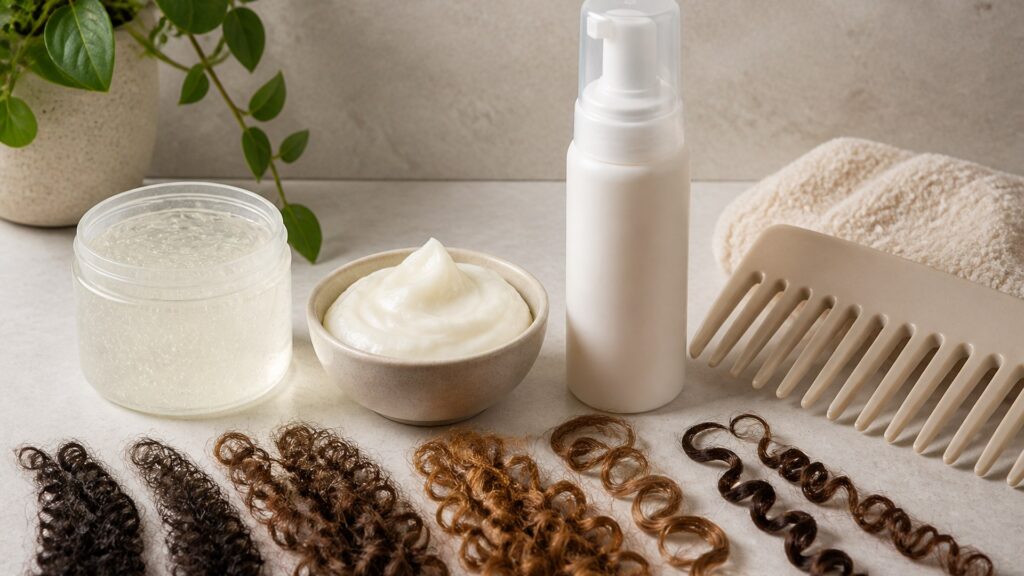
A soft cream, airy foam, firm gel, and edge product solve different parts of a curly routine. Start with the finished style rather than the longest ingredient story.
Name the curl outcome: Choose definition, elongation, volume, flexible movement, firm humidity hold, or localized control instead of asking one product to maximize all of them.
Describe the drying method: Air drying, diffusing, hood drying, plopping, and stretching alter film formation, root lift, shrinkage, and the time hair remains vulnerable to touching.
Set a feel boundary: Decide whether a temporary cast, some tack during application, fragrance, shine, or a coated next-day feel is acceptable.
Curl profiles
Match weight and hold to density and routine
Visible curl pattern is only one factor. Strand diameter, density, porosity, damage, climate, desired volume, and wash frequency change product needs.
Fine or easily flattened curls: Start with foam, light gel, or a small cream dose, keeping rich layers away from roots when lift is part of the goal.
Dense dry curls: Prioritize spread and section access, using enough water and slip to distribute product without repeatedly raking fragile interior areas.
High-humidity wearer: Compare film strength and weather performance under a consistent base routine rather than adding oil automatically when definition expands.
Formula behavior
Compare slip, film, cast, and washout
Ingredient families can suggest performance, but concentration, order, water, dose, weather, and companion products determine the actual curl result.
Wet-application evidence
Product should spread through intended sections without force, white clumps, immediate pilling, or so much manipulation that curl groups break apart.
Fully-dry evidence
Judge definition, volume, cast, softness, flakes, crunch, shrinkage, humidity response, and root weight only after moisture has left the hair.
Cream or leave-in role: Use these for slip, softness, and flexible shaping, accounting for the conditioning already supplied during washing.
Gel or custard role: Choose polymer hold and cast strength for the desired longevity, then test flaking and compatibility over the exact underlying layers.
Foam or mousse role: Consider airy distribution, quicker drying, or root volume while confirming whether hold and next-day refresh meet the routine.
Styling mistakes
Avoid fixing every weak style with another layer
More cream, gel, oil, and refresh spray can create residue and slow drying while hiding whether water level or technique caused the problem.
Breaking the cast too early: Touching or scrunching before the film is fully dry can disrupt groups and create frizz that is blamed unfairly on the gel.
Changing application and product: Keep section size, hand motion, wetness, drying, and base layers stable enough to interpret one new styler.
Refreshing the whole head daily: Target collapsed or frizzy areas first; repeated full coating can shorten wash intervals and reduce movement.
Product choice
Choose the smallest styling system that meets the goal
A complete curly routine may need one well-chosen styler or a deliberate pair, not an automatic stack of leave-in, cream, gel, mousse, and oil.
Use one gel or foam: Choose this when conditioning is already adequate and the main missing function is hold, grouping, or volume.
Pair moisture with hold: Use a light leave-in or cream beneath gel only when the combination improves slip and flexibility without flakes or excessive weight.
Add a targeted finisher: Reserve oil, pomade, or edge control for localized shine, cast softening, or precision rather than coating every curl by default.
Routine control
Record amounts, order, and reset point
Reproducible styling depends on more than a product name. Water level, sectioning, climate, and drying should be documented alongside dose.
Measure the layers: Write the approximate amount and order for leave-in, cream, gel, foam, heat protection, and finishing product.
Keep hands and tools clean: Remove old films from brushes, combs, clips, diffusers, and applicators so residue does not alter a controlled trial.
Clarify when evidence supports it: When curls become dull, tacky, difficult to wet, or unusually limp, review buildup and use an appropriate cleansing reset.
FAQ
Curly-hair styling product questions
These answers connect hold, cast, layering, application, drying, and buildup to repeatable curl results.
Do curly hair products need to create a gel cast?
Should I use cream and gel together on curly hair?
How can I tell whether curly-hair stylers are building up?
Bottom line
Let the fully dried curl pattern decide
A strong styler creates the intended shape and hold at a repeatable dose, survives the relevant climate, refreshes reasonably, and washes out before residue overtakes performance.
Fix the wash-day variables: Keep cleansing, conditioning, water, sectioning, application motion, and drying similar while comparing one product change.
Wait for complete drying: Do not score hold, cast, volume, frizz, or softness while water remains trapped inside dense or coated sections.
Keep the simpler winner: Favor the product or pair that reproduces the preferred style without unnecessary layers, prolonged drying, scalp residue, or frequent clarification.
Reading Shortcuts
Move directly to the curly hair decision stage you need.
Decision Reminders
Keep the evidence for curly hair visible while comparing.
- Role: The hair styling product serves the named task.
- Proof: The trial observes controllable shape, touchable movement, suitable finish, and reliable washout.
- Care: Close the package, keep applicators clean, and remove accumulated film on schedule.
Glossary Snippets
Useful language for comparing hair styling products.
When a Top 10 List Helps
Use rankings to discover credible hair styling products, then screen them for curly hair.
- The format is undecided: A broad list reveals plausible forms and price levels.
- A shortlist is needed: Rankings narrow discovery but do not replace fit testing.
Have finalists already? Open the comparison section.
When a Direct Comparison Helps
Compare finalists after establishing their suitability for curly hair.
- Two candidates remain: Side-by-side evidence exposes meaningful tradeoffs.
- An upgrade is uncertain: Compare whether added cost corrects the original weakness.
Still exploring? Start with the Top 10 section.