
How to Choose Hair Styling Tools for Fine Hair
Choose styling tools for fine hair by low-temperature control, heat stability, airflow, section size, plate or barrel geometry, tension, volume durability, static, and pass count.
Fine-Hair Styling Tools roadmap: Separate diameter from density; Define the finish; Start at the lowest useful exposure; Score durability without restyling; The fine oily-root user; The fine dense-hair user; The fragile color-treated user; The static-prone user; The short-style user; Lowest temperature; Control stability; Plate or barrel scale; Airflow concentration; Brush material and tension; Tool weight and speed; Buying a very high maximum; Using large sections; Repeating passes for polish; Pulling hard for root lift; Masking static with heavy oil; For root volume; For waves; For smoothing; For short fine hair; For damaged fine hair; Count passes; Remove product residue; Check cord drag; Retire snagging surfaces. Fine-Hair Styling Tools audit order: Retire snagging surfaces; Check cord drag; Remove product residue; Count passes; For damaged fine hair; For short fine hair; For smoothing; For waves; For root volume; Tool weight and speed; Brush material and tension; Airflow concentration; Plate or barrel scale; Control stability; Lowest temperature; The short-style user; The static-prone user; The fragile color-treated user; The fine dense-hair user; The fine oily-root user; Score durability without restyling; Start at the lowest useful exposure; Define the finish; Separate diameter from density. Fine hair exposes tradeoffs quickly because a tool can create lift while flattening the shape through weight, repeated passes, or excess product support. Follow root elevation, mid-length control, end condition, static, tangling, and next-day collapse separately. That evidence distinguishes genuine tool control from a temporary result purchased with more heat or handling. Build the comparison around three zones: hairline, crown, and ends. At the hairline, look for precise control without repeated contact. At the crown, assess whether lift survives cooling and ordinary movement. At the ends, check for catching, splaying, or a need to revisit the same strand. Dryer candidates should be judged on low-setting usefulness and nozzle control, while irons and brushes need an honest minimum setting and surfaces that meet evenly. A light body is helpful only when the grip, buttons, cord, and balance remain manageable during a complete style. Record static separately from volume because the two can look similar in a photograph but demand different corrections. Compare the result without adding extra finishing oil to one side. If a smaller section fixes inconsistency, include the extra time in the score. If better preparation fixes it, the tool may not be the limiting purchase. Finally, repeat the winning setup on a rushed morning; fine-hair equipment earns its place by producing controlled shape with fewer corrective passes, not by offering an impressive maximum temperature.
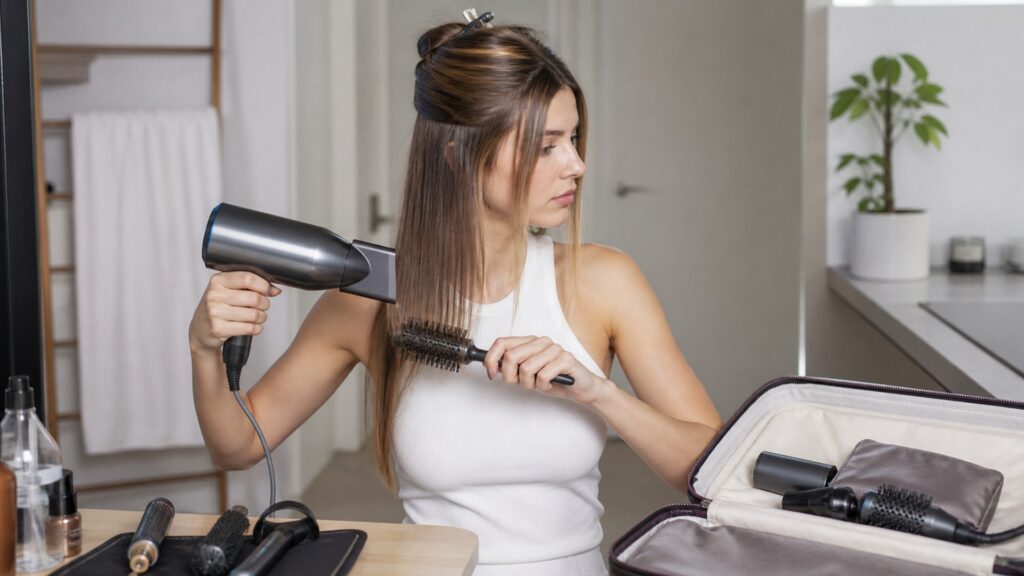
Buying framework
Separate diameter from density
Build fine-hair styling tools from the actual sequence.
Separate diameter from density: Fine strands can be sparse or dense; scalp exposure, section load, and styling time change accordingly.
Define the finish: Root lift, bend, smoothness, wave, or polish each needs a different balance of heat and contact.
Start at the lowest useful exposure: Test low temperature, moderate airflow, light tension, and one-pass technique before increasing.
Score durability without restyling: Track how long volume or shape lasts before deciding more heat is necessary.
Who should buy what
Match fine-hair styling tools to the user
Each fine-hair styling tools profile changes the configuration.
The fine oily-root user: Needs efficient root drying and lift without repeated hot passes or heavy product baked onto tools.
The fine dense-hair user: May need stronger airflow and more sections while still protecting small-diameter fibers.
The fragile color-treated user: Should prioritize stable low settings, snag-free contact, reduced tension, and verified protection.
The static-prone user: Needs controlled heat and airflow plus brush and fabric choices that do not demand heavy finishing oil.
The short-style user: Benefits from narrow plates, small barrels or brushes, cool tips, and controls reachable without scalp contact.
What to pay attention to
Read the specifications that control fine-hair styling tools
These fine-hair styling tools characteristics change selection and ownership.
Lowest temperature: A broad range is useful only when the bottom setting and increments suit fine fibers.
Control stability: Buttons, sensors, and recovery should not create unnoticed temperature jumps or repeated corrective passes.
Plate or barrel scale: Narrow sections and shorter hair need geometry that reaches the target without overheating adjacent fiber.
Airflow concentration: A nozzle can direct roots but excessive velocity may tangle fine lengths or flatten the next section.
Brush material and tension: Dense bristles can create grip and volume but may add breakage or static when force is high.
Tool weight and speed: Light handling helps precision, while a slow method can increase total heat despite a low setting.
Avoid these traps
Prevent common fine-hair styling tools failures
Replace each fine-hair styling tools shortcut with a defined test.
Buying a very high maximum: The relevant specification is controlled low heat, not a ceiling the user should avoid.
Using large sections: Fine does not mean heat passes evenly through thick section depth.
Repeating passes for polish: More contact can erase volume and increase dryness without improving hold.
Pulling hard for root lift: Tension is not a substitute for airflow direction, section elevation, and cooling.
Masking static with heavy oil: The finish may collapse while the tool, climate, or friction source remains.
Decision guidance
Choose a specific fine-hair styling tools route
Follow the fine-hair styling tools path matching the dominant constraint.
For root volume: Choose directed moderate airflow, suitable brush scale, section elevation, and a cooling step.
For waves: Use a barrel matched to length and desired bend with controlled low heat and short contact.
For smoothing: Favor narrow snag-free plates and count passes rather than chasing maximum shine.
For short fine hair: Prioritize guarded geometry, cool handling points, and controls that do not force scalp proximity.
For damaged fine hair: Reduce styling frequency and exposure before expanding the tool collection.
Ownership & compatibility
Keep fine-hair styling tools repeatable
Maintenance and tracking protect the fine-hair styling tools result.
Count passes: Log temperature, seconds, section size, tension, and whether the style survives.
Remove product residue: Fine-hair sprays and powders can accumulate on plates, barrels, brushes, and vents.
Check cord drag: A heavy or short cord can disturb precise sections and increase wrist correction.
Retire snagging surfaces: Stop using chipped coatings, burrs, bent bristles, or misaligned plates.
FAQ
How to Choose Hair Styling Tools for Fine Hair FAQ
Answers for the exact fine-hair styling tools purchase and use case.
How should buyers assess lowest temperature in fine-hair styling tools?
How should buyers assess control stability in fine-hair styling tools?
How should buyers assess plate or barrel scale in fine-hair styling tools?
How should buyers assess airflow concentration in fine-hair styling tools?
How should buyers assess brush material and tension in fine-hair styling tools?
How should buyers assess tool weight and speed in fine-hair styling tools?
What mistake belongs at fine-hair styling tools checkpoint 1?
What mistake belongs at fine-hair styling tools checkpoint 2?
What mistake belongs at fine-hair styling tools checkpoint 3?
Bottom line
For root volume
Close the fine-hair styling tools decision with a measured routine.
Set the baseline: Define the fine-hair styling tools outcome and constraint before shopping.
Stress the winner: Test the finalist at the hardest realistic fine-hair styling tools point.
Own the method: Track and maintain the complete fine-hair styling tools cycle.
Reading Shortcuts
Navigate fine-hair styling tools.
Decision Reminders
Control the fine-hair styling tools trial.
- Baseline: Write the initial fine-hair styling tools condition.
- One variable: Change one fine-hair styling tools factor at a time.
- Stop rule: Pause fine-hair styling tools when the failure boundary appears.
Glossary Snippets
Terms for fine-hair styling tools.
Using a Hair Styling Tools Top 10
Filter rankings through fine-hair styling tools.
- Apply fine-hair styling tools: Reject options that miss the central constraint.
- Normalize fine-hair styling tools: Use the same method for every finalist.
- Price fine-hair styling tools: Include dose, time, cleaning, and replacement.
- Document fine-hair styling tools: Keep the reason each finalist advanced.
Popularity cannot supply the fine-hair styling tools baseline.
Comparing Fine-Hair Styling Tools Finalists
Hold fine-hair styling tools technique and context steady.
- Start fine-hair styling tools: Use matched preparation.
- Observe fine-hair styling tools: Check the mid-routine result.
- Stress fine-hair styling tools: Test the likely weak point.
- Review fine-hair styling tools: Score ownership after cleanup.
Restart if the fine-hair styling tools baseline changes.