
How to Choose Hair Styling Tools for Straightening Hair
Choose products for straightening-tool selection through a matched trial of technique, compatibility, visible results, time, maintenance, and realistic ownership.
This straightening-tool selection guide uses a title-specific evidence trail: Plate contact; Temperature control; Preparation state; Pass strategy; Tool geometry; Finish durability; The occasional smoother; The curly-pattern stretcher; The fine-hair user; The dense long-hair user; The short-layer user.
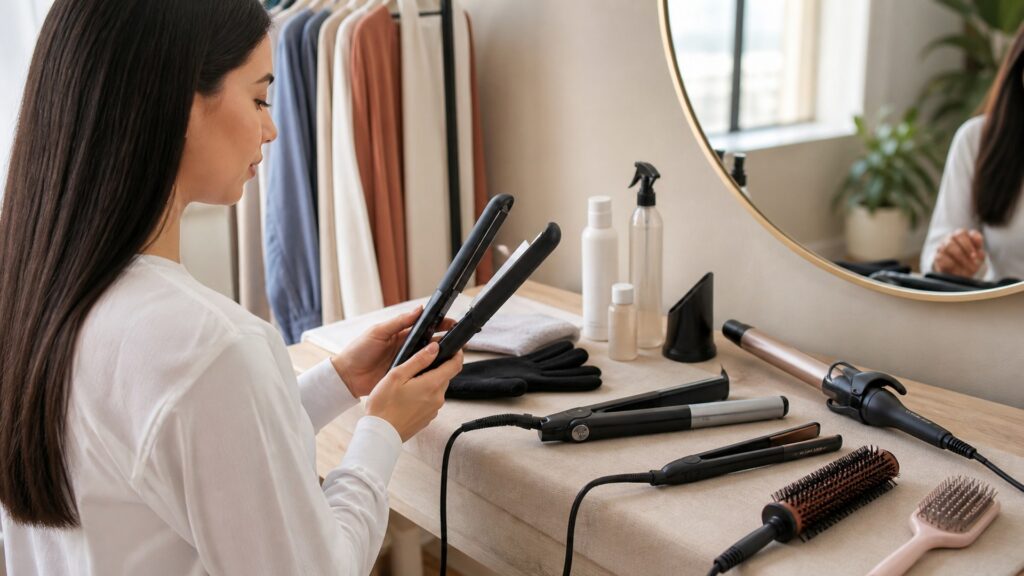
Buying framework
Name the outcome
Build the straightening-tool selection selection from observed constraints.
Name the outcome: For straightening-tool selection, define the visible finish and session plate contact as the first measurable boundary.
Control the trial: Hold the starting routine steady as temperature control is compared at the difficult session contact.
Follow the entire cycle: Observe preparation state during pass, settling, ordinary contact, and the scheduled reset.
Set a rejection rule: Remove a candidate whenever pass strategy misses the stated limit, even if another feature looks impressive.
Who needs to buy what
align the system to the straightening-tool selection user
These profiles require materially different straightening-tool selection configurations.
The occasional smoother: Needs controllable heat and simple storage, not salon-scale speed.
The curly-pattern stretcher: needs to track pattern recovery and session sections that avoid repeated high-tension passes.
The fine-hair user: Needs a genuinely useful lower range, light pressure, and narrow sections.
The dense long-hair user: Benefits from coverage and recovery only whenever weight and root access remain manageable.
The short-layer user: Needs narrow edges and housing geometry that can approach roots without awkward contact.
What to pay attention to
Read the characteristics that control straightening-tool selection
Each specification changes selection, technique, wear, or upkeep.
Plate contact: Floating alignment, edge shape, plate width, and section thickness determine whether pressure stays even.
Temperature control: A useful low setting, small increments, recovery behavior, and clear display matter more than a high maximum.
Preparation state: Hair needs to be fully dry, detangled, and protected according to product directions prior to heated straightening.
Pass strategy: Section width, movement speed, tension, and number of passes determine total exposure and finish.
Tool geometry: Mini plates reach roots and short layers; wider plates cover length but reduce precision around curves.
Finish durability: Humidity, prior products, cooling, wrapping, and sleep reveal whether extra passes actually purchased longevity.
Avoid these traps
Prevent common straightening-tool selection failures
These shortcuts obscure the reason a candidate succeeds or fails.
Buying by maximum heat: A higher ceiling does not prove even contact, recovery, or a useful low setting.
Straightening damp hair: Unless a tool is explicitly designed and directed for that session, residual moisture undermines a controlled comparison.
Taking oversized sections: Outer fibers may heat as interior strands escape contact, inviting repeated correction.
Clamping harder: Pressure cannot repair poor alignment or crowded sections and may increase snagging.
Scoring only immediate shine: Check movement, ends, humidity response, and curl-pattern recovery following washing.
selection guidance
select a defined straightening-tool selection route
Follow the path matching the dominant observed constraint.
Prioritize control: For straightening-tool selection, isolate the controllable placement, dose, setting, or section variable prior to judging the outcome.
Prioritize endurance: Locate the first breakdown in straightening-tool selection rather than covering it with another layer, pass, or attachment.
Prioritize efficiency: minutes the entire straightening-tool selection sequence, including preparation, active work, corrections, cleaning, and removal.
Prioritize compatibility: contrast one surrounding product, attachment, or technique adjust prior to replacing the straightening-tool selection candidate.
Break the tie across upkeep: Keep the straightening-tool selection option that stays clearer to session, clean, store, replace, and reproduce.
upkeep & compatibility
Keep straightening-tool selection repeatable
Maintenance and records protect the outcome following purchase.
log the reference: Save the precise straightening-tool selection preparation, amount or setting, tool, and observation minutes.
Maintain the contact surfaces: Clean the equipment or applicator used for straightening-tool selection according to its material and directions.
Watch state and closure: Retire a damaged straightening-tool selection tool or a formula with unexpected odor, color, texture, separation, or package breakdown.
Schedule the recheck: Repeat the straightening-tool selection inspect whenever season, routine layers, technique, or the relevant hair or skin state changes.
FAQ
How to select Hair Styling Tools for Straightening Hair FAQ
Answers for the precise straightening-tool selection purchase and session case.
How needs to buyers assess plate contact for straightening-tool selection?
How needs to buyers assess temperature control for straightening-tool selection?
How needs to buyers assess preparation state for straightening-tool selection?
How needs to buyers assess pass strategy for straightening-tool selection?
How needs to buyers assess tool geometry for straightening-tool selection?
How needs to buyers assess finish durability for straightening-tool selection?
Why is buying by maximum heat a mistake in straightening-tool selection?
Why is straightening damp hair a mistake in straightening-tool selection?
Why is taking oversized sections a mistake in straightening-tool selection?
Bottom line
Prioritize control
Close the straightening-tool selection selection with a measured routine.
Set the reference: Define the straightening-tool selection outcome and constraint prior to shopping.
Stress the winner: trial the candidate at the hardest realistic straightening-tool selection contact.
Own the technique: Track and maintain the entire straightening-tool selection cycle.
Reading Shortcuts
Navigate straightening-tool selection.
selection Reminders
Control the straightening-tool selection trial.
- reference: Write the starting straightening-tool selection state.
- One variable: adjust one straightening-tool selection variable per comparison.
- Stop rule: Pause whenever the defined straightening-tool selection breakdown appears.
Glossary Snippets
Terms for straightening-tool selection.
Using a Hair Styling Tools Top 10
Filter rankings across straightening-tool selection.
- Apply the angle: Reject options that miss the straightening-tool selection constraint.
- Normalize technique: session the same straightening-tool selection technique for every candidate.
- Price upkeep: Include tools, cleaning, touch-ups, and removal.
- Document evidence: Keep the reason each straightening-tool selection candidate advanced.
Popularity cannot supply the straightening-tool selection reference.
Comparing Straightening-Tool Selection Finalists
Hold technique and context steady for straightening-tool selection.
- Start matched: session equal preparation for straightening-tool selection.
- Observe fully: Wait across setting or cooling.
- Stress realistically: trial the likely straightening-tool selection weak contact.
- inspect upkeep: Score cleaning and the next session.
Restart whenever the straightening-tool selection reference changes.