
How to Choose Hair Treatments for Curly Hair
Curly hair treatments should respond to strand condition, not curl labels alone. Two heads with a similar visible pattern may differ in density, porosity, chemical history, climate exposure, scalp needs, and how easily the hair loses water or accumulates product.
Begin with one recurring problem: roughness, tangling, loss of elasticity, breakage, dull buildup, or weak definition after washing. Observe wet feel and dry results separately, then choose a treatment whose format, ingredients, contact time, and rinse requirements address that specific pattern.
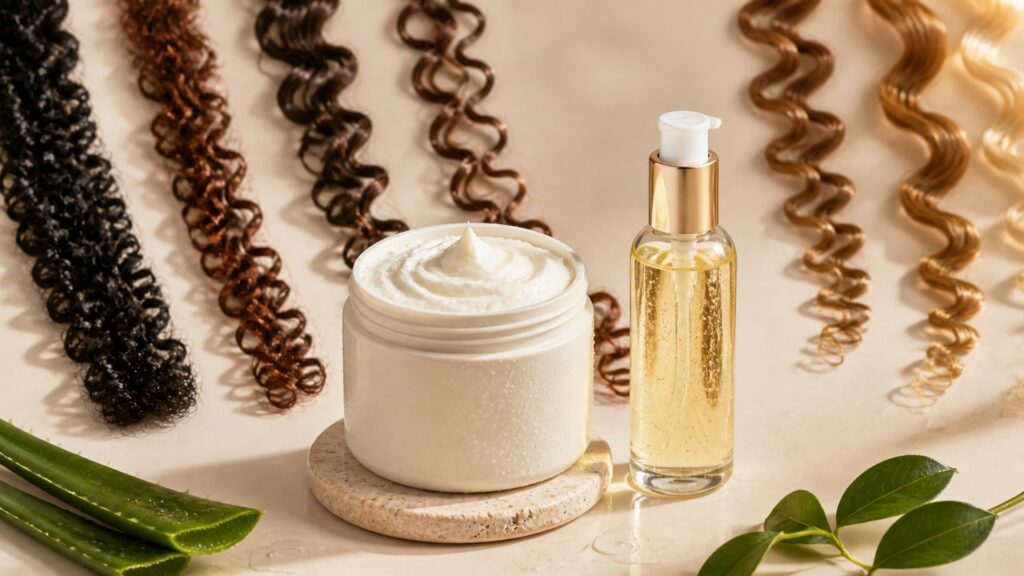
Curl assessment
Describe the hair before choosing richness
A useful treatment trial starts with strand behavior, wash routine, and damage history. “For curls” on the label does not establish suitable weight or protein content.
Check wet behavior: Notice how quickly water enters, whether sections feel slippery or rough, how knots release, and whether stretched strands recover without snapping.
Review chemical and heat history: Color, bleach, relaxers, frequent heat, and mechanical tension can change elasticity and porosity more than the visible curl shape suggests.
Choose one outcome: Target easier detangling, improved softness, reduced breakage, restored elasticity, or better rinse feel rather than expecting one mask to solve everything.
Curl profiles
Match treatment weight to density and condition
Fine strands can be dense, coarse strands can be sparse, and either may be dry or damaged. Use amount and placement to refine the formula choice.
Fine or easily weighed-down curls: Look for concentrated slip in a lighter vehicle, use modest amounts, and keep rich residue away from roots unless scalp use is stated.
Dense dry lengths: Section carefully so conditioner reaches the interior rather than coating only the surface, then rinse enough to preserve movement.
Chemically stressed curls: Consider bond-support or protein-containing treatments when damage evidence supports them, alternating with conditioning rather than stacking strength claims indiscriminately.
Formula details
Read slip, strengthening, and residue potential together
Ingredient lists can suggest a formula’s direction, but dose, vehicle, contact time, water quality, and companion products determine the result on hair.
Rinse-stage evidence
The hair should release tangles with controlled technique and should not feel coated in waxy residue or stripped of all slip.
Dry-stage evidence
Judge softness, spring, definition, frizz pattern, volume, and breakage after the full styling routine rather than immediately after rinsing.
Conditioning system: Fatty alcohols, cationic conditioners, oils, silicones, and polymers provide different combinations of slip, softness, film, and washout.
Protein or bond claims: Check the stated purpose and frequency. More strengthening product can leave some hair stiff, rough, or tangled when used without need.
Application directions: Confirm whether the treatment belongs before shampoo, after cleansing, with heat, on soaking-wet hair, or only on damaged lengths.
Common mistakes
Avoid chasing moisture with endless product layers
Heavy buildup can mimic dryness by making curls dull, sticky, poorly defined, or difficult to wet, while harsh repeated clarifying can create genuine roughness.
Using too much mask: Apply by section and add only enough for even slip. Excess product raises cost and may prolong rinsing without improving conditioning.
Changing the whole routine: A new cleanser, treatment, leave-in, gel, and drying method introduced together make softness or irritation impossible to attribute.
Detangling with force: Use suitable slip, small sections, and end-to-root progress; no treatment makes aggressive pulling harmless to fragile or knotted strands.
Treatment choice
Choose moisture, strength, clarification, or a simpler routine
The next treatment should match the strongest evidence from wet handling, dry results, buildup, and damage history rather than seasonal marketing.
Choose a conditioning mask: This fits hair that repeatedly feels rough or tangles after cleansing and improves with slip without losing shape or volume.
Choose targeted strengthening: Consider it for documented chemical or mechanical damage when the product gives clear frequency guidance and results are monitored for stiffness.
Clarify before adding richness: When water beads, roots feel coated, and styling products stop behaving normally, accumulated film may need appropriate removal before another mask.
Application routine
Section, time, rinse, and record
A consistent method reveals whether the formula works and prevents product from concentrating on easy-to-reach outer curls while inner sections remain untreated.
Divide the hair: Use manageable sections and distribute treatment with fingers or a suitable wide-tooth tool, reducing repeated manipulation of delicate wet strands.
Follow contact time: Longer is not automatically better. Use the labeled interval and any heat instructions rather than sleeping in a rinse-out product by improvisation.
Clean tools and containers: Keep wet hands out of jars when possible, close lids promptly, and wash clips, combs, and brushes that collect treatment residue.
FAQ
Curly-hair treatment questions
These answers connect product choice to strand behavior, controlled trials, and the difference between conditioning, strengthening, and buildup removal.
How often should curly hair use a deep treatment?
How do I know whether curls need protein or moisture?
Can a rich mask make curly hair less defined?
Bottom line
Let curl behavior choose the treatment
A defensible formula solves one observed problem, distributes evenly, rinses predictably, and improves the finished hair without sacrificing comfort, movement, or scalp cleanliness.
Record the baseline: Photograph comparable sections and note wet tangling, elasticity, roughness, shedding, styling products, weather, and previous chemical services.
Run one controlled wash: Keep cleanser, styling, and drying method stable while testing the treatment at its labeled amount and contact time.
Evaluate after complete drying: Retain the product only when repeated trials improve the chosen outcome without persistent buildup, stiffness, irritation, or loss of desired volume.
Reading Shortcuts
Move directly to the curly hair decision stage you need.
Decision Reminders
Keep the evidence for curly hair visible while comparing.
- Role: The hair treatment serves the named task.
- Proof: The trial observes improved manageability, reduced breakage, comfortable strands, and no heavy residue.
- Care: Protect the formula from shower water, follow timing directions, and monitor cumulative effects.
Glossary Snippets
Useful language for comparing hair treatments.
When a Top 10 List Helps
Use rankings to discover credible hair treatments, then screen them for curly hair.
- The format is undecided: A broad list reveals plausible forms and price levels.
- A shortlist is needed: Rankings narrow discovery but do not replace fit testing.
Have finalists already? Open the comparison section.
When a Direct Comparison Helps
Compare finalists after establishing their suitability for curly hair.
- Two candidates remain: Side-by-side evidence exposes meaningful tradeoffs.
- An upgrade is uncertain: Compare whether added cost corrects the original weakness.
Still exploring? Start with the Top 10 section.