
How to Choose Hair Treatments for Damage Repair
Hair treatments can improve lubrication, reduce friction, support easier detangling, and temporarily reinforce the feel of damaged fibers. They cannot restore a split or severely weathered strand to untouched condition, so “repair” claims need a realistic endpoint.
Map how damage occurred before choosing a formula. Bleach, permanent color, chemical straightening, repeated high heat, tight styling, rough detangling, and environmental exposure create different patterns. Compare breakage, elasticity, porosity, and weak zones rather than treating all dryness as structural damage.
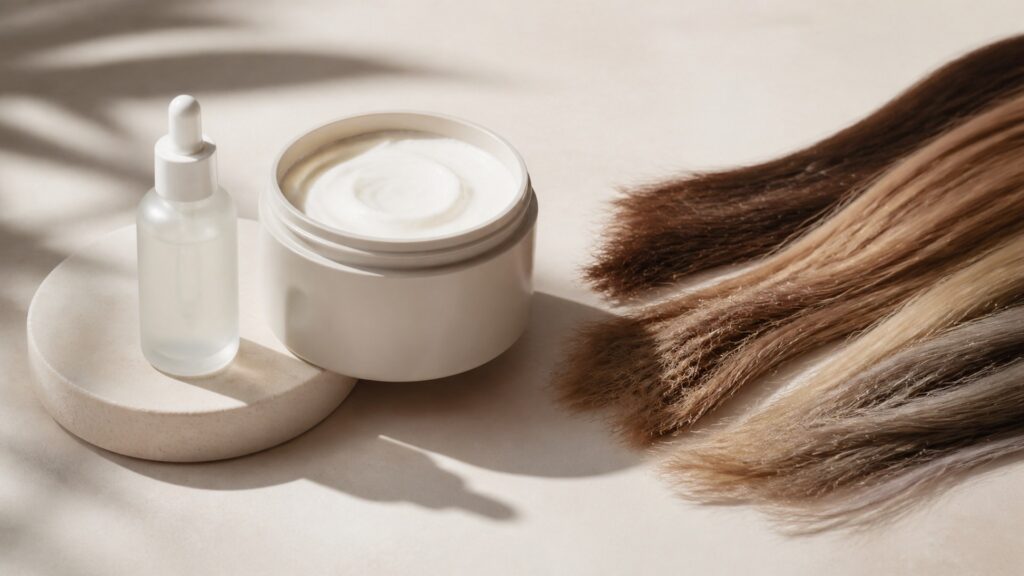
Damage map
Identify the stress and the visible failure
A defensible treatment plan links a known exposure to a measurable problem such as snapping, roughness, tangling, loss of elasticity, or porous ends.
Trace the timeline: Record chemical services, heat frequency, styling tension, swimming, sun, and the point when texture, strength, or breakage changed.
Locate the weak zones: Inspect the hairline, crown, nape, ends, and overlapping color bands; damage is often concentrated rather than uniform.
Set a realistic goal: Aim for fewer broken strands, better slip, improved flexibility, or easier styling—not permanent reconstruction of already split fibers.
Damage profiles
Match the intervention to the dominant stress
Bleached lengths, heat-weathered ends, and tension-related breakage may all feel rough while benefiting from different routine changes alongside treatment.
Chemically processed hair: Consider targeted bond-support or protein-containing formulas with clear directions, plus conditioning that preserves flexibility and detangling control.
Heat-styled hair: Reduce temperature and passes, verify heat-protectant directions, and choose conditioning that addresses friction rather than relying on a mask alone.
Mechanical-breakage pattern: Review brushes, elastics, extensions, towel use, sleeping friction, and detangling technique because product cannot offset repeated physical stress.
Treatment mechanisms
Separate conditioning, protein, and bond claims
These categories may overlap, but they are not interchangeable. Read the stated mechanism, application sequence, contact time, frequency, and compatibility warnings.
Wet-handling evidence
A useful treatment lets sections separate with less force and does not leave the hair rigid, gummy, or impossible to rinse.
Dry-hair evidence
Compare snapping, roughness, movement, shine, elasticity, and style retention after the full routine under similar drying conditions.
Conditioning system: Cationic agents, fatty alcohols, oils, silicones, and polymers can add slip and reduce friction without literally rebuilding the original strand.
Protein content: Hydrolyzed proteins may improve feel for some damaged hair, yet excessive or poorly matched use can create stiffness or tangling.
Bond language: Look for a specific use protocol and evidence supporting the product rather than assuming every “bonding” label describes the same chemistry.
Repair mistakes
Do not stack every strengthening product
Multiple masks, protein leave-ins, bonding steps, and harsh clarifiers introduced together can cause stiffness, residue, or confusion about what actually helped.
Ignoring ongoing damage: A weekly treatment cannot compensate for unchanged bleach overlap, excessive heat, tight styles, or forceful brushing.
Using more than directed: Extra contact time and higher frequency are not automatically beneficial. Follow the labeled protocol and watch for roughness or lost flexibility.
Refusing a trim: Products may smooth split ends temporarily, but progressive splitting and severely compromised sections often require cutting to prevent further unraveling.
Treatment choice
Choose lubrication, strengthening, or routine correction
The best purchase targets the observed failure while the user also removes the heat, chemical, or mechanical stress that continues causing it.
Choose conditioning repair: Prioritize slip and friction reduction when roughness and tangling drive breakage and hair remains flexible rather than structurally weak.
Choose targeted strengthening: Consider protein or bond-support treatments after chemical or heat damage, using one clear protocol and monitoring the response.
Choose less treatment: Pause additional actives when hair feels coated, rigid, gummy, or increasingly tangled, and simplify before interpreting another product.
Controlled trial
Protect the strand while testing the formula
Application technique, section size, detangling force, and drying method can overwhelm a treatment effect if they change between wash days.
Apply to the damaged area: Concentrate product where weakness is documented rather than automatically coating healthy roots or the scalp with a lengths-only formula.
Follow sequence and timing: Respect whether the product belongs before shampoo, after cleansing, before conditioner, or as a leave-in; do not combine steps casually.
Keep handling stable: Use comparable sectioning, tools, water temperature, drying, and styling so changes in breakage or feel remain interpretable.
FAQ
Damage-repair hair treatment questions
These answers clarify realistic repair, the role of protein and conditioning, and the point at which trimming or professional advice matters.
Can a hair treatment permanently repair split ends?
How do I know whether damaged hair needs protein?
How long should I test a damage-repair treatment?
Bottom line
Repair the routine as well as the hair feel
A strong plan combines a realistic treatment mechanism with reduced ongoing stress, gentle handling, and trimming when structural damage has moved beyond cosmetic smoothing.
Document the baseline: Photograph weak zones and note broken strands, elasticity, tangles, chemical overlap, heat settings, and mechanical tension.
Change one intervention: Test a single repair approach at its labeled dose and frequency while holding cleanser, styling, and drying as stable as practical.
Retain measurable gains: Continue only when repeated uses improve the chosen outcome without persistent stiffness, coating, irritation, or increased detangling difficulty.
Reading Shortcuts
Move directly to the damage repair decision stage you need.
Decision Reminders
Keep the evidence for damage repair visible while comparing.
- Role: The hair treatment serves the named task.
- Proof: The trial observes improved manageability, reduced breakage, comfortable strands, and no heavy residue.
- Care: Protect the formula from shower water, follow timing directions, and monitor cumulative effects.
Glossary Snippets
Useful language for comparing hair treatments.
When a Top 10 List Helps
Use rankings to discover credible hair treatments, then screen them for damage repair.
- The format is undecided: A broad list reveals plausible forms and price levels.
- A shortlist is needed: Rankings narrow discovery but do not replace fit testing.
Have finalists already? Open the comparison section.
When a Direct Comparison Helps
Compare finalists after establishing their suitability for damage repair.
- Two candidates remain: Side-by-side evidence exposes meaningful tradeoffs.
- An upgrade is uncertain: Compare whether added cost corrects the original weakness.
Still exploring? Start with the Top 10 section.