
How to Choose Hair Treatments for Frizz Control
Frizz is not a single defect. It may reflect humidity response, raised or weathered cuticles, breakage, new growth, curl separation, static, brushing, or a styling result that differs from the wearer’s preference. The right treatment depends on which pattern is present.
Observe when the change appears: immediately after rinsing, during towel handling, while drying, after brushing, or only outdoors. Compare consistent sections in similar weather, and define success as improved alignment, softness, definition, or manageability—not permanently forcing textured hair to behave unlike itself.
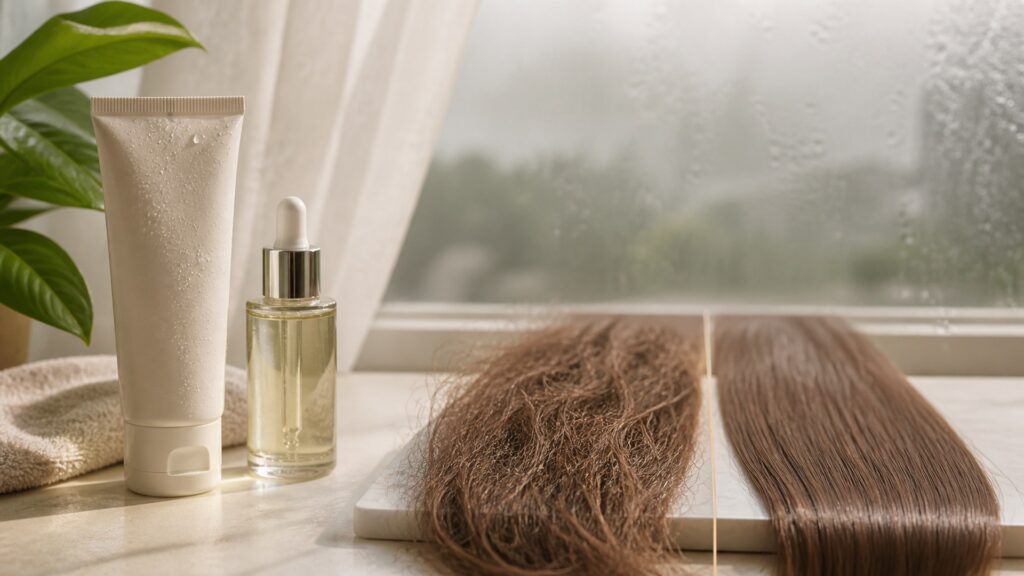
Frizz map
Identify timing, location, and weather
A treatment can improve lubrication or add a film, but it cannot correct every cause. The first step is locating where the routine loses control.
Track the timing: Note whether flyaways begin on wet hair, during drying, after sleep, after brushing, or when humidity changes.
Separate breakage from texture: Short snapped pieces, new growth, and naturally separated curls may look similar while requiring different handling and expectations.
Define the preferred finish: Choose smoother straight lengths, grouped curls, reduced static, or softer halo frizz rather than treating all volume as failure.
Frizz profiles
Match weight and hold to texture and density
Fine waves, dense curls, bleached ends, and straight hair with static may need different balances of conditioning, film, flexibility, and rinse.
Fine or low-density hair: Start with a lightweight treatment and small dose, because heavy coating can trade frizz for collapse, stringiness, or shortened clean time.
Curly or coily texture: Prioritize slip and curl grouping, then judge definition after the normal leave-in, styler, and drying method rather than after the mask alone.
Chemically weathered lengths: Reduce ongoing heat and chemical stress while using conditioning or targeted strengthening to improve handling of porous, breakage-prone sections.
Formula details
Compare conditioning, film, and buildup risk
Anti-frizz performance may come from smoother handling, reduced water exchange, static control, or stronger styling cohesion. Ingredient names alone do not reveal the final balance.
Wet-stage evidence
A suitable treatment lets sections align and detangle with less force without leaving the scalp or roots unnecessarily coated.
Weather-stage evidence
Evaluate the finished style after exposure to the humidity, wind, clothing friction, or indoor dryness that normally changes it.
Conditioning system: Cationic ingredients, fatty alcohols, oils, silicones, and polymers provide different combinations of slip, softness, shine, and surface film.
Humidity strategy: Look for clear directions and realistic claims; a rinse-out treatment usually works with leave-ins and stylers rather than replacing them.
Weight and washout: Check whether repeated use leaves hair flexible and clean-feeling or creates dullness, sticky sections, flat roots, and difficult rinsing.
Common mistakes
Do not blame the treatment for an uncontrolled drying routine
Rough towels, dry brushing, high heat, repeated touching, and incompatible stylers can overwhelm the smoothing gained during conditioning.
Changing every product: Keep cleanser, leave-in, styler, drying, and tools stable enough to identify whether the treatment improves the chosen outcome.
Applying more at each failure: Excess richness may increase coating without controlling humidity. Adjust amount, placement, and styling sequence before escalating weight.
Expecting permanent straightness: A cosmetic mask can soften and align hair temporarily; it does not permanently alter natural texture or erase new growth and breakage.
Treatment choice
Choose slip, strength, clarification, or styling support
The next step should address the documented source of disorder rather than adding the heaviest product marketed with a smooth-hair image.
Choose conditioning slip: Use it when rough detangling and friction contribute to separation and the hair improves without losing desired movement.
Choose targeted strengthening: Consider a directed protein or bond-support step for documented damage, monitoring carefully for stiffness, roughness, or new tangling.
Clarify and reset: When films make hair dull, tacky, or difficult to wet, appropriate buildup removal may restore response before another smoothing layer.
Application method
Control sectioning, water, and drying
Frizz treatment begins in the shower but is evaluated after styling. Repeatable handling makes the effect visible and protects fragile strands.
Apply by section: Distribute the labeled amount evenly through the areas that need slip, adding more only where coverage is genuinely absent.
Rinse for the formula: Follow directions rather than leaving arbitrary residue; too much remaining product can interfere with stylers and reduce volume.
Dry with intention: Use low-friction fabric, avoid unnecessary touching, and follow suitable heat guidance so the set pattern is not disrupted before it stabilizes.
FAQ
Frizz-control hair treatment questions
These answers connect visible frizz to its timing, weather, damage pattern, treatment weight, and complete styling routine.
Can a hair treatment permanently stop frizz?
How do I choose between a light and rich anti-frizz mask?
Why does hair frizz after an anti-frizz treatment?
Bottom line
Control the cause you can observe
A strong frizz-control treatment supports the preferred texture, survives realistic weather, and fits the total cleansing, styling, and drying routine without persistent buildup.
Photograph a baseline: Use the same section, lighting, weather notes, wash interval, and styling method to make changes easier to interpret.
Trial one formula: Keep dose, placement, contact time, rinse, and drying consistent across several uses unless irritation requires stopping earlier.
Accept textured movement: Retain a treatment for improved comfort and manageability, not for eliminating every flyaway or naturally separated strand.
Reading Shortcuts
Move directly to the frizz control decision stage you need.
Decision Reminders
Keep the evidence for frizz control visible while comparing.
- Role: The hair treatment serves the named task.
- Proof: The trial observes improved manageability, reduced breakage, comfortable strands, and no heavy residue.
- Care: Protect the formula from shower water, follow timing directions, and monitor cumulative effects.
Glossary Snippets
Useful language for comparing hair treatments.
When a Top 10 List Helps
Use rankings to discover credible hair treatments, then screen them for frizz control.
- The format is undecided: A broad list reveals plausible forms and price levels.
- A shortlist is needed: Rankings narrow discovery but do not replace fit testing.
Have finalists already? Open the comparison section.
When a Direct Comparison Helps
Compare finalists after establishing their suitability for frizz control.
- Two candidates remain: Side-by-side evidence exposes meaningful tradeoffs.
- An upgrade is uncertain: Compare whether added cost corrects the original weakness.
Still exploring? Start with the Top 10 section.