
How to Choose Hand Creams for Ingredient Label Reviews
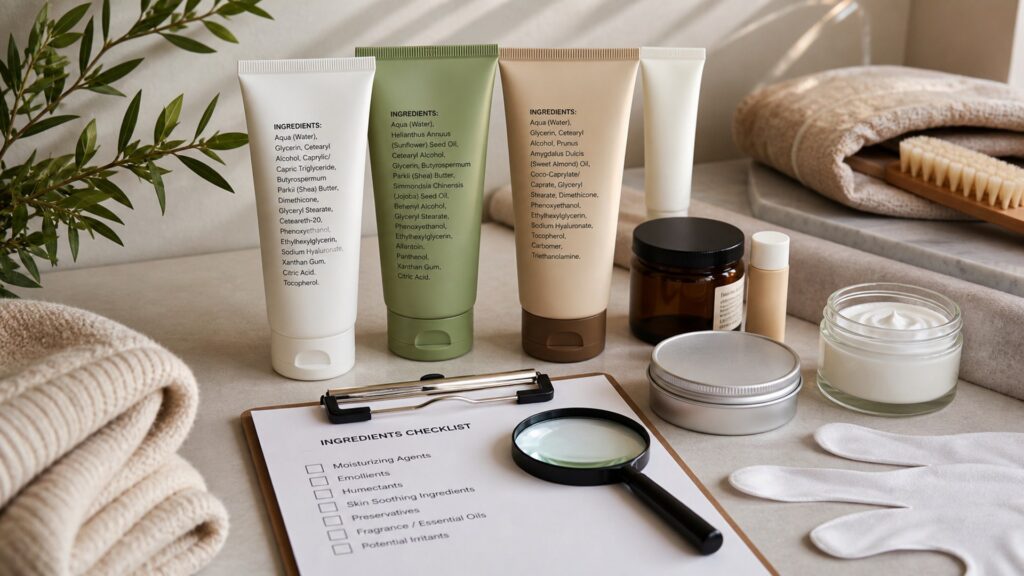
Hand-cream labels may emphasize ceramides, glycerin, shea butter, peptides, colloidal oatmeal, urea, or a repair complex. Useful comparison comes from understanding the moisturizing system and directions, not counting fashionable ingredients or trusting clinical-looking language.
Read the full ingredient list with fragrance, active strength, package design, and claims in context. A cosmetic can improve dryness and appearance but should not be assumed to heal infection, cure dermatitis, or replace protection from workplace irritants.
Buying framework
Define the ingredient label reviews routine before comparing products
Use the setting, frequency, and skin priorities to narrow hand creams logically.
Start with the use case: Identify humectant, emollient, occlusive, film-forming, and roughness-active roles.
Rank the practical tradeoffs: Review fragrance, botanical extracts, urea or acid concentration, and relevant warnings.
Check instructions early: Compare directions, dispenser, net quantity, reapplication frequency, and claim precision.
Use profiles
Match hand creams to the person and pace
Three shopper profiles expose different priorities for ingredient label reviews.
Routine-focused buyer: A frequent user needs a coherent moisturizer base and economical pump dosing.
Performance-focused buyer: A sensitivity-focused buyer should screen perfume and aromatic botanicals first.
Occasional or flexible user: A roughness buyer needs an active form and strength appropriate for intact hand skin.
Specifications
Read the specifications through a ingredient label reviews lens
Translate technical language into visible routine benefits.
Handling lens
Translate repair claims into softness, flexibility, reduced flaking, or protection.
Ownership lens
Calculate applications from pump output and net contents.
Humectant And Emollient Balance: Ingredient order provides context but not exact percentages for most cosmetics.
Texture And Absorption: Glycerin and similar humectants need a balanced base for lasting comfort.
Fragrance Profile: Petrolatum and silicones differ in occlusion, tack, and grip.
Wash Resistance: Urea concentration changes its hydrating and keratolytic intensity.
Packaging Control: Fragrance can be listed generally rather than as every component.
Common mistakes
Avoid shortcuts that undermine ingredient label reviews
A good purchase can still disappoint when selection or use is based on the wrong assumption.
Buying from one metric: Do not treat a long ingredient list as proof of superior barrier repair.
Skipping compatibility checks: Avoid assuming dermatologist tested means suitable for every sensitive user.
Ignoring post-use care: Do not infer treatment of hand disease from cosmetic repair wording.
Decision guidance
Choose the simplest option that covers the real need
Use these decision rules to finish a shortlist for ingredient label reviews.
Choose the basic format when: Choose the cream when its base, active strength, texture, and directions fit use.
Choose the flexible format when: Request clarification when a highlighted active lacks meaningful context.
Pause before upgrading when: Reject products whose disease-like promises exceed ordinary cosmetic outcomes.
Ownership & compatibility
Plan for clean, repeatable ownership
The best value remains convenient after the first few uses.
Consumables and replacements: Save the current ingredient panel and lot code.
Cleaning and storage: Keep pumps and tube openings clean at shared sinks.
Routine compatibility: Recheck ingredients before repurchase because fragrance or actives can change.
FAQ
How to Choose Hand Creams for Ingredient Label Reviews FAQ
Practical answers about choosing and owning hand creams for ingredient label reviews.
What matters most when choosing hand creams for ingredient label reviews?
Is the most expensive option better for ingredient label reviews?
How should I compare two similar hand creams options?
Bottom line
Buy for repeatable ingredient label reviews results
A focused shortlist is easier to own and use well.
Prioritize fit: Read the moisturizer system before highlighted actives.
Verify the limits: Translate repair language into observable cosmetic outcomes.
Count ownership costs: Connect package output and net contents to daily reapplication.
Reading Shortcuts
Jump to the key hand creams decisions.
Decision Reminders
Keep these checks beside your shortlist.
- Check humectant and emollient balance: Patch test unfamiliar formulas and stop if persistent irritation develops.
- Check texture and absorption: Apply to clean skin and avoid introducing product into open cuts or infected areas.
- Check fragrance profile: Use sunscreen on exposed hands when sun protection is needed; ordinary hand cream is not a substitute unless labeled with SPF.
Glossary Snippets
Plain-language hand creams terms.
When to Use a Top 10 Review
Use a ranked list to identify a manageable set of strong candidates.
- You are still exploring: A ranked list can reveal the main formats and price tiers.
- You want a shortlist: Start broad, then confirm fit with this buying guide.
Have finalists? Use a Comparison.
When to Use a Comparison
Use a direct comparison when only a few candidates remain.
- Features are close: Side-by-side details clarify meaningful differences.
- Prices overlap: Compare ownership value, not only purchase price.
Still exploring? See the Top 10.