
How to Choose Home EV Chargers for Garage Electrical Planning
An unused breaker position is a piece of panel real estate, not proof that a home can support an EV charger. The meaningful answer comes from the service, panel, existing loads, proposed charging current, and the rules that govern the installation.
Good planning also asks whether added amperage would change the driver's week. A long overnight dwell and a vehicle with a modest AC limit may need less than the charger advertises. Start with energy, then let a qualified electrical design determine the circuit or managed-load solution. That order avoids paying for capacity the car cannot use and prevents an attractive wall unit from dictating an unsuitable design.
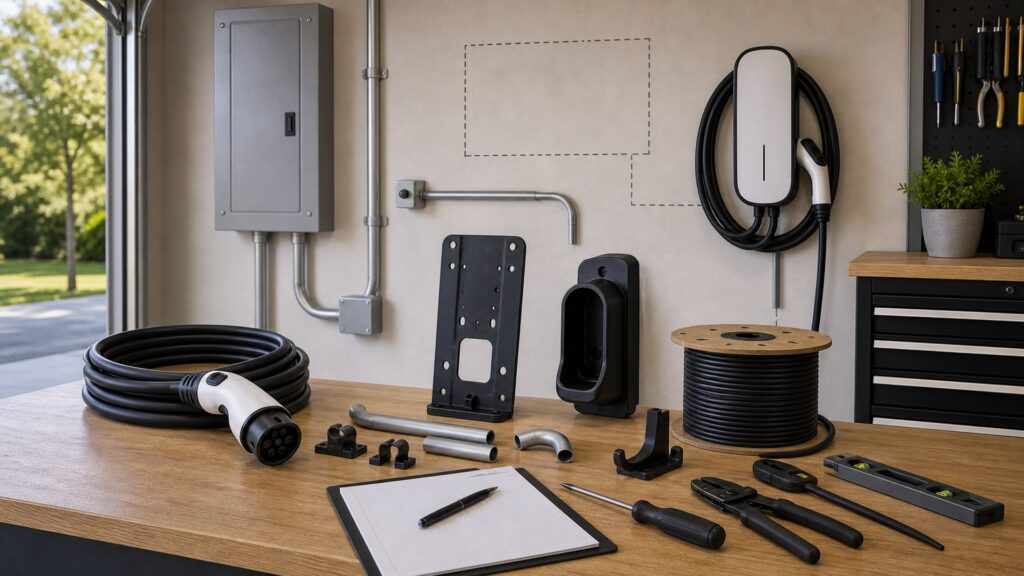
Electrical planning
Turn a driving need into a documented load
The garage charger is the final device in a longer electrical path. Each step narrows the safe, useful current.
Define the charging duty: Convert routine mileage into energy and available hours. Include the occasional demanding day without treating it as the only case.
Check the vehicle ceiling: Record the exact model's AC acceptance so the design does not chase output that the car will ignore.
Assess existing capacity: A qualified professional should evaluate service, panel, feeders, major loads, and the applicable calculation or management method.
Design the complete branch path: Coordinate protection, conductors, wiring method, terminations, connection type, route, and environmental conditions.
Set and document the limit: Commission the EVSE or controller at the approved value, protect configuration access, label the circuit, and retain test records.
Planning scenarios
The constraint identifies the right conversation
Homes with similar garages can require different designs because their services and charging routines differ.
Long overnight dwell: Moderate current may meet the energy target, leaving more capacity for other household loads.
Large daily energy use: The design may justify higher current when the vehicle accepts it and the service can support it.
Capacity-limited home: A compatible load-management system may allocate unused capacity, but only with an approved design and verified failure behavior.
Future two-EV household: Plan combined energy, concurrent demand, parking, and supported power sharing instead of installing two independent maximum-current circuits by assumption.
Electrical characteristics
Read the charger rating as a range, not a promise
The installed setting matters more than the largest number on the carton.
Capacity case
Establish the home's permissible charging load using the applicable design method and existing demand.
Installation case
Follow the proposed current through every conductor, termination, protective device, and configured setting.
Maximum versus configured current: Confirm how the installer limits output and whether changes require authorized access or recommissioning.
Input and connection requirements: Use the exact model instructions for voltage, circuit, hardwiring or receptacle, protection, conductor, and mounting conditions.
Terminal provisions: Conductor material, size range, torque, temperature rating, and enclosure access affect the final installation and serviceability.
Load-management interface: Require named compatible sensors or controllers, measurement location, response time, offline behavior, and a clear commissioning procedure.
Cable and communications routes: Plan electrical conductors separately from network or sensor wiring while respecting approved pathways and physical protection.
Certification and markings: Verify the exact configuration carries applicable recognized certification and that field labels preserve its approved settings.
Planning errors
Convenient shortcuts hide the real constraint
A charger purchase should not precede the evidence needed to support its installed current.
Counting empty panel spaces: Available positions do not establish service, bus, feeder, or load capacity.
Matching breaker size to a marketing number: The continuous charging load and exact equipment instructions belong in a coordinated branch-circuit design.
Assuming smart means load-managed: A schedule shifts charging by time; it does not necessarily respond to actual household demand or enforce a site ceiling.
Leaving sensors undocumented: Moved, reversed, disconnected, or misconfigured measurement hardware can undermine the capacity strategy without an obvious wall-unit fault.
Decision guidance
Spend on the binding electrical problem
The correct choice may be a smaller setting, a different route, managed capacity, or broader service work.
If the existing design supports the target: Choose equipment that can be securely configured to that current and installed along a practical route.
If only peak household demand is the issue: Evaluate documented dynamic management rather than assuming charging and other large loads must operate at full power together.
If the route dominates cost: Compare approved mounting and conductor paths before changing charger brands; the wall location can matter more than software features.
If future expansion is credible: Preserve panel, pathway, control, and wall-space options while sizing today's installation for evidence rather than speculation.
Electrical stewardship
Protect the assumptions after inspection
The approved system can be changed unintentionally by later work or account settings.
Keep the permit package: Store calculations, diagrams, model instructions, photos, configured current, torque or test records, and inspection outcome.
Control setting changes: Do not raise output because an app exposes a larger number. The installed limit belongs to the electrical design.
Inspect warning signs: Stop and seek qualified help for abnormal heat, odor, discoloration, repeated trips, loose equipment, water entry, or damaged wiring.
Review added loads: Electrical upgrades, heating equipment, solar, batteries, a second charger, or moved sensors can require reevaluation of the original plan.
FAQ
Garage electrical questions before installation
These answers clarify why a charger rating cannot substitute for a site design.
Does an empty breaker slot mean I can add a charger?
How is the right circuit size determined?
Can load management avoid a service upgrade?
Is hardwiring always the better garage option?
Why configure a charger below its maximum rating?
Does Wi-Fi scheduling reduce electrical capacity requirements?
What records should the homeowner receive?
Can I increase amperage after buying a different EV?
When should garage charging be shut down for inspection?
Bottom line
The current setting is the conclusion, not the starting point
A sound plan proves how much charging is useful, how the home supports it, and how that limit will be preserved.
Calculate before selecting: Driving energy and vehicle acceptance define the target.
Design the whole path: Capacity, circuit, equipment, and route must agree.
Leave durable evidence: Labels and commissioning records protect the installation from casual changes.
Reading Shortcuts
Jump to capacity, circuit design, managed load, or records.
Before You Commit
Bring these facts to the electrical planning visit.
- Service capacity: Estimate energy and parked hours.
- Circuit design: Record the vehicle's AC acceptance.
- Useful current: Map the proposed conductor route.
- Routing feasibility: Document the final current setting.
Terms in This Guide
Terms connecting service capacity to the installed EVSE.
When a Top 10 List Helps
Rank chargers only after the electrical boundary is known.
- Service capacity: The service method is documented.
- Circuit design: Every circuit component is coordinated.
- Useful current: Load controls have defined fallback.
- Routing feasibility: Settings are protected and labeled.
Already comparing finalists? Use a Comparison for a narrower decision.
When to Compare Two Finalists
Compare finalists at the same approved current and connection method.
- Circuit design: Both accept the designed conductors.
- Useful current: Both support the chosen connection.
- Routing feasibility: Both retain safe limits offline.
- Managed-load evidence: The difference affects installation risk.
Need a broader shortlist first? Visit the Top 10 collection.