
How to Choose Home EV Chargers for Multi-EV Households
Two EVs do not automatically require two full-power circuits. What matters is whether the household can deliver enough combined energy before each car leaves. A short-range commuter parked all night and a high-mileage car leaving at dawn may need unequal treatment, even when both chargers have identical ratings.
Write down a demanding week before choosing equipment. Include arrival charge, next departure, required energy, parking position, and which trip has less flexibility. That schedule reveals whether one connector, two shared stations, or a more capable managed system fits. The best arrangement makes its allocation decisions visible and lets a driver request priority without defeating the home's electrical limit.
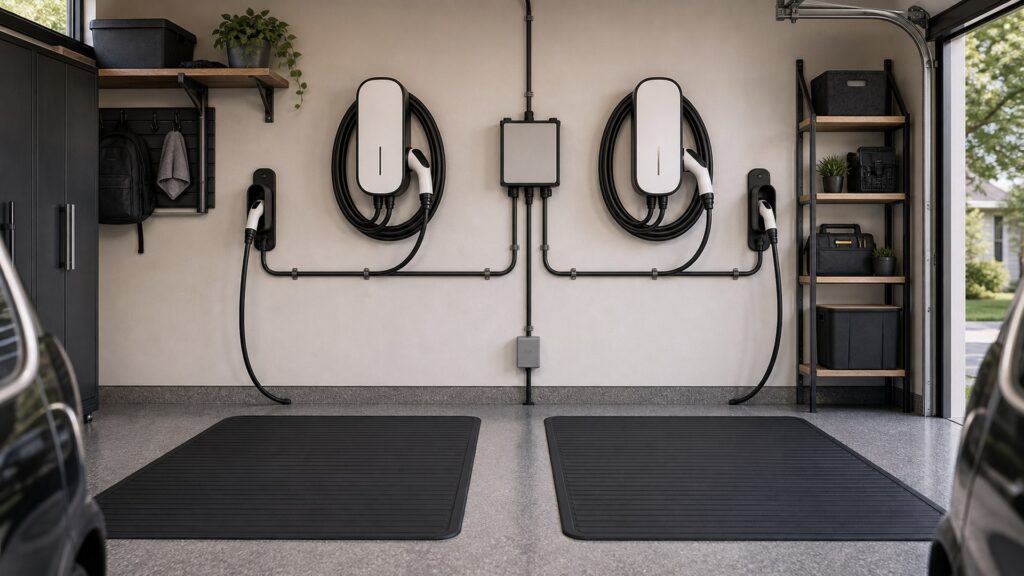
Household model
Start with two calendars, not two wall boxes
A simple table of arrivals, departures, and energy exposes the moments when charging actually competes.
Build the weekly demand case: Record required energy for each vehicle on ordinary and demanding days, not full battery capacities.
Find simultaneous windows: Mark hours when both cars are home and how long each has before its next departure.
Set readiness priorities: Decide which trips are fixed, which energy targets can move, and how a driver requests an exception.
Overlay the electrical ceiling: Have the combined current and any managed-load method designed and approved for the home.
Rehearse the parking layout: Connect both vehicles in their normal positions and test doors, walking space, cord storage, and every inlet location.
Two-car patterns
The household schedule chooses the architecture
Vehicle count alone cannot distinguish these common cases.
Alternating commuters: One station may work when arrival and departure windows rarely conflict and swapping remains convenient.
Two early departures: Managed dual charging can protect both targets without expecting someone to move a connector overnight.
Unequal daily mileage: Priority or departure-based allocation can favor the high-demand car while preserving a useful minimum for the other.
Mixed plug-in hybrid and EV: The smaller battery may finish quickly, releasing capacity, but its fuel strategy and departure still shape priority.
Frequent vehicle changes: Independent configurable stations may age better than a system tightly coupled to two current models.
Shared-system behavior
Ask what each car receives at the worst moment
Headline combined amperage says little about the rules behind it.
Household energy
Model both vehicles' energy and departure requirements over a demanding ordinary week.
Shared operation
Test allocation, cable reach, overrides, and failure behavior with both cars connected.
Aggregate current limit: Confirm the maximum across all ports and how it relates to the approved circuit or site control.
Allocation method: Determine whether power is divided evenly, rotated, prioritized, or scheduled from energy and departure targets.
Minimum-current response: Some cars pause or restart when allocation falls low. Test stable operation with the actual vehicle pair.
Local priority control: A driver should request urgent energy without deleting shared limits or relying entirely on cloud access.
Per-vehicle status: Each person needs to know whether the car is charging, waiting, curtailed, faulted, or complete.
Compatible expansion: For paired stations, require exact models, firmware, communications, and documented behavior when the link fails.
Coordination mistakes
Symmetry is attractive but rarely necessary
Buying identical maximums can obscure unequal schedules and physical constraints.
Doubling a single-car design: Two independent high-current stations may exceed capacity even though the combined energy target is modest.
Assuming equal split is fair: A car leaving later can absorb current needed by an early high-mileage departure.
Ignoring parking-side changes: A new driver or reversed vehicle can make the assigned cable unusable without unsafe crossover.
Stacking multiple schedules: Vehicle timers, station apps, and a shared controller can wait on one another or produce misleading status.
Architecture choices
Match complexity to the real collision
Use the least elaborate arrangement that survives the household's difficult week.
Choose one shared connector: This works when schedules seldom overlap and moving the plug is dependable, safe, and convenient.
Choose two power-sharing stations: This suits simultaneous parking when both cars need unattended recovery and the product pair has clear local behavior.
Choose departure-aware control: Use it when targets vary and unequal allocation produces a meaningful readiness benefit.
Add whole-home management: Consider it when charging must respond to changing household demand within a qualified electrical design.
Preserve a manual fallback: Know which car can charge and at what safe limit if communications, accounts, or one station becomes unavailable.
Household operation
Rules must survive new drivers and new cars
A system is only as reliable as the shared expectations around it.
Post the priority rule: Make urgent-charge requests, connector assignments, and completion checks understandable to every driver.
Review missed targets: Use logs to distinguish insufficient time, wrong priority, low allocation, vehicle limits, and hardware faults.
Inspect both cable routes: Unequal use can hide wear on one connector while the other remains visually new.
Recalculate after change: A new commute, vehicle, resident, appliance, electrical project, or parking arrangement can alter the combined case.
FAQ
Questions for households charging more than one EV
The answers focus on shared limits and competing departures.
Do two EVs need two separate charger circuits?
Can one charger serve two cars every night?
How does power sharing divide current?
Should both cars receive the same charging power?
What if both vehicles start charging at once?
Can vehicle apps manage a two-car household?
How should cable placement work for two EVs?
What happens if the power-sharing controller fails?
When should the household charging plan be reviewed?
Bottom line
Plan for the hour when both cars need attention
Combined energy, not charger count, defines the task; clear allocation and cable access make the solution livable.
Model the shared week: Energy and departures reveal real concurrency.
Make priorities visible: Drivers should understand waiting, charging, and urgent overrides.
Keep a fallback: One failure should not force an unsafe workaround.
Reading Shortcuts
Jump to household demand, sharing rules, placement, or fallback.
Before You Commit
Test these points with both cars at home.
- Combined energy: Model combined weekly energy.
- Departure overlap: Mark overlapping departures.
- Shared limit: Verify the aggregate current limit.
- Allocation rule: Connect both normal parking positions.
Terms in This Guide
Terms defining multi-EV allocation and readiness.
When a Top 10 List Helps
Use rankings after the shared demand case is written.
- Combined energy: Each departure target is explicit.
- Departure overlap: The shared limit is protected.
- Shared limit: Both cable routes are safe.
- Allocation rule: Failure behavior is documented.
Already comparing finalists? Use a Comparison for a narrower decision.
When to Compare Two Finalists
Compare finalists with both vehicles connected simultaneously.
- Departure overlap: Both expose per-port state.
- Shared limit: Both allow controlled priority.
- Allocation rule: Both work without unsafe swapping.
- Physical reach: The difference affects household fairness.
Need a broader shortlist first? Visit the Top 10 collection.