
How to Choose Hot Brushes for Fine Hair
Fine hair responds quickly, so a hot brush must offer finesse rather than brute output. The goal is flexible lift and tidy shape without dragging at sparse roots or repeatedly heating delicate ends.
Begin at the mildest productive setting and use airy sections. A light, well-spaced head can be easier to control than a large barrel marketed for volume, especially around a fringe, crown, or shorter layers.
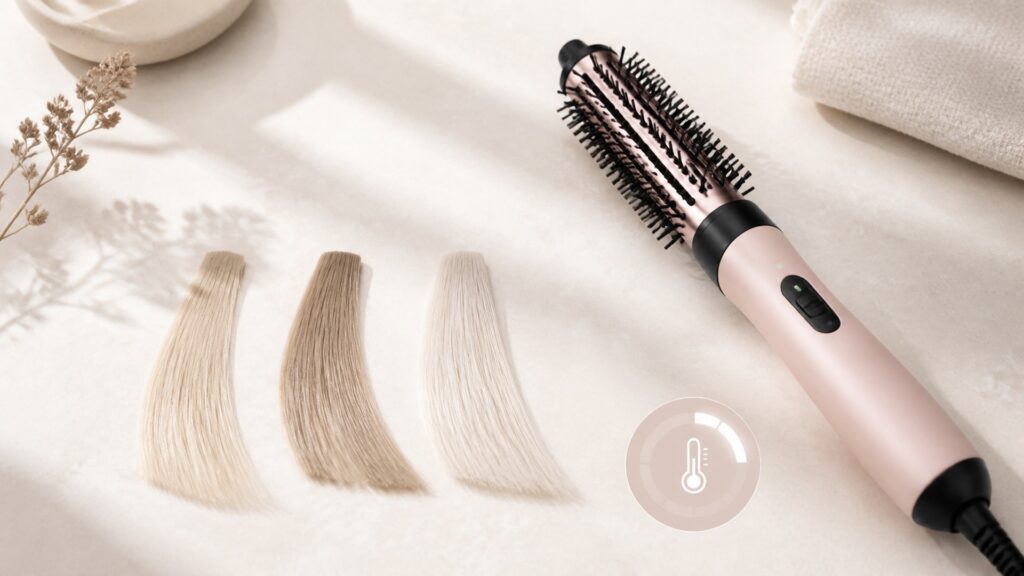
Frame the real job
Start with the result you want from a hot brush
Decide whether the missing element is root lift, surface neatness, or an inward turn at the ends.
Write a finish brief: Fine hair rarely needs every effect at once.
Rehearse the sequence: Write down how long volume should last and how much movement you want to preserve before reviewing devices.
Choose a stopping rule: For how to choose hot brushes for fine hair, record this point during a complete session before reaching a verdict.
Fit tool to user
Who benefits from this hot brush setup?
People with low density need scalp clearance and precise root access.
Occasional finisher: Longer fine hair may need gentle engagement through the mid-lengths.
Routine stylist: Sensitive hands benefit from a lighter handle.
Technique-minded buyer: Anyone who styles daily should be especially cautious about minimum temperature and repeated exposure.
Translate the specification sheet
Features that affect fine hair
Prioritize low heat steps, smooth bristle tips, modest head weight, and even spacing.
Evidence from the first session
Dense bristle fields can flatten fine strands or hold them too firmly.
Evidence after repetition
Check whether the controls are easy to read without looking away from the mirror and whether the cord pulls.
Control under load: Dense bristle fields can flatten fine strands or hold them too firmly.
Contact and release: Check whether the controls are easy to read without looking away from the mirror and whether the cord pulls.
Settings you can repeat: For how to choose hot brushes for fine hair, record this point during a complete session before reaching a verdict.
Avoid misleading trials
Common errors when testing for fine hair
Dry and detangle according to the manual, then apply a compatible protectant sparingly.
Chasing the hottest result: Heavy product can erase volume and leave residue on heated parts.
Using showcase sections: Keep the head moving and avoid lingering at the roots.
Ignoring tool boundaries: Stop if fine strands catch between bristles or seams.
Spend for demonstrated value
Choose a basic model, upgrade, or keep waiting
A simple brush with an effective low range may outperform a premium high-powered design.
Choose the straightforward option: Spend more for lighter balance, smoother contact, or finer regulation that you can feel.
Upgrade for a named constraint: Do not finance extra maximum heat or bulky attachments that work against the intended delicacy.
Wait when evidence is thin: For how to choose hot brushes for fine hair, record this point during a complete session before reaching a verdict.
Include life after checkout
Cleaning, storage, and safe use of a hot brush
Fine strands can remain hidden deep in bristle rows.
Build a cooling habit: After cooling, remove them gently rather than pulling against the mounting.
Clean without damaging parts: Wipe styling residue as directed and keep vents open.
Inspect before restarting: Store the brush where bristles cannot be crushed by heavier tools.
Practical answers
Questions buyers ask about a hot brush for fine hair
Answers to the decisions that most often change a how to choose hot brushes for fine hair shortlist.
What matters first when choosing for Fine Hair?
How should I test the tool at home?
Does the headline feature guarantee better results?
What is a clear reason to reject or replace it?
Make the final call
Your final hot brush check
Choose the lightest-handed option that creates the desired lift or shape in controlled strokes.
Return to the brief: Hair should release easily and still feel supple afterward.
Review the whole session: If the brush needs aggressive tension or a high setting to show a difference, it is mismatched.
Record the reason: Store the brush where bristles cannot be crushed by heavier tools.
Reading Shortcuts
Jump to the evidence you need for a fine hair decision.
Decision Reminders
Keep these hot brush checkpoints beside your shortlist.
- Desired result: Create lift and neat ends without collapsing volume or scorching delicate strands.
- Fair trial: Test on small airy sections and watch whether volume lasts.
- Safety limit: Begin at the lowest effective setting and avoid holding the brush motionless near roots.
Glossary Snippets
Terms that clarify a hot brush comparison.
When a Top 10 List Helps
Use a ranked list to discover credible hot brush formats, then screen them against the fine hair routine.
- The format is undecided: A broad list reveals plausible forms and price levels.
- A shortlist is needed: Rankings narrow discovery but do not replace fit testing.
Have finalists already? Open the comparison section.
When a Direct Comparison Helps
Place finalists side by side only after confirming that each can perform the fine hair job safely.
- Two candidates remain: Side-by-side evidence exposes meaningful tradeoffs.
- An upgrade is uncertain: Compare whether added cost corrects the original weakness.
Still exploring? Start with the Top 10 section.