
How to Choose Hot Brushes for Smooth Finishes
A smooth finish from a hot brush depends on controlled contact, not maximum temperature. Start with fully detangled, appropriately dry hair and a section narrow enough for the bristles to engage evenly.
Because a hot brush leaves more volume than clamped plates, decide whether that softer result matches the brief. Compare total styling time, root access, end control, and the amount of corrective work.
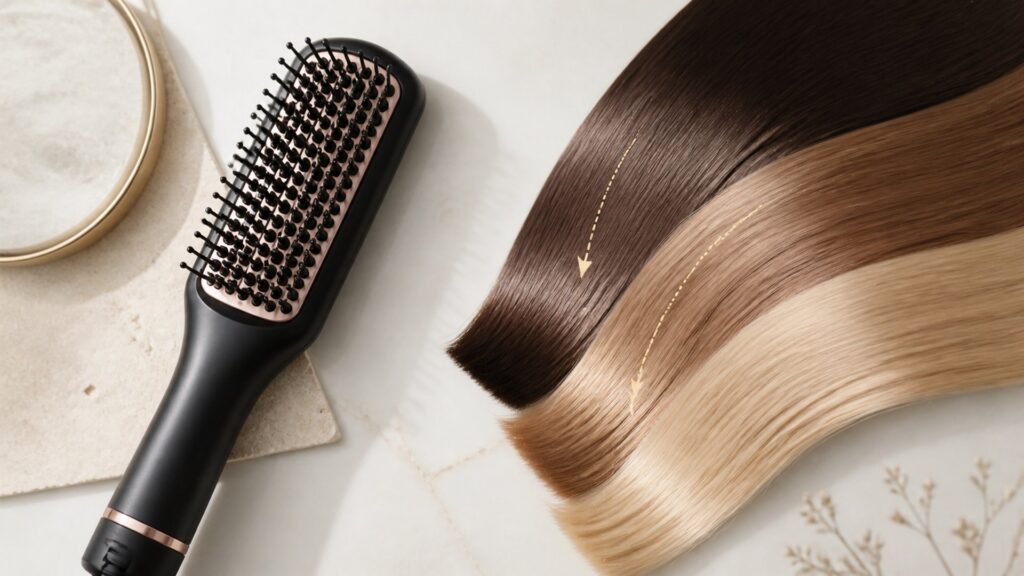
Set the test
Define one repeatable styling brief and its rejection limits.
For people seeking a smooth finish with lift rather than pin-straight compression, the central question is whether a smoothing hot brush can align the surface while preserving body. Use bristle tension and hot-edge clearance as observable evidence.
Routine evidence: Recreate people seeking a smooth finish with lift rather than pin-straight compression. Observe bristle tension on the hardest section and log time, comfort, and finish.
Performance boundary: Set a boundary around barrel temperature. Stop for scalp contact, trapped hair, melted bristles, or a damaged cord; never lower the safety standard to complete a comparison.
Decision signal: Use hot-edge clearance to distinguish improvement from decoration. Keep a smoothing hot brush only when the benefit repeats.
Match the routine
Decide who gains from this format and who should choose another tool.: a smoothing hot brush
This part of the decision concerns barrel temperature. Test a smoothing hot brush under the normal constraints of people seeking a smooth finish with lift rather than pin-straight compression, then document its effect on align the surface while preserving body.
Routine evidence: Begin with the normal constraints of people seeking a smooth finish with lift rather than pin-straight compression, then examine barrel temperature before changing technique.
Performance boundary: During the hot-edge clearance check, end the session at any sign of scalp contact, trapped hair, melted bristles, or a damaged cord.
Decision signal: A worthwhile a smoothing hot brush makes section depth measurably better across complete styles, not merely one easy section.
Read useful specifications
Connect each control or construction detail to behavior on real hair.
A credible verdict for a smoothing hot brush links hot-edge clearance with cooling stand. That pairing matters especially for people seeking a smooth finish with lift rather than pin-straight compression.
First evidence: bristle tension
On the opening session, document bristle tension, setup friction, and immediate control with a smoothing hot brush. Do not finalize the verdict from novelty.
Repeated evidence: cord movement
After several routines, revisit cord movement, cleanup, and fatigue. Confirm that a smoothing hot brush still supports align the surface while preserving body for people seeking a smooth finish with lift rather than pin-straight compression.
Routine evidence: Make hot-edge clearance the first controlled observation for people seeking a smooth finish with lift rather than pin-straight compression; include correction work in the timing.
Performance boundary: Do not excuse scalp contact, trapped hair, melted bristles, or a damaged cord while assessing section depth. That behavior disqualifies the candidate.
Decision signal: Review cord movement after several sessions. The evidence should justify choosing a smoothing hot brush over a simpler format.
Avoid false wins
Remove shortcuts that make weak performance appear convincing.: a smoothing hot brush
Keep the people seeking a smooth finish with lift rather than pin-straight compression routine intact while examining section depth. The purchase earns consideration only when it advances the goal to align the surface while preserving body.
Routine evidence: On a representative people seeking a smooth finish with lift rather than pin-straight compression session, document section depth, hand strain, and the finished shape.
Performance boundary: Treat cord movement as a safety check as well as a performance detail; stop for scalp contact, trapped hair, melted bristles, or a damaged cord.
Decision signal: Let repeated behavior in cooling stand decide whether a smoothing hot brush earns its storage space and price.
Set the value threshold
Pay for demonstrated improvements, not unused bundle size.
Treat cord movement as practical evidence, not a label. With a smoothing hot brush, its value appears in comfort, control, and the ability to align the surface while preserving body.
Routine evidence: Keep preparation stable for people seeking a smooth finish with lift rather than pin-straight compression. Only then can the effect of cord movement be judged fairly.
Performance boundary: Inspect cooling stand throughout use, and abandon the trial if it creates scalp contact, trapped hair, melted bristles, or a damaged cord.
Decision signal: Count setup and cleanup when scoring bristle tension; a smoothing hot brush must improve the whole process.
Plan care and storage
Include cooling, cleaning, inspection, and safe placement.: a smoothing hot brush
Ownership changes the meaning of cooling stand. Assess it across repeated sessions with people seeking a smooth finish with lift rather than pin-straight compression, including setup, corrections, cooling, and storage.
Routine evidence: Test cooling stand where people seeking a smooth finish with lift rather than pin-straight compression is most demanding, rather than on an unusually cooperative area.
Performance boundary: Watch bristle tension as the session continues. scalp contact, trapped hair, melted bristles, or a damaged cord is a stop condition, not a manageable tradeoff.
Decision signal: Compare barrel temperature with the current method and retain a smoothing hot brush only for a clear, repeatable gain.
Practical answers
Questions buyers ask about a hot brush for smooth finishes
Practical answers for comparing a smoothing hot brush without losing sight of people seeking a smooth finish with lift rather than pin-straight compression, repeatability, or safety.
What should I compare first when choosing a smoothing hot brush?
How long should I test a smoothing hot brush?
When is a premium version of a smoothing hot brush worthwhile?
Make the final call
Choose only after several representative, controlled sessions.
The final evidence comes from bristle tension under realistic use. It should support align the surface while preserving body without introducing scalp contact, trapped hair, melted bristles, or a damaged cord.
Routine evidence: Use identical preparation while studying bristle tension in the intended people seeking a smooth finish with lift rather than pin-straight compression routine.
Performance boundary: Pause the barrel temperature assessment immediately for scalp contact, trapped hair, melted bristles, or a damaged cord; styling speed cannot offset that risk.
Decision signal: Judge hot-edge clearance after cooling and cleanup so the value of a smoothing hot brush reflects full ownership.
Reading Shortcuts
Move directly to the evidence needed for a smoothing hot brush.
Decision Reminders
Keep the brush trial grounded in actual use.
- Brief: The target is to align the surface while preserving body.
- Proof: Track bristle tension, comfort, time, and finish.
- Stop: End use for scalp contact, trapped hair, melted bristles, or a damaged cord.
Glossary Snippets
Useful language for evaluating a smoothing hot brush.
When a Top 10 List Helps
Use rankings to discover plausible brush options, then screen each for people seeking a smooth finish with lift rather than pin-straight compression.
- Explore the category: A list can reveal relevant forms and ranges of bristle tension.
- Create finalists: Discovery helps, but only a brush trial establishes fit.
Have finalists already? Open the comparison section.
When a Direct Comparison Helps
Compare finalists after both prove they can align the surface while preserving body.
- Two candidates remain: Set barrel temperature, comfort, and total routine time side by side.
- The upgrade is uncertain: Ask whether added cost improves cord movement in repeated use.
Still exploring? Start with the Top 10 section.