
How to Choose Interior Comfort for Cargo and Storage Planning
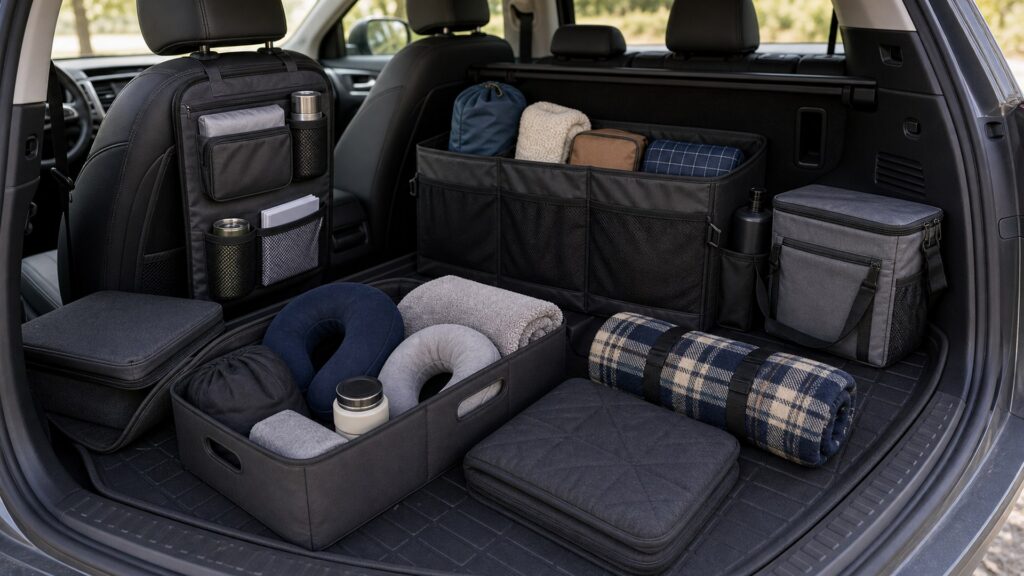
A pillow, water bottle, tablet, charging cable, blanket, and cleaning kit may each seem harmless. Together they can fill door pockets, hang from seatbacks, occupy footwells, bury emergency equipment, and move into passengers or controls during a hard stop. Comfort storage is therefore a cargo-control problem at cabin scale.
Give every item a use state and a restrained transit state. Keep driver retrieval simple enough to avoid reaching, preserve airbags and seat travel, maintain vents and rear visibility, and keep hard objects away from occupant impact zones. Then convert seats and cargo panels through every used layout. Removed cushions and shades also need secure homes; the floor or parcel shelf is not a storage plan.
Buying framework
Set the comfort storage planning baseline before buying
Convert the desired comfort storage planning improvement into physical, functional, and maintenance requirements.
Inventory comfort gear: List cushions, blankets, shades, tablets, bottles, cables, tissues, waste, cleaning items, medication, first aid, warning gear, and seasonal equipment.
Assign access frequency: Separate driver-essential, passenger-use, stop-only, emergency, and seasonal items so each receives appropriate reach and restraint.
Map exclusion zones: Protect pedals, steering, airbags, belts, seat rails, under-seat wiring, vents, windows, mirrors, exits, latches, and child-restraint space.
Rehearse layout conversion: Fold and raise seats, slide rows, load cargo, reach emergency equipment, deploy tie-downs, and stow displaced accessories without leaving loose items.
Who this is for
Match the solution to the comfort storage planning user
Different bodies, occupants, routes, climates, and cabin layouts justify different comfort storage planning priorities.
Minimal solo commuter: Closed console and door storage may handle essentials while keeping the seat, floor, and dashboard free of accessories.
Family road-trip vehicle: Passenger-use items need zoned low-mass storage, cable control, waste containment, airflow, and quick access without unbuckling.
Mobile worker: Documents, devices, tools, and comfort gear require stronger separation so hard work equipment cannot occupy passenger impact zones.
Passenger-cargo converter: Use modular organizers that detach and secure elsewhere when seats fold, rather than hanging loose during layout changes.
What to pay attention to
Evidence that predicts comfort storage planning performance
Specifications matter only when translated into what changes inside the exact vehicle during comfort storage planning use.
Cabin Storage Hierarchy
Place frequently used soft items, charging, waste, emergency gear, and occasional accessories by safe access and secure containment.
Cargo Conversion
Test seat folding, tie-down use, rear visibility, airflow, passenger clearance, emergency retrieval, and storage of removed comfort pieces.
Restraint strength: Evaluate closures, anchors, straps, hooks, load rating, hard-item retention, and behavior when pockets are partially filled or the seat moves.
Driver retrieval demand: Frequently needed items should be reachable only when doing so does not require eyes off road, twisting, leaning, or releasing steering control.
Seatback interface: Preserve side-airbag seams, seat adjustment, rear knees, tables, pockets, child restraints, and front-seat wiring while limiting organizer mass.
Under-seat exclusion: Avoid rails, motors, occupant sensors, air ducts, wiring, batteries, amplifiers, heater components, and objects that can roll forward.
Visibility footprint: Do not stack cargo or hang storage where it blocks rear glass, mirrors, shoulder views, cameras, lamps, or required driver sight lines.
Emergency retrieval: Time access to first aid, warning devices, spare or inflator, fire extinguisher where applicable, mobility aids, and releases with normal luggage aboard.
Avoid these traps
Mistakes that compromise comfort storage planning
Convenience becomes a defect when an add-on alters controls, restraints, airbags, visibility, airflow, or secure storage.
Keeping loose comfort gear on the parcel shelf: Items can block rear vision and travel forward during braking; use enclosed or restrained storage below sight lines.
Loading seatback pockets with hard electronics: Mass near rear passengers can increase impact risk and strain attachments; follow load limits and choose safer cargo storage.
Hiding cables under seats: Leads can enter tracks, motors, vents, or wiring and may be pulled forward; use visible supported routes and disconnect when layouts change.
Burying emergency gear beneath convenience items: Practice the retrieval order with actual cargo and redesign layers that require unloading the cabin during an urgent stop.
Decision guidance
Choose a defensible comfort storage planning path
Select the least intrusive option that proves the required comfort storage planning outcome under representative conditions.
Use closed built-in storage first: Factory consoles, bins, and latching compartments generally preserve cabin geometry when used within their intended loads.
Add light organizers for named contents: Buy only enough capacity for a documented low-mass item set and verify attachments plus passenger clearance.
Move dense or sharp items to restrained cargo zones: Tools, large batteries, bottles, and equipment belong behind appropriate barriers or tie-downs, not hanging near occupants.
Choose modular storage for convertible interiors: Organizers should detach, close, label, and restrain in another location when seats or cargo floors change.
Ownership & compatibility
Maintain the comfort storage planning result
Inspection, cleaning, adjustment, records, and replacement keep the original comfort storage planning decision valid.
Run a weekly loose-object sweep: Empty floors, seat gaps, cupholders, door pockets, organizers, and cargo transitions; discard unused items and restore cable routes.
Inspect attachment wear: Check seams, clips, straps, hooks, latches, anchors, seat contact, hard-object movement, and declared load limits.
Rehearse emergency access seasonally: Load the typical vehicle, retrieve safety equipment, open required panels, and update the storage map when cargo or occupants change.
FAQ
Questions to resolve for comfort storage planning
Use exact vehicle documentation and product instructions to settle these points.
Can comfort items stay loose on an empty seat?
How heavy should a seatback organizer be?
Is under-seat storage safe?
Where should unused windshield shades be stored?
Can charging cables remain connected all the time?
How is rear visibility tested with organizers?
Where should an emergency kit sit?
Can a cargo barrier improve cabin comfort?
How often should cabin storage be emptied?
Bottom line
Preserve safety while improving comfort storage planning
A successful upgrade remains compatible, removable, understandable, and safe throughout ownership.
Treat comfort gear as cargo: Assign every item a safe use position and a closed or restrained transit position.
Preserve cabin systems: Keep controls, airbags, belts, seats, vents, views, exits, tie-downs, panels, and wiring clear.
Practice the transitions: Convert layouts, retrieve emergency gear, sweep loose objects, inspect attachments, and update storage as needs change.
Reading Shortcuts
Move through the secure comfort storage decision in order.
Decision Reminders
If an item is not in use, it still needs restraint.
- Inventory comfort gear: Verify and record this requirement.
- Assign access frequency: Verify and record this requirement.
- Map exclusion zones: Verify and record this requirement.
- Run a weekly loose-object sweep: Verify and record this requirement.
- Inspect attachment wear: Verify and record this requirement.
- Rehearse emergency access seasonally: Verify and record this requirement.
Glossary Snippets
Terms used in this comfort accessory plan.
When to Use a Top 10 Review
Use rankings only after the requirements are fixed.
- Treat comfort gear as cargo: Use this as a shortlist filter.
- Preserve cabin systems: Use this as a shortlist filter.
- Practice the transitions: Use this as a shortlist filter.
- Exclude: Use this as a shortlist filter.
Already down to 2–3 options? A Comparison is usually the faster next step.
When to Use a Comparison
Compare finalists through the seating, belt, airbag, sensor, control-reach, visibility, airflow, securement, power, and removal trial; make closed console storage an explicit recorded result.
- Inventory comfort gear: Check both candidates against this requirement.
- Assign access frequency: Record the result for each shortlisted option.
- Map exclusion zones: Use the same operating conditions for both tests.
- Rehearse layout conversion: Keep the evidence with the final decision.
Still exploring? Start with a Top 10 to build a shortlist first.