
How to Choose Interior Organization for Ride-Share and Commuter Cars
A commuter cabin repeats the same small tasks; a ride-share cabin adds unfamiliar passengers and rapid turnover. Receipts collect near controls, cables migrate across seats, cleaning products occupy door pockets, and found items become mixed with the driver's property. More storage can make those workflows slower if it hides contents or expands the inventory.
Define the exact shift load and give each object a closed, labeled, restrained home. Anything requiring visual search or a long reach becomes parked-only. Keep passenger areas simple, washable, and free of driver documents or personal data. Use short supported charging leads and a separate secured cleaning module. After each rider, time the inspection, lost-property sweep, cable reset, surface care, ventilation, and readiness check.
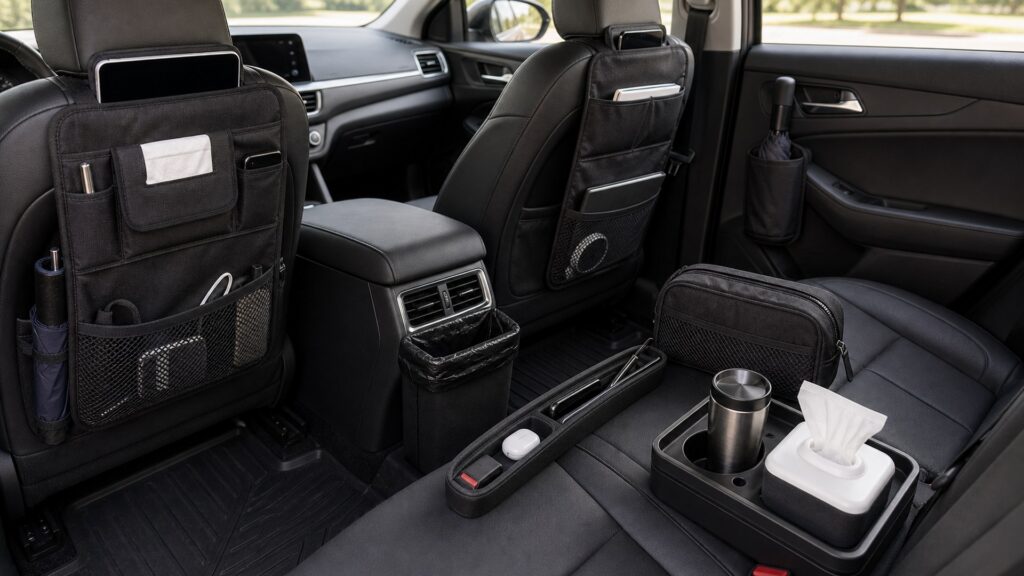
Buying framework
Define the high-turnover organization job before shopping
Turn the high-turnover organization goal into measurable zones, loads, access rules, and safety exclusions.
Shift-load limit: List navigation accessories, documents, toll devices, water, charging gear, cleaning supplies, safety equipment, and permitted passenger amenities.
Driver attention map: Move any item that requires looking down, twisting, sorting, opening several layers, or entering passenger space to parked-only access.
Passenger boundary: Reserve usable seat, knee, foot, door, belt, vent, and window space without exposing driver records, medicine, keys, or personal belongings.
Turnover sequence: Write the order for passenger exit, found-item sweep, cable reset, debris removal, odor check, cleaning, drying, restocking, and release.
Who this is for
Match storage to the people using it
Different occupants and routines place different demands on high-turnover organization products.
Solo daily commuter: A compact driver zone for a few essentials should reduce searching while preserving controls, cupholders, passenger space, and a clean exit.
Hybrid worker: Separate office devices and documents from vehicle supplies, and restrain work bags in a location accessed only while parked.
Part-time ride-share driver: Use a reversible passenger arrangement with quick lost-item inspection, basic charging, washable surfaces, and locked personal storage.
Full-time passenger operator: Prioritize commercial-duty closures, replaceable components, short turnover, clear policies, and redundant supplies stored outside occupant zones.
What to pay attention to
Evidence that predicts high-turnover organization performance
Judge specifications by what they change in the exact vehicle during high-turnover organization use.
Driver Workflow
Reduce reaches, searches, document handling, cable movement, and visual clutter throughout the longest representative work or commute period.
Passenger Turnover
Time inspection, lost-item handling, surface cleaning, charging reset, odor response, restocking, and cabin release between riders.
Charging management: Limit connector choices, support short leads, inspect heat and damage, protect ports, and prevent cables from crossing buckles or walkways.
Cleanable architecture: Favor removable modules and accessible surfaces that reveal crumbs, spills, pests, sharp debris, and forgotten property without extensive unloading.
Document privacy: Secure registration copies, insurance information, trip notes, payment devices, and work records away from casual view and passenger reach.
Found-item isolation: Provide a sealed or controlled temporary location and follow the platform, company, and local process without mixing property into supplies.
Wear-part serviceability: Choose replaceable cables, clips, liners, straps, and modules with stable sourcing so one failure does not disable the layout.
Downtime measurement: Count unloading, active cleaning, drying, searching, repair, replacement delivery, and reorganizing when comparing organizer cost.
Avoid these traps
Errors that undermine high-turnover organization
A convenient container fails when it creates movement, interference, or distraction within the high-turnover organization layout.
Mounting storage in the driver's scan path: Maps, receipts, devices, and pocket contents can compete with road information and create reach behavior during motion.
Offering long loose charging cables: Extra reach becomes entanglement, pinch, trip, and lost-connector risk; support only the length passengers need.
Keeping cleaners in passenger door pockets: Chemicals and tools require labeled secured storage compatible with temperature, children, spills, and product instructions.
Combining found items with driver property: Mixed storage complicates identification, privacy, reporting, and return; isolate each item under a documented process.
Decision guidance
Choose a workable high-turnover organization layout
Select the smallest arrangement that proves the required high-turnover organization outcome.
Create a minimal driver module: Use a latching console or approved adjacent compartment for the fixed shift list, with nonessential access restricted to stops.
Create a simple passenger interface: Offer only durable low-profile amenities that preserve seats, restraints, airflow, entry, and a fast visual sweep.
Create a removable cleaning kit: Store it secured outside passenger reach, then bring it out only while parked according to product handling requirements.
Remove features that lengthen turnover: Decorative pockets, redundant cables, and unneeded amenities should go when they create inspection or cleaning burden without clear value.
Ownership & compatibility
Keep the high-turnover organization system dependable
Inspection and deliberate resets preserve the original high-turnover organization decision.
Run every passenger turnover: Check seats and floors, isolate found property, reset leads, remove waste, address spills, ventilate, and confirm restraint access.
Close every driving day: Reconcile inventory, secure records, empty waste, inspect cables and attachments, clean modules, and record damage or unresolved odors.
Replace high-cycle components early: Frayed leads, hot plugs, stretched pockets, broken closures, sharp shells, staining, or recurring migration justify immediate removal.
FAQ
Questions to settle before purchase
Resolve these product-specific questions with the vehicle and accessory instructions.
How should I verify shift-load limit in this vehicle?
How should I verify driver attention map in this vehicle?
How should I verify passenger boundary in this vehicle?
How should I verify turnover sequence in this vehicle?
How should I verify charging management in this vehicle?
How should I verify cleanable architecture in this vehicle?
How should I verify document privacy in this vehicle?
How should I verify found-item isolation in this vehicle?
How should I verify wear-part serviceability in this vehicle?
Bottom line
Build a safer, calmer cabin
The best high-turnover organization setup stays restrained, accessible, reversible, and easy to audit.
Map the real cabin: Measure the spaces, movements, loads, and exclusions that govern the high-turnover organization goal.
Prove every transition: Rehearse the representative parked sequence with normal users and contents before accepting the high-turnover organization arrangement.
Reset and inspect: Remove clutter, restore high-turnover organization clearances, and retire damaged parts before the planned use degrades.
Reading Shortcuts
Move through the ride-share and commuter cabin operations decision in order.
Decision Reminders
The best high-use layout minimizes attention and minutes, not just visible clutter.
- Shift-load limit: Verify and record this requirement.
- Driver attention map: Verify and record this requirement.
- Passenger boundary: Verify and record this requirement.
- Run every passenger turnover: Verify and record this requirement.
- Close every driving day: Verify and record this requirement.
- Replace high-cycle components early: Verify and record this requirement.
Glossary Snippets
Terms used in this interior organization plan.
When to Use a Top 10 Review
Use rankings only after the requirements are fixed.
- Map the real cabin: Use this as a shortlist filter.
- Prove every transition: Use this as a shortlist filter.
- Reset and inspect: Use this as a shortlist filter.
- Exclude: Use this as a shortlist filter.
Already down to 2–3 options? A Comparison is usually the faster next step.
When to Use a Comparison
Compare finalists through the full-shift driver-reach, passenger turnover, cleaning, lost-item, and end-of-day reset trial; make shift inventory an explicit recorded result.
- Shift-load limit: Check both candidates against this requirement.
- Driver attention map: Record the result for each shortlisted option.
- Passenger boundary: Use the same operating conditions for both tests.
- Turnover sequence: Keep the evidence with the final decision.
Still exploring? Start with a Top 10 to build a shortlist first.