
How to Choose Lighting & Visibility for Inspection and Compliance Needs
A lamp can illuminate and still fail the larger compliance question. The wrong color, an obscured signal, incorrect activation, a mismatched replacement source, excessive headlamp aim, or an auxiliary light that impairs a required function can all matter at inspection or roadside.
Build a function-by-function inventory for the exact vehicle rather than shopping from a generic legal label. For U.S. road equipment, confirm applicable federal replacement requirements and required markings, then research the state's current installation, operation, and inspection rules. Check the product and the completed installation: quantity, position, visibility, wiring state, lens condition, aim, and interaction with racks, winches, covers, tint, and accessories. Preserve documentation because inspectors evaluate installed results, not marketing screenshots.
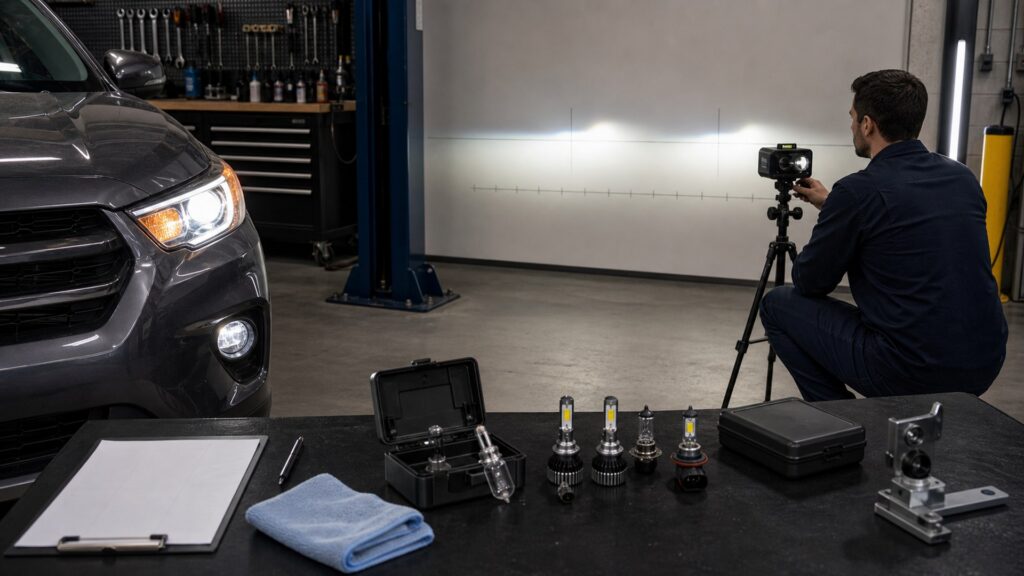
Buying framework
Audit the installed lighting system one function at a time
Compliance is a chain from certified equipment through correct installation, activation, visibility, condition, and jurisdictional operation.
Create the required-lamp inventory: List every headlamp, stop, turn, tail, marker, reflector, license, backup, and high-mounted stop function applicable to the vehicle.
Separate rule layers: Use current federal requirements for original and replacement equipment, then check state registration, inspection, height, color, auxiliary-light, and operating rules.
Trace each replacement: Record manufacturer, part number, required lens or housing markings, source designation, application evidence, invoice, and instructions.
Inspect the installed outcome: Verify quantity, color, activation, aim, visibility angles, mounting rigidity, wiring, condition, and whether accessories obstruct or impair any required device.
Who this is for
Match the compliance check to the vehicle change
A failed bulb, collision replacement, lifted vehicle, rack installation, and auxiliary-light build create different inspection risks.
Routine repair buyers: Use the specified source or exact replacement assembly, restore caps and seals, and confirm every lamp state and aim after installation.
Collision and restoration projects: Check replacement certification, lens color, reflectors, mounting structure, wiring logic, high-mounted stop lamps, plate illumination, and evidence for unusual original configurations.
Lifted or loaded vehicles: Reassess headlamp aim, mounting height where regulated, required visibility, tire coverage, and whether suspension or permanent load changed beam direction.
Accessory-heavy vehicles: Inspect winches, racks, carriers, spare tires, guards, covers, tint, and auxiliary lamps for obstruction, confusing signals, or impairment of required equipment.
What to pay attention to
Compliance details a product listing should prove
A credible replacement resolves the exact application and function while the installation preserves visibility and activation.
Equipment Evidence
Manufacturer, part, application, required markings, source designation, function, color, and instructions.
Installed Evidence
Quantity, location, height, visibility, activation, aim, condition, obstruction, and current jurisdiction rules.
Required markings: For U.S. headlamps, verify the applicable DOT certification mark and other identification required for the headlamp type; photograph markings before installation.
Application and light source: Match the exact vehicle and specified source designation. A bulb base that inserts into a housing does not prove replacement-equipment conformity.
Function and color: Confirm each lens and emitted color serves the intended stop, turn, tail, marker, backup, fog, or headlamp function without confusing combinations.
Mounting and visibility: Rigid mounting, height, spacing, unobstructed lens area, and visibility angles can be compromised by aftermarket bodywork or cargo equipment.
Activation and aim: Test controls and combinations, flash behavior, high and low beams, hazard operation, DRLs, license light, and headlamp aim using applicable procedures.
Avoid these traps
Compliance shortcuts that fail at the installed vehicle
Labels and illuminated bulbs are evidence, but neither replaces a complete function and installation audit.
Treating DOT as universal approval: A marking does not establish that the part matches the vehicle, is installed correctly, preserves required functions, or satisfies every state rule.
Checking bulbs without checking signals: A lamp may illuminate in the wrong state, color, intensity, or combination, while another required function becomes obscured or ambiguous.
Ignoring accessory obstruction: Racks, carriers, plows, winches, guards, spare tires, and covers can block lamps or reflectors even when the original devices still work.
Using one state's rule everywhere: Auxiliary-light quantity, covers, colors, mounting, inspection, and operation can differ. Research the current rules where the vehicle is registered and driven.
Decision guidance
Choose parts that make the inspection trail simple
Favor exact, documented replacements and modifications whose installed operation can be demonstrated without interpretation.
If a required lamp failed: Restore the specified source or exact function with traceable equipment, then test its paired and combined states, seal, condition, and aim.
If an accessory blocks a lamp: Relocate the accessory or add only a compliant duplicate function as permitted and engineered; do not rely on partial visibility from an angle.
If adding auxiliary lamps: Document their exact road or off-road function, legal color, mounting, switching, aim, cover requirements, and non-impairment of required lighting.
If rules are unclear: Use the current agency or inspection source, retain written guidance, and choose the conservative reversible configuration until the jurisdictional question is resolved.
Ownership & compatibility
Keep an inspection file with the vehicle
Traceability and periodic function checks reduce disputes and reveal failures before the annual test or night trip.
Save product evidence: Retain invoices, manufacturer instructions, application data, marking photographs, wiring diagrams, aim records, and any agency or inspection guidance used.
Run a complete lamp walkaround: Use a helper or reflection to verify every steady, flashing, brake, reverse, hazard, high, low, marker, plate, and auxiliary state at regular intervals.
Reinspect after changes: Repeat visibility and aim checks after suspension work, new carriers, plows, winches, collision repair, lamp replacement, tint, body changes, or permanent loading.
FAQ
Lighting inspection and compliance questions
These answers clarify federal equipment rules, markings, state requirements, and installed checks.
Does a DOT mark make any lamp legal on any vehicle?
Are federal and state vehicle-lighting rules the same thing?
Can auxiliary lights remain installed if they are switched off?
What lighting functions should I test before inspection?
Can a bike rack or cargo carrier cause a lighting violation?
Do replacement headlamp bulbs need to match the original type?
Will a lifted vehicle need its headlights aimed again?
Is tinted film acceptable on headlamps or taillamps?
What records are useful if an inspector questions a replacement lamp?
Bottom line
Inspection readiness comes from a complete, traceable system
Choose exact equipment, preserve every required function, and make the installed vehicle easy to audit from markings through aim and activation.
Inventory functions: Know which lamps and reflectors apply to the exact vehicle.
Verify two layers: Check equipment evidence and the completed installation under current federal and state rules.
Preserve proof: Keep markings, applications, diagrams, aim records, and repeat the walkaround after modifications.
Reading Shortcuts
Move from the lighting compliance problem to a vehicle-compatible plan that can be installed and verified.
Decision Reminders
Keep the complete lighting compliance system in view while comparing parts.
- Inventory: List every required function.
- Traceability: Save maker, part, and markings.
- Color: Match the intended signal.
- Visibility: Check with accessories loaded.
- Activation: Test combinations, not bulbs alone.
- Jurisdiction: Verify current state rules.
Glossary Snippets
Terms that separate useful performance from apparent compatibility.
When to Use a Top 10 Review
Use a lighting compliance roundup only after the required function, vehicle interface, and operating limits are known.
- Problem defined: The visibility or mobility failure is specific.
- Vehicle mapped: Interfaces and limits are documented.
- Format chosen: The correct product family is settled.
- Evidence available: Finalists can be compared on relevant tests.
Have finalists already? Open a Comparison for a closer tradeoff.
When to Use a Comparison
Compare lighting compliance finalists that solve the same defined problem on the same vehicle configuration.
- Application: Both match the exact vehicle and function.
- Performance: Evidence addresses the operating problem.
- Integration: Mounting and system effects are understood.
- Ownership: Inspection and service demands are acceptable.
Need a broader field? Use a Top 10 to form a shortlist.